
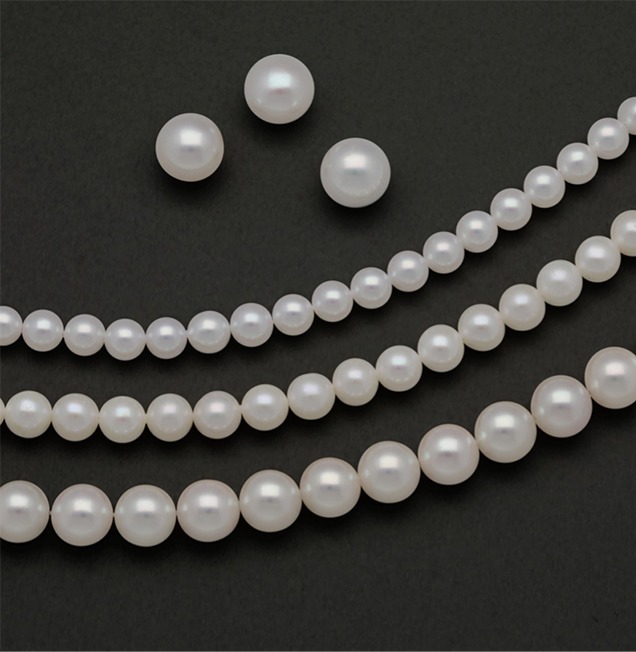
Small but bright, saltwater akoya pearls are famed for their white to cream color, mirror-like shine and attractive overtones. Freshwater pearls, on the other hand, are famed for their wide palette of colors, including white, pink, peach and lavender, and wide range of sizes. They are also the most affordable pearl types, with the largest number of pearls produced in each mollusk.
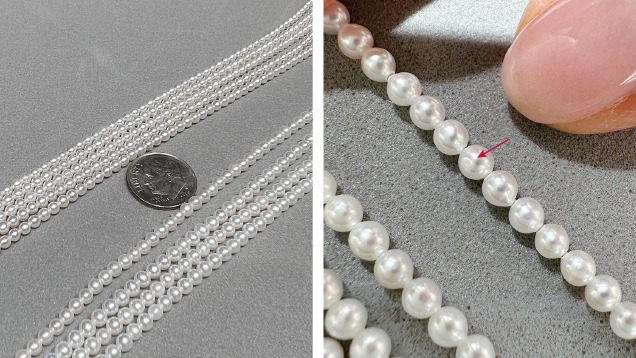
Advances in culturing techniques have led to a surge in small, bead-nucleated freshwater pearls from China. These cultured pearls often display near-round to round shapes, bright white bodycolor and excellent luster—qualities traditionally associated with saltwater akoya cultured pearls. Their visual similarity and attractive pricing have made them increasingly popular among consumers and jewelry designers.
Some sellers have been marketing these pearls under names like “Chinese akoya,” “baby akoya,” or “freshwater akoya (AK).” It is important to note that these are not akoya pearls, and using terminology associated with akoya pearls can be misleading.
WHY THESE PEARLS LOOK LIKE AKOYA
The visual similarity comes from how they are cultured. Traditional freshwater pearls are tissue-nucleated, meaning a small piece of mantle tissue from a donor mollusk is inserted into a host mollusk. Because no bead nucleus is used, this method often results in more irregular, organic shapes.
In contrast, these new Chinese freshwater pearls are grown using shell bead-nucleation—the same technique used for akoya cultured pearls. A round shell bead is inserted into the mollusk, along with a piece of “white cell” mantle tissue, providing a uniform foundation for the nacre to form around.
Because the culturing process now mirrors that of akoya pearls, the resulting gems can look remarkably similar—making accurate identification and proper terminology essential.
WHY ‘FRESHWATER AKOYA’ IS INCORRECT NOMENCLATURE
True akoya cultured pearls originate from the saltwater mollusk Pinctada fucata, traditionally farmed in Japan, and to a lesser extent in China and Vietnam. They have distinct cultivation methods and recognizable gemological traits.
By contrast, the pearls sometimes labeled as “Chinese akoyas”, “baby akoyas”, or “freshwater akoyas (AK)” are freshwater pearls, not saltwater, typically produced in lakes or ponds by the freshwater mollusk Hyriopsis cumingii (and hybrids).
Even though they may resemble saltwater akoyas at first glance, pearl identity is rooted in origin, mollusk and environment—not appearance alone.
Using the term “akoya” for freshwater pearls creates confusion for buyers and undermines transparency in the trade.
Saltwater akoya cultured pearls are generally more expensive than freshwater cultured pearls of similar size and quality, due in part to greater rarity and higher culturing costs.
ENSURING ACCURACY: THE ROLE OF GIA PEARL REPORTS
Because freshwater bead-nucleated pearls can closely mimic the appearance of akoya cultured pearls, visual assessment alone is often not enough to determine pearl type.
A GIA Pearl Identification Report offers an independent, objective evaluation on loose, mounted or strung pearls that documents:
- Quantity
- Size
- Shape
- Color
- Identity (natural or cultured)
- Environment (freshwater or saltwater)
- Mollusk species (when determinable)
- Detectable treatments
This level of documentation helps separate freshwater bead-nucleated pearls from saltwater akoya pearls, supporting proper transparency and disclosure, and consumer confidence.
In addition, the GIA Pearl Identification and Classification Report evaluates nacreous saltwater cultured pearls based on the GIA 7 Pearl Value Factors™:
- Size
- Shape
- Color
- Luster
- Surface
- Nacre
- Matching
This report also includes all Identification Report information and is available for any loose, mounted or strung nareous saltwater cultured pearls from Pinctada fucata (Akoya), Pinctada maxima (South Sea) and Pinctada margaritifera (Tahitian) pearl oysters.
Learn more about GIA pearl services and how GIA analyzes pearls in its laboratories.
THE BOTTOM LINE
“Freshwater akoya” pearls are not akoya pearls. They are bead-nucleated freshwater cultured pearls that visually resemble akoyas but differ in species and growth environment.
As these pearls continue to appear in the marketplace, clear, accurate nomenclature and proper identification are essential for protecting both consumers and the integrity of the pearl trade.
Small but bright, saltwater akoya pearls are famed for their white to cream color, mirror-like shine and attractive overtones. Freshwater pearls, on the other hand, are famed for their wide palette of colors, including white, pink, peach and lavender, and wide range of sizes. They are also the most affordable pearl types, with the largest number of pearls produced in each mollusk.
Advances in culturing techniques have led to a surge in small, bead-nucleated freshwater pearls from China. These cultured pearls often display near-round to round shapes, bright white bodycolor and excellent luster—qualities traditionally associated with saltwater akoya cultured pearls. Their visual similarity and attractive pricing have made them increasingly popular among consumers and jewelry designers.
Some sellers have been marketing these pearls under names like “Chinese akoya,” “baby akoya,” or “freshwater akoya (AK).” It is important to note that these are not akoya pearls, and using terminology associated with akoya pearls can be misleading.
WHY THESE PEARLS LOOK LIKE AKOYA
The visual similarity comes from how they are cultured. Traditional freshwater pearls are tissue-nucleated, meaning a small piece of mantle tissue from a donor mollusk is inserted into a host mollusk. Because no bead nucleus is used, this method often results in more irregular, organic shapes.
In contrast, these new Chinese freshwater pearls are grown using shell bead-nucleation—the same technique used for akoya cultured pearls. A round shell bead is inserted into the mollusk, along with a piece of “white cell” mantle tissue, providing a uniform foundation for the nacre to form around.
Because the culturing process now mirrors that of akoya pearls, the resulting gems can look remarkably similar—making accurate identification and proper terminology essential.
WHY ‘FRESHWATER AKOYA’ IS INCORRECT NOMENCLATURE
True akoya cultured pearls originate from the saltwater mollusk Pinctada fucata, traditionally farmed in Japan, and to a lesser extent in China and Vietnam. They have distinct cultivation methods and recognizable gemological traits.
By contrast, the pearls sometimes labeled as “Chinese akoyas”, “baby akoyas”, or “freshwater akoyas (AK)” are freshwater pearls, not saltwater, typically produced in lakes or ponds by the freshwater mollusk Hyriopsis cumingii (and hybrids).
Even though they may resemble saltwater akoyas at first glance, pearl identity is rooted in origin, mollusk and environment—not appearance alone.
Using the term “akoya” for freshwater pearls creates confusion for buyers and undermines transparency in the trade.
Saltwater akoya cultured pearls are generally more expensive than freshwater cultured pearls of similar size and quality, due in part to greater rarity and higher culturing costs.
ENSURING ACCURACY: THE ROLE OF GIA PEARL REPORTS
Because freshwater bead-nucleated pearls can closely mimic the appearance of akoya cultured pearls, visual assessment alone is often not enough to determine pearl type.
A GIA Pearl Identification Report offers an independent, objective evaluation on loose, mounted or strung pearls that documents:
- Quantity
- Size
- Shape
- Color
- Identity (natural or cultured)
- Environment (freshwater or saltwater)
- Mollusk species (when determinable)
- Detectable treatments
This level of documentation helps separate freshwater bead-nucleated pearls from saltwater akoya pearls, supporting proper transparency and disclosure, and consumer confidence.
In addition, the GIA Pearl Identification and Classification Report evaluates nacreous saltwater cultured pearls based on the GIA 7 Pearl Value Factors™:
- Size
- Shape
- Color
- Luster
- Surface
- Nacre
- Matching
This report also includes all Identification Report information and is available for any loose, mounted or strung nareous saltwater cultured pearls from Pinctada fucata (Akoya), Pinctada maxima (South Sea) and Pinctada margaritifera (Tahitian) pearl oysters.
Learn more about GIA pearl services and how GIA analyzes pearls in its laboratories.
THE BOTTOM LINE
“Freshwater akoya” pearls are not akoya pearls. They are bead-nucleated freshwater cultured pearls that visually resemble akoyas but differ in species and growth environment.
As these pearls continue to appear in the marketplace, clear, accurate nomenclature and proper identification are essential for protecting both consumers and the integrity of the pearl trade.