
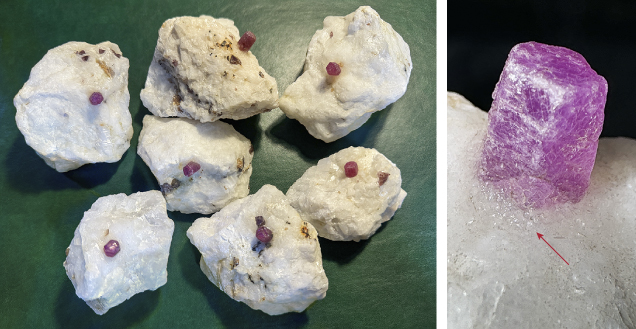
Recent field observations in Pakistan have revealed that specimens circulating in local gem markets and near mine sites have increasingly been artificially assembled or altered. Local dealers and prospectors from the Hunza and Gilgit mining areas offered “Frankenstein” specimens, pieces assembled by gluing together fragments of crystals and host rock (figure 1). While adhesives can sometimes be seen under magnification, many joints are subtle enough to mislead buyers or tourists. Crystals such as aquamarine are often skillfully mounted onto matrices to imitate natural specimens, with some pieces further polished, dyed, or even oiled to enhance their appearance (figure 2). In certain cases, resins mixed with crushed marble or host rock are applied, making detection even more difficult. For example, in Peshawar’s Namak Mandi gem market, a ruby reportedly from Jegdalek was identified as a synthetic crystal mounted on natural host rock. In addition to this deceptive practice of adhering specimens to host rock, broken specimens are also repaired with adhesives, often without disclosure. With time, the quality of assembly is improving, making detection more challenging.

The close proximity of these reconstructed specimens to the mines is a reminder that “from the mine” does not automatically guarantee authenticity. Collectors and gemologists should be aware that stones described as directly sourced may have undergone significant human intervention. Similar practices are common in neighboring regions, including Afghanistan.
Economic pressures play a major role in these trends. With average salaries in Pakistan ranging from 20,000 to 60,000 PKR per month (approximately US$70 to $212), many dealers and retailers offer inexpensive alternatives to natural gemstones. As a result, the domestic trade is dominated by simulants, imitations, and heavily treated stones. Dyed stones including lapis lazuli, nephrite jade, and emerald are widespread, as well as glass-filled sapphires, composite stones, and resin-treated turquoise. Irradiation is another common practice, particularly for beryl, tourmaline, and topaz. Large gemstone trading centers in Lahore, Karachi, Islamabad, and Peshawar (Namak Mandi) are particularly affected, making vigilance essential for anyone in the trade as these treatments are often undisclosed and may be unstable.
In another deceitful practice, problematic gemstones are often mixed into lots of natural stones. One 77 ct parcel of melee-sized red stones labeled as natural Jegdalek ruby, for instance, actually contained a mixture of natural unheated, heated, glass-filled, and synthetic ruby. Some dealers have even dotted natural jasper with blue dye to imitate the popular granite-like stone with distinctive blue spots found near K2 Mountain in Pakistan.
A general lack of understanding of gemstones in Pakistan, coupled with minimal regulation and a challenging economy, allows deceptive dealers to take advantage of unaware buyers, often presenting laboratory reports with misleading words such as “natural dyed emerald” or “natural glass-filled blue sapphire” or failing to disclose treatments. The word natural has been used incorrectly for such stones, which is a problem for local gem testing laboratories, although efforts are being made to revise the terminology applied to these types of materials. Similarly, terms such as “Shajri natural turquoise” have been applied to resin-composite mixtures intended to imitate the natural weblike structure of turquoise. Treatments are often left undisclosed, including the dyeing of natural opal and the oiling of natural emerald rough to hide fractures. Additionally, authentic reports have been reprinted and fraudulently attached to multiple stones in various markets such as Lahore.

Historically, Pakistani jewelers supplied royalty, from Nawabs to Maharajas, but many traditional techniques are fading in favor of faster, cheaper production. Many craftsmen are making jewelry with thinner or plated metal and/or including synthetic or imitation stones (figure 3), or closing their businesses, as the domestic trade cannot support the higher costs of gold and precious stones. For collectors, gemologists, and buyers, these trends underscore the importance of scrutiny, education, and caution when navigating Pakistan’s complex gemstone market. Once a deal is done, it is very difficult to recover funds.
The increasing presence of glued reconstructed specimens near Pakistan’s mining areas and all the above-stated practices underscore the need for vigilance in the field. Transparency in trade practices is essential for maintaining trust in the region’s gem market. Unfortunately, many sellers fail to disclose such treatments, making it essential for buyers to exercise caution. Regardless of where the specimen is acquired and the price being asked, one should suspect alterations unless proven otherwise. If the gemstone market in Pakistan is to gain worldwide recognition, more awareness and stricter regulations must be implemented. At the same time, many genuine and honest people remain in Pakistan’s gem industry, and the actions of a few should not ruin the reputation for all.
Talha H. Bakht and M. Moeez Shah are cofounders of Origin Gems in the United Kingdom and Pakistan.
Recent field observations in Pakistan have revealed that specimens circulating in local gem markets and near mine sites have increasingly been artificially assembled or altered. Local dealers and prospectors from the Hunza and Gilgit mining areas offered “Frankenstein” specimens, pieces assembled by gluing together fragments of crystals and host rock (figure 1). While adhesives can sometimes be seen under magnification, many joints are subtle enough to mislead buyers or tourists. Crystals such as aquamarine are often skillfully mounted onto matrices to imitate natural specimens, with some pieces further polished, dyed, or even oiled to enhance their appearance (figure 2). In certain cases, resins mixed with crushed marble or host rock are applied, making detection even more difficult. For example, in Peshawar’s Namak Mandi gem market, a ruby reportedly from Jegdalek was identified as a synthetic crystal mounted on natural host rock. In addition to this deceptive practice of adhering specimens to host rock, broken specimens are also repaired with adhesives, often without disclosure. With time, the quality of assembly is improving, making detection more challenging.
The close proximity of these reconstructed specimens to the mines is a reminder that “from the mine” does not automatically guarantee authenticity. Collectors and gemologists should be aware that stones described as directly sourced may have undergone significant human intervention. Similar practices are common in neighboring regions, including Afghanistan.
Economic pressures play a major role in these trends. With average salaries in Pakistan ranging from 20,000 to 60,000 PKR per month (approximately US$70 to $212), many dealers and retailers offer inexpensive alternatives to natural gemstones. As a result, the domestic trade is dominated by simulants, imitations, and heavily treated stones. Dyed stones including lapis lazuli, nephrite jade, and emerald are widespread, as well as glass-filled sapphires, composite stones, and resin-treated turquoise. Irradiation is another common practice, particularly for beryl, tourmaline, and topaz. Large gemstone trading centers in Lahore, Karachi, Islamabad, and Peshawar (Namak Mandi) are particularly affected, making vigilance essential for anyone in the trade as these treatments are often undisclosed and may be unstable.
In another deceitful practice, problematic gemstones are often mixed into lots of natural stones. One 77 ct parcel of melee-sized red stones labeled as natural Jegdalek ruby, for instance, actually contained a mixture of natural unheated, heated, glass-filled, and synthetic ruby. Some dealers have even dotted natural jasper with blue dye to imitate the popular granite-like stone with distinctive blue spots found near K2 Mountain in Pakistan.
A general lack of understanding of gemstones in Pakistan, coupled with minimal regulation and a challenging economy, allows deceptive dealers to take advantage of unaware buyers, often presenting laboratory reports with misleading words such as “natural dyed emerald” or “natural glass-filled blue sapphire” or failing to disclose treatments. The word natural has been used incorrectly for such stones, which is a problem for local gem testing laboratories, although efforts are being made to revise the terminology applied to these types of materials. Similarly, terms such as “Shajri natural turquoise” have been applied to resin-composite mixtures intended to imitate the natural weblike structure of turquoise. Treatments are often left undisclosed, including the dyeing of natural opal and the oiling of natural emerald rough to hide fractures. Additionally, authentic reports have been reprinted and fraudulently attached to multiple stones in various markets such as Lahore.
Historically, Pakistani jewelers supplied royalty, from Nawabs to Maharajas, but many traditional techniques are fading in favor of faster, cheaper production. Many craftsmen are making jewelry with thinner or plated metal and/or including synthetic or imitation stones (figure 3), or closing their businesses, as the domestic trade cannot support the higher costs of gold and precious stones. For collectors, gemologists, and buyers, these trends underscore the importance of scrutiny, education, and caution when navigating Pakistan’s complex gemstone market. Once a deal is done, it is very difficult to recover funds.
The increasing presence of glued reconstructed specimens near Pakistan’s mining areas and all the above-stated practices underscore the need for vigilance in the field. Transparency in trade practices is essential for maintaining trust in the region’s gem market. Unfortunately, many sellers fail to disclose such treatments, making it essential for buyers to exercise caution. Regardless of where the specimen is acquired and the price being asked, one should suspect alterations unless proven otherwise. If the gemstone market in Pakistan is to gain worldwide recognition, more awareness and stricter regulations must be implemented. At the same time, many genuine and honest people remain in Pakistan’s gem industry, and the actions of a few should not ruin the reputation for all.
Talha H. Bakht and M. Moeez Shah are cofounders of Origin Gems in the United Kingdom and Pakistan.