
Since mid-2024, a newly discovered deposit in northern Vietnam has produced some fine red garnet. These stones are found in the rural Bao Yen district of the Lao Cai province, roughly 50 km northwest of the ruby-spinel mining district of Luc Yen. Artisanal miners dig for the garnet in river sediments and colluvial material at the base of hilly flanks. The rough stones are typically recovered as broken elongated fragments. Rough fragments can get very large, with pieces over 10 g routinely found. Euhedral garnet crystals have not been reported.
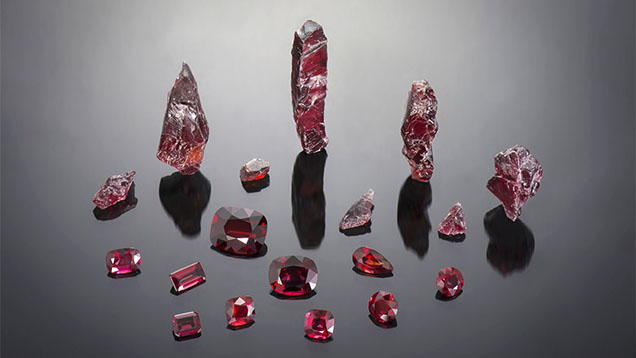
GIA recently studied a selection of rough and cut garnet from the new source (figure 1), loaned by Precious Le Gems. The color of the stones is typically a pure red, with a medium to dark tone. In rare cases, a slight purple tint can be observed. The stones were isotropic with a refractive index (RI) between 1.753 and 1.758. The specific gravity measured between 3.80 and 3.85, correlating with the higher RI. A handheld spectroscope showed three strong bands in the green to yellow region of the spectrum around 505, 530, and 575 nm, with the 505 nm band being strongest and sharpest, and two more subtle lines in the blue region around 460–470 nm. These properties are typical for pyrope-almandine garnet. Chemical analysis revealed 50.0–52.7% pyrope and 34.1–37.5% almandine in the garnets, with a smaller component of grossular (11.0–12.5%) and spessartine (1.4–2.7%).

Most stones appeared eye-clean. When observed under high magnification, some stones showed an inclusion scene typical of red garnet (figure 2). The inclusions consisted of reflective needles and platelets. Crystal inclusions were limited to opaque sulfides and small translucent primary rutile, which were identified by Raman spectroscopy.
While northern Vietnam has only been explored for a few decades and has traditionally focused on spinel and corundum, this new discovery shows that there is a large potential for other gems as well.
Narint Jaisanit is a staff gemologist, and Wim Vertriest is manager of field gemology, at GIA in Bangkok.
Since mid-2024, a newly discovered deposit in northern Vietnam has produced some fine red garnet. These stones are found in the rural Bao Yen district of the Lao Cai province, roughly 50 km northwest of the ruby-spinel mining district of Luc Yen. Artisanal miners dig for the garnet in river sediments and colluvial material at the base of hilly flanks. The rough stones are typically recovered as broken elongated fragments. Rough fragments can get very large, with pieces over 10 g routinely found. Euhedral garnet crystals have not been reported.
GIA recently studied a selection of rough and cut garnet from the new source (figure 1), loaned by Precious Le Gems. The color of the stones is typically a pure red, with a medium to dark tone. In rare cases, a slight purple tint can be observed. The stones were isotropic with a refractive index (RI) between 1.753 and 1.758. The specific gravity measured between 3.80 and 3.85, correlating with the higher RI. A handheld spectroscope showed three strong bands in the green to yellow region of the spectrum around 505, 530, and 575 nm, with the 505 nm band being strongest and sharpest, and two more subtle lines in the blue region around 460–470 nm. These properties are typical for pyrope-almandine garnet. Chemical analysis revealed 50.0–52.7% pyrope and 34.1–37.5% almandine in the garnets, with a smaller component of grossular (11.0–12.5%) and spessartine (1.4–2.7%).
Most stones appeared eye-clean. When observed under high magnification, some stones showed an inclusion scene typical of red garnet (figure 2). The inclusions consisted of reflective needles and platelets. Crystal inclusions were limited to opaque sulfides and small translucent primary rutile, which were identified by Raman spectroscopy.
While northern Vietnam has only been explored for a few decades and has traditionally focused on spinel and corundum, this new discovery shows that there is a large potential for other gems as well.
Narint Jaisanit is a staff gemologist, and Wim Vertriest is manager of field gemology, at GIA in Bangkok.