
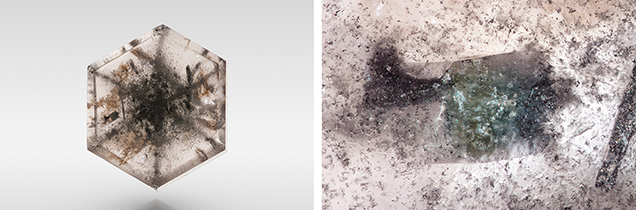
Grossular is known in the gem market for its popular varieties, such as tsavorite, hessonite, and rosolite. However, the occurrence of trapiche grossular has rarely been reported. Recently, some previously collected grossular crystals from Hangzhou, Zhejiang Province, China, were found to exhibit a distinct trapiche structure after being cut along specific orientations.
The term trapiche refers to a rare growth pattern characterized by radial sector zoning, forming a spoke-like or wheel-shaped appearance. This phenomenon is most commonly observed in emerald, corundum, and tourmaline but has rarely been reported in garnet.
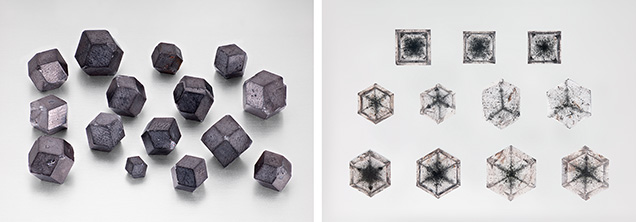
The grossular crystals were collected from a skarn outcrop in southwestern Hangzhou. The formation of skarn is the result of contact metamorphism between granite and limestone. The grossular crystals (figure 1, left) were in the form of rhombic dodecahedrons and appeared black due to a coating of graphite and pyrite. When cut into slices (figure 1, right), they exhibited a colorless and highly transparent appearance. Scanning electron microscopy with energy-dispersive spectroscopy (SEM-EDS) and laser ablation–inductively coupled plasma–mass spectrometry (LA-ICP-MS) analyses indicated their compositions were close to the grossular endmember, with trace amounts of magnesium, titanium, vanadium, chromium, manganese, and iron.
Based on the Raman spectrum and SEM-EDS analyses, the black arms were mainly composed of graphite and possibly other carbonaceous matter (such as bitumen or other amorphous phases). Diopside, fluorapatite, and quartz were also enriched in the arms, which corresponded to boundaries between {110} growth sectors. Furthermore, inclusions were preferentially concentrated along the tetrad and triad axes of the crystals.
The crystals were also fluorescent, showing orangish red under long-wave UV and yellowish orange under short-wave UV. Two main fluorescence centers were identified using 3D fluorescence mapping (not shown). The strongest fluorescence was at ~590 nm in the emission spectra, which is attributed to Mn2+. The weaker fluorescence center in the orange-red region exhibited three sharp peaks centered at 689, 703, and 718 nm, which are usually attributed to Cr3+.
Pyrite, calcite, and zircon were present in almost every sample. Additionally, two rare mineral inclusions, troilite (FeS) and hellandite-Ce, were identified. Troilite was confirmed with SEM-EDS and Raman spectroscopy on polished thin sections; the Fe/S atomic percentage ratio consistently ranged from 0.93 to 0.96. Electron probe microanalysis–wavelength dispersive spectroscopy (EPMA-WDS) analysis was used to identify hellandite-Ce; one calculated chemical formula was (Ca3.66Y0.34)∑4.00(Ce0.71Nd0.37Y0.37La0.30Sm0.07Pr0.07Gd0.05Dy0.05Eu0.04Tm0.02Er0.02Yb0.02Ho0.01)∑2.12(Al0.94Ti0.06)∑1.00Si4.00B4.00O22(OH)1.74F0.03. Troilite occurred as particles up to ~800 μm, while hellandite formed druses ranging from 50 to 195 μm. These inclusions occurred randomly within the slices, without a clear association with growth sectors. In some slices, large columnar inclusions were also observed (figure 2), up to 4 mm in length, identified as marialite (Na4Al3Si9O24Cl) by Raman and SEM-EDS analyses. Some marialite crystals were partially or completely replaced by a series of common minerals including calcite, diopside, albite, K-feldspar, celsian, prehnite, titanite, and fluorapatite. Celsian (Ba(Al2Si2O8)) was also found in some grossular slices and was often associated with K-feldspar with zoning structure resulting from isomorphism. Occasionally, baryte (BaSO4) and alstonite (BaCa(CO3)2) inclusions could also be detected.
These materials present a new occurrence of a mineral species with a trapiche structure and reflect the unique geological environment of the region as well. The presence of troilite indicates extremely low oxygen fugacity, which suggests a highly reducing environment (X. Li et al., “Thermally induced phase transition of troilite during micro-Raman spectroscopy analysis,” Icarus, Vol. 390, 2023, article no. 115299). The marialite suggests these grossular garnets may have crystallized from high-salinity hydrothermal fluids (J. Hammerli et al., “Exchange experiments for chlorine and bromine partitioning in scapolite at variable fluid salinities, pressures, and temperatures: Implications for tracing crustal fluid sources via Cl/Br ratios in scapolite,” Contributions to Mineralogy and Petrology, Vol. 179, 2024, article no. 92). Celsian and some other barium-bearing minerals serve as indicators of an unusual barium-rich environment. Further study of these special inclusions may provide insights into the formation mechanisms of these grossular garnets with fine trapiche textures.
Yinuo Wu, Xingtong Li, and Qian Zhang are affiliated with the Gemological Institute at China University of Geosciences (CUG) in Wuhan. Hongtao Shen is with the State Key Laboratory of Geological Processes and Mineral Resources at CUG in Wuhan. Ningyue Sun is affiliated with the Science Research Institute at CUG in Beijing. Zhi Qu is affiliated with the Qingdao Institute of Measurement Technology in Shandong, China. Ho Yin Tsang is affiliated with Bedside Mineral Studio in Hong Kong. Xiang Pi is affiliated with Meticulous Minerals in Xiamen, China.
Grossular is known in the gem market for its popular varieties, such as tsavorite, hessonite, and rosolite. However, the occurrence of trapiche grossular has rarely been reported. Recently, some previously collected grossular crystals from Hangzhou, Zhejiang Province, China, were found to exhibit a distinct trapiche structure after being cut along specific orientations.
The term trapiche refers to a rare growth pattern characterized by radial sector zoning, forming a spoke-like or wheel-shaped appearance. This phenomenon is most commonly observed in emerald, corundum, and tourmaline but has rarely been reported in garnet.
The grossular crystals were collected from a skarn outcrop in southwestern Hangzhou. The formation of skarn is the result of contact metamorphism between granite and limestone. The grossular crystals (figure 1, left) were in the form of rhombic dodecahedrons and appeared black due to a coating of graphite and pyrite. When cut into slices (figure 1, right), they exhibited a colorless and highly transparent appearance. Scanning electron microscopy with energy-dispersive spectroscopy (SEM-EDS) and laser ablation–inductively coupled plasma–mass spectrometry (LA-ICP-MS) analyses indicated their compositions were close to the grossular endmember, with trace amounts of magnesium, titanium, vanadium, chromium, manganese, and iron.
Based on the Raman spectrum and SEM-EDS analyses, the black arms were mainly composed of graphite and possibly other carbonaceous matter (such as bitumen or other amorphous phases). Diopside, fluorapatite, and quartz were also enriched in the arms, which corresponded to boundaries between {110} growth sectors. Furthermore, inclusions were preferentially concentrated along the tetrad and triad axes of the crystals.
The crystals were also fluorescent, showing orangish red under long-wave UV and yellowish orange under short-wave UV. Two main fluorescence centers were identified using 3D fluorescence mapping (not shown). The strongest fluorescence was at ~590 nm in the emission spectra, which is attributed to Mn2+. The weaker fluorescence center in the orange-red region exhibited three sharp peaks centered at 689, 703, and 718 nm, which are usually attributed to Cr3+.
Pyrite, calcite, and zircon were present in almost every sample. Additionally, two rare mineral inclusions, troilite (FeS) and hellandite-Ce, were identified. Troilite was confirmed with SEM-EDS and Raman spectroscopy on polished thin sections; the Fe/S atomic percentage ratio consistently ranged from 0.93 to 0.96. Electron probe microanalysis–wavelength dispersive spectroscopy (EPMA-WDS) analysis was used to identify hellandite-Ce; one calculated chemical formula was (Ca3.66Y0.34)∑4.00(Ce0.71Nd0.37Y0.37La0.30Sm0.07Pr0.07Gd0.05Dy0.05Eu0.04Tm0.02Er0.02Yb0.02Ho0.01)∑2.12(Al0.94Ti0.06)∑1.00Si4.00B4.00O22(OH)1.74F0.03. Troilite occurred as particles up to ~800 μm, while hellandite formed druses ranging from 50 to 195 μm. These inclusions occurred randomly within the slices, without a clear association with growth sectors. In some slices, large columnar inclusions were also observed (figure 2), up to 4 mm in length, identified as marialite (Na4Al3Si9O24Cl) by Raman and SEM-EDS analyses. Some marialite crystals were partially or completely replaced by a series of common minerals including calcite, diopside, albite, K-feldspar, celsian, prehnite, titanite, and fluorapatite. Celsian (Ba(Al2Si2O8)) was also found in some grossular slices and was often associated with K-feldspar with zoning structure resulting from isomorphism. Occasionally, baryte (BaSO4) and alstonite (BaCa(CO3)2) inclusions could also be detected.
These materials present a new occurrence of a mineral species with a trapiche structure and reflect the unique geological environment of the region as well. The presence of troilite indicates extremely low oxygen fugacity, which suggests a highly reducing environment (X. Li et al., “Thermally induced phase transition of troilite during micro-Raman spectroscopy analysis,” Icarus, Vol. 390, 2023, article no. 115299). The marialite suggests these grossular garnets may have crystallized from high-salinity hydrothermal fluids (J. Hammerli et al., “Exchange experiments for chlorine and bromine partitioning in scapolite at variable fluid salinities, pressures, and temperatures: Implications for tracing crustal fluid sources via Cl/Br ratios in scapolite,” Contributions to Mineralogy and Petrology, Vol. 179, 2024, article no. 92). Celsian and some other barium-bearing minerals serve as indicators of an unusual barium-rich environment. Further study of these special inclusions may provide insights into the formation mechanisms of these grossular garnets with fine trapiche textures.
Yinuo Wu, Xingtong Li, and Qian Zhang are affiliated with the Gemological Institute at China University of Geosciences (CUG) in Wuhan. Hongtao Shen is with the State Key Laboratory of Geological Processes and Mineral Resources at CUG in Wuhan. Ningyue Sun is affiliated with the Science Research Institute at CUG in Beijing. Zhi Qu is affiliated with the Qingdao Institute of Measurement Technology in Shandong, China. Ho Yin Tsang is affiliated with Bedside Mineral Studio in Hong Kong. Xiang Pi is affiliated with Meticulous Minerals in Xiamen, China.