
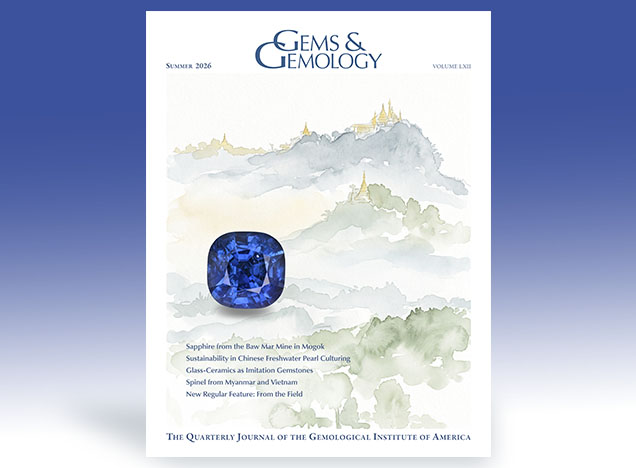
Explore the Summer 2026 issue of G&G, featuring four in-depth studies on sapphire and spinel from Southeast Asia, the sustainability of China’s freshwater pearl industry, and glass-ceramics used as imitation gemstones. Plus, don’t miss the debut of From the Field, a new column highlighting the expeditions of GIA’s field gemology team.
GEMOLOGICAL, GEOCHEMICAL, AND GEOCHRONOLOGICAL STUDY OF SAPPHIRE FROM THE BAW MAR MINE IN MOGOK, MYANMAR
Arkar Moe Myint and coauthors present a detailed study of blue sapphires from Baw Mar, Myanmar, shedding light on their color, clarity, and distinctive internal features. The authors’ analytical approach, which combines laser ablation–inductively coupled plasma–mass spectrometry with uranium-lead dating of a zircon inclusion, suggests that the sapphires formed in a magmatic environment 54 to 65 million years ago.
POLICY-DRIVEN SUSTAINABILITY IN CHINA’S FRESHWATER PEARL CULTURING INDUSTRY
Dr. Qishen Zhou and colleagues investigate how sustainability is reshaping freshwater pearl culturing in China. While environmental regulations initially posed significant challenges, they also drove improvements in farming practices and pearl quality. The authors argue that this shift toward sustainability may offer a pathway to greater long-term success for the industry.
GLASS-CERAMICS AS IMITATION GEMSTONES: A STUDY ON A SILICON-ALUMINUM- MAGNESIUM-ZINC SYSTEM
Dr. Wasura Soonthorntantikul and fellow researchers examine silicon-aluminum-magnesium-zinc glass-ceramics, a class of manufactured materials designed to closely mimic the appearance of natural gemstones. Their study identifies the key optical, chemical, and spectroscopic features that distinguish these convincing imitation gems from natural stones, laboratory-grown gemstones, and conventional glass simulants.
CHARACTERIZATION OF RED AND ORANGE SPINEL FROM MYANMAR AND VIETNAM
Boonyapak Aksorn and coauthors compare red and orange spinel from Myanmar and Vietnam, revealing that the gems are often alike in basic gemological properties but differ in chemical composition. Their findings demonstrate the value of trace element analysis for origin determination while highlighting the ongoing challenges of tracing some orange spinel to a specific locality.
FROM THE FIELD
This new G&G column highlights GIA’s field gemology expeditions, where geologists collaborate with local mining communities and collect samples that support origin research. The first installment captures a recent journey through northern Vietnam with vivid photographs and short videos of the country’s mining and trading activities.
LAB NOTES
GIA’s global laboratory staff present their latest findings in the Lab Notes section, including a natural pinkish brown diamond with an atypical color center, South Sea cultured pearls containing microscopic marine organisms, and a heat-treated Sri Lankan sapphire with reversible photochromism.
MICRO-WORLD
Micro-World continues to showcase the wonders inside gems, with a two-phase inclusion in a Pakistani peridot, a colorful mosaic pattern in orange sapphire, fluorescent crystal inclusions in spinel, and more.
GEM NEWS INTERNATIONAL
Gem News International contributors share notable discoveries from around the globe, such as hematite and rutile needles in a six-rayed star quartz and an unusual specimen of yellow raindrop turquoise.
Explore the Summer 2026 issue of G&G, featuring four in-depth studies on sapphire and spinel from Southeast Asia, the sustainability of China’s freshwater pearl industry, and glass-ceramics used as imitation gemstones. Plus, don’t miss the debut of From the Field, a new column highlighting the expeditions of GIA’s field gemology team.
GEMOLOGICAL, GEOCHEMICAL, AND GEOCHRONOLOGICAL STUDY OF SAPPHIRE FROM THE BAW MAR MINE IN MOGOK, MYANMAR
Arkar Moe Myint and coauthors present a detailed study of blue sapphires from Baw Mar, Myanmar, shedding light on their color, clarity, and distinctive internal features. The authors’ analytical approach, which combines laser ablation–inductively coupled plasma–mass spectrometry with uranium-lead dating of a zircon inclusion, suggests that the sapphires formed in a magmatic environment 54 to 65 million years ago.
POLICY-DRIVEN SUSTAINABILITY IN CHINA’S FRESHWATER PEARL CULTURING INDUSTRY
Dr. Qishen Zhou and colleagues investigate how sustainability is reshaping freshwater pearl culturing in China. While environmental regulations initially posed significant challenges, they also drove improvements in farming practices and pearl quality. The authors argue that this shift toward sustainability may offer a pathway to greater long-term success for the industry.
GLASS-CERAMICS AS IMITATION GEMSTONES: A STUDY ON A SILICON-ALUMINUM- MAGNESIUM-ZINC SYSTEM
Dr. Wasura Soonthorntantikul and fellow researchers examine silicon-aluminum-magnesium-zinc glass-ceramics, a class of manufactured materials designed to closely mimic the appearance of natural gemstones. Their study identifies the key optical, chemical, and spectroscopic features that distinguish these convincing imitation gems from natural stones, laboratory-grown gemstones, and conventional glass simulants.
CHARACTERIZATION OF RED AND ORANGE SPINEL FROM MYANMAR AND VIETNAM
Boonyapak Aksorn and coauthors compare red and orange spinel from Myanmar and Vietnam, revealing that the gems are often alike in basic gemological properties but differ in chemical composition. Their findings demonstrate the value of trace element analysis for origin determination while highlighting the ongoing challenges of tracing some orange spinel to a specific locality.
FROM THE FIELD
This new G&G column highlights GIA’s field gemology expeditions, where geologists collaborate with local mining communities and collect samples that support origin research. The first installment captures a recent journey through northern Vietnam with vivid photographs and short videos of the country’s mining and trading activities.
LAB NOTES
GIA’s global laboratory staff present their latest findings in the Lab Notes section, including a natural pinkish brown diamond with an atypical color center, South Sea cultured pearls containing microscopic marine organisms, and a heat-treated Sri Lankan sapphire with reversible photochromism.
MICRO-WORLD
Micro-World continues to showcase the wonders inside gems, with a two-phase inclusion in a Pakistani peridot, a colorful mosaic pattern in orange sapphire, fluorescent crystal inclusions in spinel, and more.
GEM NEWS INTERNATIONAL
Gem News International contributors share notable discoveries from around the globe, such as hematite and rutile needles in a six-rayed star quartz and an unusual specimen of yellow raindrop turquoise.