
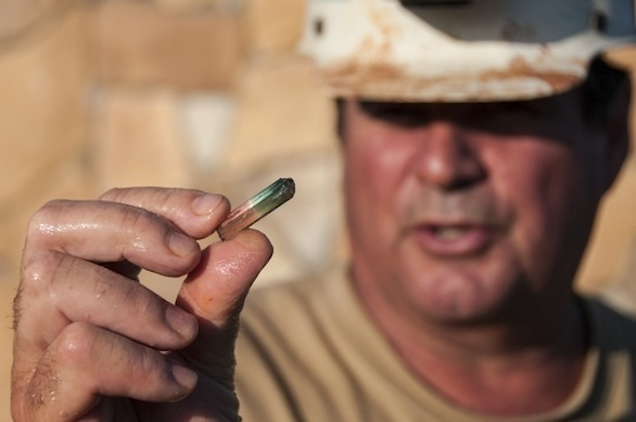
For over a century, Southern California has been the source of some of the world’s finest mineral and gem specimens. Colored tourmalines appear to have been first recognized in 1872 at Thomas Mountain in Riverside County and then, about twenty years later, just north of the small village of Pala in northern San Diego County. The latter occurrence, named the Stewart Mine (or Stewart Lithia Mine), quickly became famous for the production of attractive mineral specimens of purple lepidolite mica which contained clusters and sprays of small red (rubellite) tourmaline crystals. In 1898, a third important discovery of gem tourmaline (including some bicolored crystals) occurred at Mesa Grande about 20 miles southwest of Pala. This would become the Himalaya Mine, the greatest producer of gem tourmaline in North America. An additional locality was found at Pala in 1902 – it produced tourmaline and what provided to be a spectacular new lilac-colored variety of spodumene that was given the name kunzite. Within the decade, several other deposits in Southern California were found containing tourmaline, aquamarine beryl, and a gem-quality spessartine garnet. All occurred in veins or dikes of a coarse-grained granitic rock called a pegmatite. The main efforts to recover gems continued until about 1910, after which most gem mining operations in the region ceased or were only pursued on more a limited and intermittent basis. Lithium mica production, however, continued at the Stewart Mine until about 1928.
How to Use this Reading List
This reading list gives you an opportunity to learn more about the history of gem tourmaline from Southern California. Entries in the list are presented in chronological order to emphasize the development of ideas over time. The list is not comprehensive, but is a compilation of some interesting information that has often been forgotten or overlooked.
Many of the articles in the reading list exist in the public domain and can be found online at digital libraries such as Hathitrust, Internet Archive, or other digital repositories. More recent publications can often be found in libraries. Abstracts of these more recent articles can usually be found on the website of the original journal or magazine, and the article itself is often available for purchase from the publisher.
Minerals and Mines of San Diego County. C.R. Orcutt, West American Scientist, Vol. 3, No. 23, pp. 69-72, (1887). A review of mining in the county, with a brief mention of tourmaline (but no locations) on page 72.
Notes on the Occurrence of Rubellite and Lepidolite in Southern California. H.W. Fairbanks, Science, Vol. 21, No. 520, pp. 35-36, (1893). One of the first published reports on the deposit of red tourmaline in lilac-colored lithium mica (lepidolite) in a pegmatite dike just north of the village of Pala.
Life Today in the Pala Mission Station. F.J. Polley, Publications of the Historical Society of Southern California, Vol. 3, pp. 41-46, (1893). The Mission San Antonio de Pala was organized by Franciscan clergy in 1816 at a location that had been a traditional gathering place for Native Americans. This brief article describes life at the mission station at about the time that gem mining was beginning to take place in the Pala area of San Diego County.
Rubellite in California. W.G. Wright, Mineral Collector, Vol. 1, No. 2, pp. 18-20, (1894). An early description of the rubellite tourmaline occurrence near Pala.
“Precious Gems and Commercial Minerals – San Diego County California”. W.H. Holcomb, Frye, Garrett and Smith Publishers, San Diego, 28 pp. (1900). This booklet describes the gem minerals and their properties.
California as a Gem State. G.E. Bailey, Overland Monthly, Vol. 40, No. 5, pp. 468-470, (1902). This short article reviews the occurrences of gem minerals in the state.
On a New Lilac-Colored Spodumene. G.F. Kunz, Science, Vol. 18, No. 452, p. 280, (1903). After having received samples in late 1902 the author, the noted gem expert for Tiffany and Company in New York City, announced the discovery of a new gem variety of spodumene found as large transparent crystals. The variety would later be named kunzite is his honor. A longer article on the discovery appeared in the American Journal of Science, Ser. 4, Vol. 166, No. 93, pp. 264-267, (1903); a summary of the article also appeared in the Jewelers’ Circular-Weekly, Vol. 47, No. 5, p. 81, (1903).
Kunzite, a New Gem. C. Baskerville, Science, Vol. 18, No. 453, pp. 303-304, (1903). A report on the luminescence properties of kunzite.
The Action of Radium, Roentgen Rays, and Ultraviolet Light on Minerals and Gems. G.F. Kunz and C. Baskerville, Science, Vol. 18, No. 468, pp. 769-783, (1903). The authors studied the effects of various types of radiation to produce fluorescence in various minerals including spodumene.
Spodumene from San Diego County, California. W.T. Schaller, University of California Publications - Bulletin of the Department of Geology, Vol. 3, No. 13, pp. 265-275, (1904). The first detailed description of the new lilac-colored gem variety of spodumene called kunzite found near Pala in 1902.
Kunzite and its Unique Properties. C. Baskerville and G.F. Kunz, American Journal of Science, Ser. 4, Vol. 168, No. 103, pp. 25-28, (1904). A discussion of the color and luminescence properties of this new gem variety. Similar articles appeared in the Mineral Collector, Vol. 11, No. 8, pp. 113-116, (1904), and in the Chemical News, Vol. 91, No. 2357, pp. 45-46, (1905).
How Kunzite was Discovered. Author unknown, Mineral Collector, Vol. 11, No. 1, pp. 1-4, (1904). General information on the history and properties of kunzite. This article also appeared in the Jewelers’ Circular-Weekly, Vol. 48, No. 1, pp. 47-51, (1904).
Analysis of Kunzite. R.O.E. Davis, Chemical News, Vol. 90, No. 2333, p. 80, (1904). Results of a chemical analysis of a lilac-color crystal. A similar article appeared in the American Journal of Science, Ser. 4, Vol. 168, No. 103, p. 29, (1904).
The Tourmaline Localities of Southern California, W.T. Schaller, Science, Vol. 19, No. 476, pp. 266-268, (1904). The author gives a short review of the main gem tourmaline occurrences.
Fluorescent Bodies Excited by Radium, F. Soddy, Nature, Vol. 69, No. 1796, p. 523, (1904). The luminescence of kunzite and other minerals to radiation emitted by radium is discussed.
Une Nouvelle Substance Phosphorescents – La Kunzite [A New Phosphorescent Substance – Kunzite]. Author unknown, Le Radium, Vol. 1, No. 4, p. 13, (1904). Note on the discovery of kunzite in California.
Tourmaline from San Diego County, California. D.B. Sterrett, American Journal of Science, Ser. 4, Vol. 167, No. 102, pp. 459-465, (1904). The author discusses the results of a morphological study of 160 tourmaline crystals from the Mesa Grande area.
“Gems, Jewelers’ Materials, and Ornamental Stones of California”. G.F. Kunz, California State Mining Bureau Bulletin, No. 37, 171 pp., (1905). This publication gives one of the earliest detailed descriptions of the gem deposits in Southern California and in other parts of the state. The author recounts the stories of the discoveries of several tourmaline deposits that, within just a few years, would become world-famous for both mineral and gem specimens. A short summary on spodumene appeared in the Engineering and Mining Journal, Vol. 79, No. 1, p. 23, (1905).
The Pegmatyte Veins of Pala, San Diego County. G.A. Waring, American Geologist, Vol. 35, No. 6, pp. 356-369, (1905). A report on the granitic pegmatites near Pala and the occurrence of gem-quality crystals in open or clay-filled pockets along the central zones of these dikes.
Quartz from San Diego County, California. G.A. Waring, American Journal of Science, Ser. 4, Vol. 170, No. 116, pp. 125-127, (1905). Quartz crystals from the pegmatite dikes are discussed.
Geology of the Tourmaline Deposits. T.C. Hopkins, Mining and Engineering World, Vol. 23, No, 19, p. 523, (1905). A note on the tourmaline pegmatites in San Diego County.
Tourmaline in California. Author unknown, Pacific Monthly, Vol. 14, No. 3, pp. 291-294, (1905). A brief description of the gem tourmaline from Southern California.
Where Nature Stores Her Jewels. E.R. Schley, Sunset Magazine, Vol. 15, No. 6, pp. 546-555, (1905). This article reviews the natural resources, including gems, from San Diego County.
Kunzite the Precious. W.B. Gross, Sunset Magazine, Vol. 15, No. 6, pp. 556-560, (1905). The author recounts the discovery of kunzite near Pala and its interesting physical properties. A summary of this article appeared as Something about Kunzite in the Mining and Engineering World, Vol. 23, No.19, pp. 522-523, (1905).
Gems and Rare Minerals of Southern California. L.D. Sovereign, Bulletin of the Southern California Academy of Sciences, Vol. 4, No. 5, pp. 85-90, (1905). A review of the Southern California gem deposits; a summary of this report appeared as Valuable Crystals and Rare Minerals of San Diego County, California in the Mining and Engineering World, Vol. 23, No. 19, pp. 521-522, (1905).
Geology of the Tourmaline Deposits, T.C. Hopkins, Mining and Engineering World, Vol. 23, No. 19, p. 523, (1905). A brief geological description of the gem deposits is given.
Gem Mining in California. Author unknown, Pacific Monthly, Vol. 14, No. 5, pp. 495-496, (1905). The discovery of gem tourmalines at Mesa Grande in San Diego County.
San Diego’s Gem Casket. R. Keene, Pacific Monthly, Vol. 15, No. 3, pp. 328-334, (1906). A description of the gem mining occurring at the time in San Diego County.
“Precious Stones and Commercial Minerals – San Diego County, California”, W.H. Holcomb, County Board of Supervisors, 28 pp., (1907). This booklet describes early gem mining in the county.
Precious Stones at Home. W.E. Burke, Technical World Magazine, Vol. 7, No. 4, pp. 388-395, (1907). The author describes the recovery of various gems within the United States, but mainly discusses gem production in Southern California.
Un Don au Muséum – Tourmalines et Kuntzite [A Donation to the Museum – Tourmalines and Kunzite]. J. Bardet, La Vulgarisation Scientifique, Vol. 4, No. 4, pp. 91-92, (1907). The report of a donation of California gem pegmatite specimens by the American financier J.P. Morgan.
Diamonds and Other Gems. Author unknown, Pacific Miner, Vol. 12, (May), p. 184, (1908). The author discusses the possibility of a gemstone industry being developed in California.
Minerals from the Pegmatite Veins of Rincon, San Diego County, California. A.F. Rogers, School of Mines Quarterly, Vol. 31, pp. 208-218, (1910). A review of the pegmatites and their minerals in the vicinity of the town of Rincon.
Tourmaline in California. J.L. Cowan, Mining and Scientific Press, Vol. 100, No. 24, pp. 864-865, (1910). The deposits of gem tourmaline and the history of their discovery are discussed.
Gem Mining in California a Profitable Industry. A.H. Martin, Mining and Engineering World, Vol. 33, No. 27, pp. 1227-1228, (1910) ); and Mining for Precious Stones in California, Mining Science, Vol. 63, No. 1625, pp. 316-317, (1911). These two articles by the same author gem production in southern California.
How the World’s Great Gem Mines were Discovered. J.L. Cowan, Pacific Monthly, Vol. 26, No. 5, pp. 545-556, (1911). The history is presented of several major gem deposits around the world, including the tourmaline deposits in Southern California.
Himalaya Tourmaline Mine. J.L. Cowan, Mines and Minerals, Vol. 32, (October), pp. 181-182, (1911). A note on the tourmaline mine.
California Gem Stones. Author unknown, Mining and Scientific Press, Vol. 104, No. 22, p. 778, (1912). This short article lists the various gem materials as well as typical prices per carat for each one.
The Luminescence of Kunzite. E.L. Nichols and H.L. Howes, Physical Review, Ser. 2, Vol. 4, No. 1, pp. 18-27, (1914). The authors discuss the luminescence behavior of kunzite.
Ueber Edelsteinfunde auf der Halbinsel Nieder-Kalifornien [On the Gemstones of the Lower California Peninsula]. E. Wittich, Zentralblatt für Mineralogie, Geologie, und Paläontologie, pp. 449-459, (1914). The author provides a description of gem minerals in Southern California and the Baja California peninsula.
“Geology and Mineral Resources of San Diego and Imperial Counties”. F.J.H. Merrill, California State Mining Bureau, 113 pp., (1914). This state report describes the gem and mineral resources from San Diego County.
Building a Gem Mine. J. Bassett, Technical World Magazine, Vol. 23, No. 3, p. 83, (1915). This brief note describes a model of a gem pegmatite mine that was constructed for display at the Panama-California Exposition held in San Diego in 1915 and 1916.
“San Diego County – Non-Metallic Minerals: Gems”. F. Hamilton, California State Mining Bureau, Report XIV of the State Mineralogist, Part 5, Chap. 1, pp. 691-705, (1916). This state report gives a description of the gem mines.
The Gem of Prophecy. F.J. Biermann, Sunset – The Pacific Monthly, Vol. 37, No. 4, pp. 27 and 67-68, (1916). The history of the discovery of kunzite by Frank Salmons and two Basque shepherds working for him.
Gem Mining in the United States – Tourmaline and Turquoise. L.P. Gratacap, American Museum Journal, Vol. 17, No. 1, pp. 64-69, (1917). The mining of these two gem minerals in various parts of the country.
Kathodo-Fluorescence of Crystals. T.B. Brown, Physical Review, Ser. 2, Vol. 11, No. 1, pp. 39-57, (1918). A study of the cathodoluminescence of kunzite.
Precious and Semi-Precious Stones of California. A.M. Keatinge, Overland Monthly, Vol. 71, No. 1, pp. 53-56, (1918). A brief summary of the gem minerals found in California.
The Coloring and Thermophosphorescence Produced in Transparent Minerals and Gems by Radium Radiation. S.C. Lind and D.C. Bardwell, American Mineralogist, Vol. 8, No. 10, pp. 171-180, (1923). This article contains a section on the luminescence behavior of kunzite. A similar article by these authors appeared in the Journal of the Franklin Institute, Vol. 196, No. 1173, pp. 375-390, (1923).
The Genesis of Lithium Pegmatites. W.T. Schaller, American Journal of Science, Vol. 210, No. 57, pp. 269-279, (1925). Based on field studies of gem pegmatites in Southern California and elsewhere, the author proposes that the central portions of granitic pegmatite dikes were not the result of original crystallization of a “mineralized” igneous magma, but formed by hydrothermal alteration and replacement of pre-existing graphite granite dikes.
The X-ray Phosphorescent and Thermophosphorescent Radiations of Kunzite. O. Stuhlman and A.F. Daniel, Journal of the Optical Society of America, Vol. 17, No. 4, pp. 289-292, (1928). An investigation of the phosphorescence reactions of kunzite.
The Coloration of Kunzite and Hiddenite by X-rays. P.L. Bayley, Journal of the Optical Society of America, Vol. 17, No. 5, pp. 350-355, (1928). Article not seen.
The Thermophosphorescent Radiations of Hiddenite and Kunzite. O. Stuhlman, Journal of the Optical Society of America, Vol. 18, No. 5, pp. 365-369, (1929). Article not seen.
Gem Mining in San Diego County, California. J.W. Ware, Gems & Gemology, Vol. 1, No. 8, pp. 218-219, (1935). This short article describes the gem mines in Southern California.
Notes on the Lithium Pegmatites of Pala, California. M. Donnelly, Pacific Mineralogist, Vol. 3, No. 1, pp. 8-12, (1936). A note on the Pala pegmatites and the interesting minerals for collectors that they contain.
Gem Minerals of California. F.J. Sperisen, California Journal of Mines and Geology, Vol. 34, No. 1, pp. 34-71, (1938). This publication reviews the locations of gem minerals in the state.
Mineral Resources of San Diego County. W.B. Tucker, California Journal of Mines and Geology, Vol. 35, No. 1, pp. 8-55, (1939). A review of minerals in the country, including gem materials.
Minor Constituents in Spodumene. A. Gabriel, M. Slavin and H.F. Carl, Economic Geology, Vol. 37, No. 2, pp. 116-125, (1942). A study of the minor impurity elements in various colored spodumenes, with the detection of manganese in kunzite.
Mineral Resources of Riverside County. W.B. Tucker and R.J. Sampson, California Journal of Mines and Geology, Vol. 41, No. 3, pp. 121-182, (1945). Article not seen.
The Gem Deposits of Southern California. R.H. Jahns, Engineering and Science Monthly, Vol. 11, No. 2, pp. 6-9, (1948). The author, one of the foremost experts on the geology and genesis of granitic pegmatites, discusses the geologic setting of the gem producing areas of Southern California.
Gem Minerals of San Diego County, California. N.E. Dawson, Lapidary Journal, Vol. 2, No. 4, pp. 208-214, (1948). Article not seen.
Gem Deposits of Southern California. R.H. Jahns, Gems & Gemology, Vol. 6, No. 1, pp. 6-9, 28, 30, (1948). This article reviews the occurrences of gem minerals in Southern California.
“Gem- and Lithium-Bearing Pegmatites of the Pala District, San Diego County, California”. R.H. Jahns and L.A. Wright, California Division of Mines Report, No. 7A, 72 pp. (1951). Based on fieldwork conducted between 1946 and 1948, this report represents the most comprehensive description of the geology and mineralogy of the Pala pegmatite district. The main gem mines in the area and described in detail.
“Economic Geology of the Rincon Pegmatites, San Diego County, California”. J.B. Hanley, California Division of Mines Report, No. 7B, 24 pp., (1951). This report gives a geologic description of the Rincon pegmatite district, which lies about 10 miles southeast of Pala.
Buried Treasure. Author unknown, Union Title-Trust Topics, Vol. 5, No. 6, pp. 2-7 and 14-15, (1951). This article describes the gem mines in San Diego County.
Composition, Tenebrescence and Luminescence of the Spodumene Minerals. E.W. Claffy, American Mineralogist, Vol. 38, No. 11/12, pp. 919-931, (1953). The author describes the transient color-change and luminescence behavior of spodumenes including kunzite.
“Geology of Southern California”. R.H. Jahns (ed.), California Department of Natural Resources Bulletin, No. 170, Two Volumes, 1054 pp., (1954). This state publication gives a detailed description of the geology of Southern California including the pegmatite deposits.
Pegmatite Gem Area of Southern California. J. Murdoch and R.W. Webb, California Division of Mines Bulletin, No. 173, pp. 25-27, (1956). A note of the gem pegmatite districts in San Diego County.
Recent Gem Mining at Ramona, San Diego County, California. J. Sinkankas, Gems & Gemology, Vol. 8, No. 12, pp. 367-373, (1957). Mining for tourmaline, topaz and spessartine at the Little Three pegmatite near Ramona is described.
“Minerals of California – Gemstones”. L.A. Wright, California Department of Natural Resources Bulletin, No. 176, pp. 205-214, (1957). This state publication summarizes the granitic pegmatites and their mining for gem materials.
Recent Gem Mining at Pala, San Diego County, California. J. Sinkankas, Gems & Gemology, Vol. 9, No. 3, pp. 80-87, 95, (1957). Activities at the gem pegmatite mines lying just north and northwest of Pala are summarized.
How I Cut Kunzite. G.A. Ashley, Lapidary Journal, Vol. 11, No. 3, pp. 320-322, (1957). The author discusses the faceting of kunzite for gem use.
Historical Himalaya Tourmaline Mine Resumes Production. J.G.M. Martin, Gems & Gemology, Vol. 9, No. 6, pp. 163-173, (1958). The renewed mining of tourmaline at the Himalaya mine.
Largest American Gem Find in 42 Years. J. Sinkankas, Lapidary Journal, Vol. 12, No. 3, pp. 340-352, (1958). The discovery of a large tourmaline gem pocket in the Himalaya mine near Mesa Grande.
Kunzite Strike at Reopened California Mine. H. Leiper, Lapidary Journal, Vol. 13, No, 2, pp. 348-351, (1959). The author discusses the discovery of a spodumene gem pocket at the Pala Chief mine.
“Gemstones of North America”. J. Sinkankas, Vol. 1, D. Van Nostrand Company, New York, 675 pp., (1959). This book contains a section on the gem deposits of Southern California.
Graphic Granite from the Ramona Pegmatite District, California. D.R. Simpson, American Mineralogist, Vol. 47, No. 9/10, pp. 1123-1138, (1962). The occurrence of graphic granite, and the possible conditions of its formation in pegmatite dikes, are discussed.
San Diego’s Gem-Studded Tiara. J. Sinkankas, Lapidary Journal, Vol. 16, No. 3, pp. 300-314, (1962). The author reviews the pegmatite occurrences of gem minerals in San Diego County.
“Geology and Mineral Resources of San Diego County, California”. F.H. Weber, California Division of Mines and Geology County Report, No. 3, 309 pp., (1963). This book contains a section on the gem pegmatites and it describes the gem mining locations.
The Development of the White Queen Mine. N.A. Dawson, Lapidary Journal, Vol. 17, No. 5, pp. 522-525, (1963). A report on mining at the White Queen Mine on Hiriart Mountain near Pala.
“Geology of the Central Part of the Ramona Pegmatite District, San Diego County, California”. D.R. Simpson, California Division of Mines and Geology Special Report, No. 86, pp. 3-23, (1965). The author describes the geologic setting of the Ramona pegmatite district.
“Minerals of California – Centennial Volume (1866-1966)”. J. Murdoch and R.W. Webb, California Division of Mines and Geology Bulletin, No. 189, 559 pp., (1966). This book describes the minerals of the state.
“Gold in the Sun 1900-1919”. R.F. Pourade, Union-Tribune Publishers, San Diego, Vol. 5, 282 pp., (1966). This book, part of a seven-volume series, describes the development of San Diego County, and it contains a section (Chapter 3) on the early development of gem mining.
The Fabulous Gems of Pala. J.C. Zeitner, Lapidary Journal, Vol. 21, No. 8, pp. 956-958, 960, 962, 964, 966 and 968, (1967). The author describes a visit to some of the Pala gem mines.
Still another Pala Gem Find! – The Pala Chief Awakened. A.C. Ordway, Lapidary Journal, Vol. 21, No. 8, pp. 970, 972-973 and 975, (1967). The author recounts the reopening of the Pala Chief mine and the discovery of new pockets containing gem spodumene.
Common Gems of San Diego County, California. P.W. Johnson, Journal of Gemmology, Vol. 11, No. 7, pp. 274-296, (1969). A review on the gem and non-gem minerals recovered from the San Diego County pegmatites. A similar article by the same author appeared earlier in Gems & Gemology, Vol. 12, No. 12, pp. 358-371, (1968).
Experimental Studies of Pegmatite Genesis: I, A Model for the Derivation and Crystallization of Granitic Pegmatites. R.H. Jahns and C.W. Burnham, Economic Geology, Vol. 64, No. 8, pp. 843-864, (1969). Based on field studies of pegmatites in Southern California and elsewhere, the authors present a model for the formation of granitic pegmatites.
Gemstones of San Diego County. P.W. Johnson, Lapidary Journal, Vol. 23, No. 7, pp. 998-1014, (1969). A review on the gem minerals found in pegmatite deposits in the county.
Gem Pockets of the Stewart Mine. R.W. Bartsch, Lapidary Journal, Vol. 24, No. 3, pp. 428 and 430, (1970). The author describes the different types of crystal-lined gem pockets at the Stewart Mine near Pala.
The Special Magic of Pink Tourmaline. T. Szenics, Lapidary Journal, Vol. 24, No. 8, pp. 1042-1057 and No. 9, pp. 1210-1218, (1970). The important occurrence of pink tourmaline from the Stewart Mine.
The Queen Reigns Again. W. Larson, Lapidary Journal, Vol. 26, No. 7, pp. 1002-1032, (1972). A description of the discovery of spectacular multicolored tourmaline crystal specimens at the Tourmaline Queen mine near Pala.
Zoned Lithium-Aluminum Mica Crystals from the Pala Pegmatite District. K.J. Brock, American Mineralogist, Vol. 59, No. 11/12, pp. 1242-1248, (1974). A description of muscovite mica crystals with rims of lepidolite mica from the Tourmaline Queen mine.
Color Centers of Manganese in Natural Spodumene LiAlSi2O6. B. Schmitz and G. Lehmann, Berichte der Bunsengesellschaft für Physikalische Chemie, Vol. 79, No. 11, pp. 1044-1049, (1975). Lilac and green colors in manganese-containing spodumene are the result of color centers formed by ionizing radiation.
Plutonic Zones in the Peninsular Ranges of Southern California and Northern Baja California. R.G. Gastil, Geology, Vol. 3, No. 7, pp. 361-363, (1975). The author discusses the geologic setting of the pegmatites in both Southern California and across the border in Northern Baja California in Mexico.
California Gemstones: Gems and Indians. M.L. Peters, Lapidary Journal, Vol. 30, No. 1, pp. 238-249, (1976). The author reviews the use of various gem materials by the California Indians, including tourmaline from the Pala area.
The King of Tourmaline. W.R.C. Shedenhelm, Rock and Gem, Vol. 6, No. 3, pp. 28-31, (1976). A brief discussion of Pala tourmalines in major mineral collections.
Pala – A “Jewel” of a Name. J. Pfefer, Lapidary Journal, Vol. 31, No. 1, pp. 202-210, (1977). The author reviews the Pala gem pegmatite deposits.
Famous Mineral Localities: The Himalaya Dike System Mesa Grande District, San Diego County, California. E.E. Foord, Mineralogical Record, Vol. 8, No. 6, pp. 461-474, (1977). The author, who wrote his Ph.D. thesis at Stanford University on the Himalaya Mine, describes this famous source of gem tourmaline.
The Best of San Diego County. W. Larson, Mineralogical Record, Vol. 8, No. 6, pp. 507-515, (1977). This article is a review of the best mineral specimens from the county.
Gem pegmatites in San Diego County. J.D. Smith, California Geology, (February), pp. 43-44, (1977). Article not seen.
Tourmaline. P. Bancroft, Pacific Discovery, Vol. 32, No. 3, pp. 10-14, (1979). A description of the Pala mines and their history.
Kein Land für Turmaline? [No Country for Tourmaline?]. W.D. Birch, Lapis, Vol. 4, No. 1, pp. 33-37 and 46, (1979). Article not seen.
Stable Isotope and Fluid Inclusion Studies of Gem-bearing Granitic Pegmatite-Aplite Dikes, San Diego County, California. B.E. Taylor, E.E. Foord and H. Friedrichsen, Contributions to Mineralogy and Petrology, Vol. 68, No. 2, pp. 187-205, (1979). The authors present results of a geological study of the conditions of formation of the gem pegmatite dikes.
The Tourmalines of the Pala Valley, San Diego County, California, U.S.A. M.J. O’Donoghue, Journal of Gemmology, Vol. 16, No. 5, pp. 290-295, (1979). The author recounts a visit to the Pala area in 1975 and describes the colored tourmalines found in the pegmatites in the area.
Rock & Gem Digs Tourmaline. B. Jones, Rock & Gem, Vol. 12, No. 6, pp. 27-35, 74, (1982). A report of a collecting trip to the San Diego county pegmatites.
“Minerals of California”. H.E. Pemberton, Van Nostrand Reinhold Press, New York, 591 pp., (1983). This book describes California minerals including the gem minerals in San Diego County.
Recent Work at the Himalaya Mine. C.R. Marcusson, Mineralogical Record, Vol. 16, No. 5, pp. 419-424, (1985). A report on tourmaline mining at the Himalaya Mine.
Occurrence and Alteration of Phosphate Minerals at the Stewart Pegmatite, Pala District, San Diego County, California. J.E. Shigley and G.E. Brown, American Mineralogist, Vol. 70, No. 3/4, pp. 395-408, (1985). A description of the primary and secondary phosphate minerals found in the Stewart mine.
Mineralogy and Paragenesis of “Pocket” Clays and Associated Minerals in Complex Granitic Pegmatites, San Diego County, California. E.E. Foord, H.C. Starkey and J.E. Taggart, American Mineralogist, Vol. 71, No. 3/4, pp. 428-439, (1986). A detailed analysis of the clays and associated minerals that often fill the gem pockets in granitic pegmatites.
Mineralogy and Geochemical Evolution of the Little Three Pegmatite-Aplite Layered Intrusive, Ramona, California. L.A. Stern, G.E. Brown, D.K. Bird, R.H. Jahns, E.E. Foord, J.E. Shigley, L.B. Spaulding, American Mineralogist, Vol. 71, No. 3/4, pp. 406-427, (1986). The authors present the results of a geological field study of the Little Three pegmatite near Ramona.
On Kunz and Kunzite. L.H. Conklin, Mineralogical Record, Vol. 18, No. 5, pp. 369-372, (1987). A recounting of the history of the discovery of kunzite in San Diego County.
Die Himalaya Mine bei Mesa Grande in Kalifornien [The Himalaya Mine near Mesa Grande in California]. R. Hochleitner and C. Weise, Lapis, Vol. 12, No. 10, pp. 11-22, (1987). Article not seen.
Tourmalines of Pala. J.C. Zeitner, Lapidary Journal, Vol. 40, No. 11, pp. 34-41, (1987). A review of the gem tourmalines from the Pala pegmatite district.
Role of Natural Radiation in Tourmaline Coloration. I.M. Reinitz and G.R. Rossman, American Mineralogist, Vol. 73, No. 7/8, pp. 822-825, (1988). Based in part on measurements of the radiation levels in tourmaline pockets in southern California pegmatites, the authors concluded that radiation doses that some elbaite tourmalines should have experienced over geologic time in gem pockets would have been sufficient to produce a natural pink color. This pink color can be bleached by heating above about 400-500°C. Therefore, the radiation exposure must have occurred at lower temperatures after crystallization of the pocket tourmaline.
The Peninsular Ranges Batholith: An Insight into the Evolution of the Cordilleran Batholiths of Southwestern North America. L.T. Silver and B.W. Chappell, Transactions of the Royal Society of Edinburgh - Earth Sciences, Vol. 79, No. 2/3, pp. 105-121, (1988). A geological study of the igneous rocks that host the gem pegmatites.
Mineralogy and Paragenesis of the Little Three Mine Pegmatites, Ramona District, San Diego County, California. E.E. Foord, L.B. Spaulding, R.A. Mason and R.F. Martin, Mineralogical Record, Vol. 20, No. 2, pp. 101-127, (1989). This article presents the results of a geological field study of a pegmatite dike system that produced gem tourmaline and spessartine garnet.
Tourmaline Treasures in San Diego. B. Jones, Rock & Gem, Vol. 20, No. 2, pp. 33-36, (1990). The author reports on tourmaline mining at the Himalaya Mine near Mesa Grande.
California Gem Mining - Chronicle of a Comeback D. Federman, Modern Jeweler, Vol. 90, No. 9, pp. 54-60, (1991). A discussion of efforts to reactivate gem pegmatite mining in Southern California.
Polarized Luminescence Spectra of Kunzite. B.K. Chandrasekhar and W.B. White, Physics and Chemistry of Minerals, Vol. 18, No. 7, pp. 433-440, (1992). A study of kunzite luminescence to ultraviolet and electron beam excitation.
Aquamarine in the United States - The Search Continues. M.I. Jacobsen, Rocks & Minerals, Vol. 68, No. 5, pp. 306-319, (1993). A review of aquamarine localities including those in Southern California.
Foitite, [Fe2+2(Al,Fe3+)]Al6Si6O18(BO3)3(OH)4, a New Alkali-deficient Tourmaline: Description and Crystal Structure. D.J. MacDonald, F.C. Hawthorne and J.D. Grice, American Mineralogist, Vol. 78, No. 11/12, pp. 1299-1303, (1993). Description of a new tourmaline group mineral species found in the Southern California pegmatites.
Gemstones of California. M. Gray, Rocks & Minerals, Vol. 69, No. 6, pp. 379-384, (1994), and The Minerals of California. A.R. Kampf, Rocks & Minerals, Vol. 69, No. 6, pp. 396-409 (1994). These two articles present reviews of the gem minerals from California.
Recent Work at the Lithia Dike Claim, Cahuilla Mountain, Riverside County, California. P. Geffner and J. Fisher, Rocks & Minerals, Vol. 72, No. 3, pp. 156-161, (1997). A report on the mining of two pegmatite dikes near the town of Anza.
Luminescence Spectroscopy of Cr3+ and Mn2+ in Spodumene (LiAlSi2O6). G. Walker, A. El Jaer, R. Sherlock, T.J. Glynn, M. Czaja and Z. Mazurak, Journal of Luminescence, Vol. 72/74, pp. 278-280, (1997). A study the trace elements that produce color in spodumene.
The Geology, Mineralogy, and History of the Himalaya Mine, Mesa Grande, San Diego County, California. J. Fisher, E.E. Foord and G.A. Bricker, Rocks & Minerals, Vol. 73, No. 3, pp. 156-180, (1998). The authors describe the Himalaya Mine, which has been the largest producer of gem- and specimen-grade tourmaline in North America. A condensed version of the article appeared in California Geology, Vol. 51, No. 1, pp. 3-18, (1999).
A Recent Find of Kunzite at the Historic Katerina Mine, Pala District, San Diego County, California. J. Fisher, Mineral News, Vol. 15, No. 1, pp. 1 and 6-7, (1999). A note on a discovery of kunzite.
The First California Gem Tourmaline Locality. M.C. Taylor, Gems & Gemology, Vol. 35, No. 3, pp. 153-154, (1999). Brief report on early mining on Thomas Mountain in Riverside County, where tourmalines were first recognized in 1872.
The Himalaya Rises Again. M. Lurie, Lapidary Journal, Vol. 52, No. 11, pp. 24-28, (1999). The reopening of tourmaline mining at the Himalaya mine.
Crystallization of the Little Three Layered Pegmatite-Aplite Dike, Ramona District, California. G.B. Morgan and D. London, Contributions to Mineralogy and Petrology, Vol. 136, No. 4, pp. 310-330, (1999). A geological model of the formation on this dike based on field studies and crystallization experiments.
Cooling Rates and Crystallization Dynamics of Shallow-Level Pegmatite-Aplite Dikes, San Diego County, California. K.L. Webber, W.B. Simmons, A.U. Falster and E.E. Foord, American Mineralogist, Vol. 84, No. 5/6, pp. 708-717, (1999). A model for the crystallization of pegmatite-aplite dikes which includes rates of both dike cooling and crystal growth.
Foitite: Formation during Late Stages of Evolution of Complex Granitic Pegmatites at Dobra Voda, Czech Republic, and Pala, California, U.S.A. M. Novak and M.C. Taylor, Canadian Mineralogist, Vol. 38, No. 6, pp. 1399-1408, (2000). Some color zoned crystals from the White Queen Mine near Pala consist of two tourmaline mineral species – elbaite and foitite. The authors discuss the geochemical evolution during late stages of pegmatite crystallization where there was an enrichment in iron in the magmatic fluids to produce these iron-bearing tourmalines.
Spessartine Garnet from Ramona, San Diego County, California. B.M. Laurs and K. Knox, Gems & Gemology, Vol. 37, No. 4, pp. 278-295, (2001). A description of gem garnets for the Little Three pegmatite mine.
Gem Tourmaline Chemistry and Paragenesis. W.B. Simmons, K.I. Webber, A.U. Falster and J.W. Nizamoff, Australian Gemmologist, Vol. 21, No. 1, pp. 24-29, (2001). A study of the chemical composition of gem tourmalines from several localities including Southern California.
History of the Tourmaline Queen Mine, San Diego County, California. E.R. Swoboda and B. Larson, Mineralogical Record, Vol. 33, No. 5, pp. 409-425, (2002). This mine is a famous historical source of crystals of tourmaline and morganite beryl, and in 1972, it produced several extraordinary blue-capped pink elbaites that represent in the author’s opinion the most famous mineral specimens of any kind ever found in California.
Successful Application of Ground-Penetrating Radar in the Exploration of Gem Tourmaline Pegmatites of Southern California. J.E. Patterson and F.A. Cook, Geophysical Prospecting, Vol. 50, No. 2, pp. 107-117, (2002). In granitic pegmatites, the crystal-lined open pockets are often located along a central gem-bearing zone in the pegmatite dike. The authors describe the use of ground-penetrating radar to locate the pocket zone in the Himalaya Mine near Mesa Grande.
Gem and Rare-Element Pegmatites of Southern California. J. Fisher, Mineralogical Record, Vol. 33, No. 5, pp. 363-407, (2002). The author reviews the geological setting and mining history of the gem pegmatites in Southern California. A similar article by the same author entitled Les Pegmatites Gemmifères á Éléments Rares du Sud de la Californie appeared earlier in Le Règne Minéral, No. 31, pp. 9-36, (2000).
Tourmaline Discovery at the Cryo-Genie Mine, San Diego County, California. A.R. Kampf, K. Gochenour and J. Clanin, Rocks & Minerals, Vol. 78, No. 3, pp. 156-168, (2003). A description of mining activities at a little-known pegmatite that lies north of Warner Springs.
Late-stage Hydrothermal Alteration Products Occurring in the Stewart Mine, San Diego County, California, U.S.A. A. Ertl and M. Prem, Mitteilungen der Oesterreichischen Mineralogischen Gesellschaft, Vol. 153, pp. 273-274, (2007). A note on late-stage alteration minerals in the Stewart pegmatite.
The 49er Pocket, Oceanview Mine, Pala District, San Diego County, California. M. Mauthner, Rocks & Minerals, Vol. 83, No. 4, pp. 292-297, (2008). In the summer of 2007 a large pocket was found at the Oceanview mine that yielded fine specimens of aquamarine and morganite beryl.
California Tourmaline. B. Jones, Rock & Gem, Vol. 38, No. 12, pp. 12-14, 16, 18, (2008). A review on tourmaline from the pegmatite deposits in the state.
Lithium and Its Isotopes in Tourmaline as Indicators of the Crystallization Process in the San Diego County Pegmatites, California, USA. J.S. Maloney, P.I. Nabelek, M-L.C. Sirbescu and R. Halama, European Journal of Mineralogy, Vol. 20, No. 5, pp. 905-916, (2008). The authors present a geochemical study of the formation process of tourmaline-bearing pegmatite dikes.
Paleomagnetism of the Mid-Cretaceous Gem-bearing Pegmatite Dikes of San Diego County, California, USA. D.T.A. Symons, T.E. Smith, K. Kawasaki, and M.J. Walawender, Canadian Journal of Earth Sciences, Vol. 46, No. 9, pp. 675-687, (2009). The authors conducted a paleomagnetic study of rock specimens from 20 sites to better relate the pegmatite dikes to the geological structure of the host igneous batholith.
Tourmaline of the Elbaite-Schorl Series from the Himalaya Mine, Mesa Grande, California: A Detailed Investigation. A. Ertl, G.R. Rossman, J.M. Hughes, D. London, Y. Wang, J.A. O’Leary, M.D. Dyer, S. Prowatke, T. Ludwig and E. Tillmanns, American Mineralogist, Vol. 95, No. 1, pp. 24-40, (2010). The authors present a detail mineralogical study of tourmalines from the gem pockets in the Himalaya Mine.
Gem News International: Recent Finds of Kunzite in Pala, California. M. Mauthner, Gems & Gemology, Vol. 46, No. 2, pp. 148-149, (2010). A short note on kunzite discoveries in Pala.
Mines and Minerals of Southern California Pegmatite Province. J. Fisher, Rocks & Minerals, Vol. 86, No. 1, pp. 14-34, (2011). A summary is presented of the geologic features of gem pegmatite province that extends from the Baja Peninsula in Mexico northward through San Diego and Riverside counties in California.
Connoisseur’s Choice: Beryl, Variety Morganite, San Diego County, California. R.B. Cook, Rocks & Minerals, Vol. 86, No. 1, pp. 50-57, (2011). The author highlights the specimens of morganite beryl that have come from San Diego County.
Touring the Pala Tourmaline Mines. H. Serras-Herman, Rock & Gem, Vol. 41, No. 10, pp. 28-32, (2011). A report of a fieldtrip made to the Pala gem mines.
Recent Finds at the Oceanview Mine, Pala District, California. M. Mauthner, Rocks & Minerals, Vol. 86, No. 1, pp. 41-47, (2011). This article is a report on gem mining at the Oceanview Mine, one of just a few pegmatite mines still in operation in San Diego County.
The History of Kunzite and the California Collection. M. Mauthner, Rocks & Minerals, Vol. 86, No. 2, pp. 112-131, (2011). A detailed history of the discovery of kunzite in Southern California.
Internal Evolution of Miarolitic Granitic Pegmatites at the Little Three Mine, Ramona, California, USA. D. London, G.B. Morgan, K.A. Paul and B.M. Guttery, Canadian Mineralogist, Vol. 50, No. 4, pp. 1025-1054, (2012). Based on experimental studies of pegmatite crystallization, the authors discuss the physical conditions under which this pegmatite dikes form.
Analysis of Boron in Fluid Inclusions by Microthermometry, Laser Ablation ICP-MS, and Raman Spectroscopy: Application to the Cryo-Genie Pegmatite, San Diego County, California USA. M-L.C. Sirbescu, E.G. Krukowski, C. Schmidt, R. Thomas, I.M. Samson, and R.J. Bodnar, Chemical Geology, Vol. 342, pp. 138-150, (2013). A study of fluid inclusion in pegmatitic quartz by several techniques provides information on boron contents of the magmatic fluids which were responsible for the formation of minerals in gem pockets.
Oceanview Mine, Kalifornien: Edle Tourmalin und Spodumen [Oceanview Mine, California: Gem Tourmaline and Spodumene]. M. Mauthner, Lapis, Vol. 40, No. 2, pp. 36-41, (2015). A report on gem mining at one of the few active gem pegmatite mines.
Fluid Inclusion Examination of the Transition from Magmatic to Hydrothermal Conditions in Pegmatites from San Diego County, California. E.M. Gammel and P.I. Nabelek, American Mineralogist, Vol. 101, No. 8, pp. 1906-1915, (2016). Results of a study of fluid inclusions in gem minerals are used by the authors to understand why some pegmatites contain lithium-bearing minerals in gem pockets while other pegmatites in the region do not.
Melt Evolution in Felsic Dikes inferred from the Composition of Gahnite in Two New Occurrences, Pala Chief and Elizabeth R Composite Dikes, California. A. Heimann, J.A. Younts and M.A. Wise, Mineralogy and Petrology, Vol. 110, No. 6, pp. 731-746, (2016). A study of pegmatite-aplite dike formation based on a chemical analyses of gahnite.
The Boron Isotope Evolution of the Little Three Pegmatite, Ramona, California. J.L. Maner and D. London, Chemical Geology, Vol. 460, pp. 70-83, (2017). A study of the conditions of pegmatite formation.
Petrogenesis of the Cogenetic Stewart Pegmatite-Aplite, Pala, California: Regional Implications. D.M. Morton, J.B. Sheppard, F.K. Miller and C.T.A. Lee, Lithosphere, Vol. 11, No. 1, pp. 91-128, (2019). Based on extensive field studies, the authors conclude that the gem-bearing pegmatites formed within their gabbro/mafic tonalite host rocks by internal segregation of magmatic fluids within the dikes. These fluids were not generated from a nearby or distant granitic body, with the fluids subsequently migrating to, and intruding, the host rocks.
California Gems: More than a Century-old Legacy. M. Mauthner, InColor Magazine, Vol. 48, pp. 20-28, (2020). A review of gem mining in Southern California.
Gem Notes: Aquamarine with Spodumene Inclusions from the Oceanview Mine, California, USA. F. Schmitz, S. Müller and T. Stephan, Journal of Gemmology, Vol. 37, No. 1, pp. 121-123, (2020). Note on mineral inclusions in aquamarine.
Some Complementary Data about the Spectroscopic Properties of Manganese Ions in Spodumene Crystals. M. Czaja, R. Lisiecki, M. Kądziołka-Gaweł and A. Winiarski, Minerals, Vol. 10, No. 6, Article 554, (2020). A study of the stability of pink color in spodumene to irradiation and heating.
The Lure of Chief Mountain, Pala Pegmatite District, San Diego County, California. T.B. Moore, Mineralogical Record, Vol. 52, No. 1, pp. 11-46, (2021). The author discusses current mining operations for tourmaline, beryl and kunzite at the only active pegmatite mines in Southern California – the Pala Chief, Elizabeth R, and Oceanview mines – all located northeast of Pala.
Dr. James Shigley is a distinguished research fellow at the Gemological Institute of America in Carlsbad, California.
For over a century, Southern California has been the source of some of the world’s finest mineral and gem specimens. Colored tourmalines appear to have been first recognized in 1872 at Thomas Mountain in Riverside County and then, about twenty years later, just north of the small village of Pala in northern San Diego County. The latter occurrence, named the Stewart Mine (or Stewart Lithia Mine), quickly became famous for the production of attractive mineral specimens of purple lepidolite mica which contained clusters and sprays of small red (rubellite) tourmaline crystals. In 1898, a third important discovery of gem tourmaline (including some bicolored crystals) occurred at Mesa Grande about 20 miles southwest of Pala. This would become the Himalaya Mine, the greatest producer of gem tourmaline in North America. An additional locality was found at Pala in 1902 – it produced tourmaline and what provided to be a spectacular new lilac-colored variety of spodumene that was given the name kunzite. Within the decade, several other deposits in Southern California were found containing tourmaline, aquamarine beryl, and a gem-quality spessartine garnet. All occurred in veins or dikes of a coarse-grained granitic rock called a pegmatite. The main efforts to recover gems continued until about 1910, after which most gem mining operations in the region ceased or were only pursued on more a limited and intermittent basis. Lithium mica production, however, continued at the Stewart Mine until about 1928.
How to Use this Reading List
This reading list gives you an opportunity to learn more about the history of gem tourmaline from Southern California. Entries in the list are presented in chronological order to emphasize the development of ideas over time. The list is not comprehensive, but is a compilation of some interesting information that has often been forgotten or overlooked.
Many of the articles in the reading list exist in the public domain and can be found online at digital libraries such as Hathitrust, Internet Archive, or other digital repositories. More recent publications can often be found in libraries. Abstracts of these more recent articles can usually be found on the website of the original journal or magazine, and the article itself is often available for purchase from the publisher.
Minerals and Mines of San Diego County. C.R. Orcutt, West American Scientist, Vol. 3, No. 23, pp. 69-72, (1887). A review of mining in the county, with a brief mention of tourmaline (but no locations) on page 72.
Notes on the Occurrence of Rubellite and Lepidolite in Southern California. H.W. Fairbanks, Science, Vol. 21, No. 520, pp. 35-36, (1893). One of the first published reports on the deposit of red tourmaline in lilac-colored lithium mica (lepidolite) in a pegmatite dike just north of the village of Pala.
Life Today in the Pala Mission Station. F.J. Polley, Publications of the Historical Society of Southern California, Vol. 3, pp. 41-46, (1893). The Mission San Antonio de Pala was organized by Franciscan clergy in 1816 at a location that had been a traditional gathering place for Native Americans. This brief article describes life at the mission station at about the time that gem mining was beginning to take place in the Pala area of San Diego County.
Rubellite in California. W.G. Wright, Mineral Collector, Vol. 1, No. 2, pp. 18-20, (1894). An early description of the rubellite tourmaline occurrence near Pala.
“Precious Gems and Commercial Minerals – San Diego County California”. W.H. Holcomb, Frye, Garrett and Smith Publishers, San Diego, 28 pp. (1900). This booklet describes the gem minerals and their properties.
California as a Gem State. G.E. Bailey, Overland Monthly, Vol. 40, No. 5, pp. 468-470, (1902). This short article reviews the occurrences of gem minerals in the state.
On a New Lilac-Colored Spodumene. G.F. Kunz, Science, Vol. 18, No. 452, p. 280, (1903). After having received samples in late 1902 the author, the noted gem expert for Tiffany and Company in New York City, announced the discovery of a new gem variety of spodumene found as large transparent crystals. The variety would later be named kunzite is his honor. A longer article on the discovery appeared in the American Journal of Science, Ser. 4, Vol. 166, No. 93, pp. 264-267, (1903); a summary of the article also appeared in the Jewelers’ Circular-Weekly, Vol. 47, No. 5, p. 81, (1903).
Kunzite, a New Gem. C. Baskerville, Science, Vol. 18, No. 453, pp. 303-304, (1903). A report on the luminescence properties of kunzite.
The Action of Radium, Roentgen Rays, and Ultraviolet Light on Minerals and Gems. G.F. Kunz and C. Baskerville, Science, Vol. 18, No. 468, pp. 769-783, (1903). The authors studied the effects of various types of radiation to produce fluorescence in various minerals including spodumene.
Spodumene from San Diego County, California. W.T. Schaller, University of California Publications - Bulletin of the Department of Geology, Vol. 3, No. 13, pp. 265-275, (1904). The first detailed description of the new lilac-colored gem variety of spodumene called kunzite found near Pala in 1902.
Kunzite and its Unique Properties. C. Baskerville and G.F. Kunz, American Journal of Science, Ser. 4, Vol. 168, No. 103, pp. 25-28, (1904). A discussion of the color and luminescence properties of this new gem variety. Similar articles appeared in the Mineral Collector, Vol. 11, No. 8, pp. 113-116, (1904), and in the Chemical News, Vol. 91, No. 2357, pp. 45-46, (1905).
How Kunzite was Discovered. Author unknown, Mineral Collector, Vol. 11, No. 1, pp. 1-4, (1904). General information on the history and properties of kunzite. This article also appeared in the Jewelers’ Circular-Weekly, Vol. 48, No. 1, pp. 47-51, (1904).
Analysis of Kunzite. R.O.E. Davis, Chemical News, Vol. 90, No. 2333, p. 80, (1904). Results of a chemical analysis of a lilac-color crystal. A similar article appeared in the American Journal of Science, Ser. 4, Vol. 168, No. 103, p. 29, (1904).
The Tourmaline Localities of Southern California, W.T. Schaller, Science, Vol. 19, No. 476, pp. 266-268, (1904). The author gives a short review of the main gem tourmaline occurrences.
Fluorescent Bodies Excited by Radium, F. Soddy, Nature, Vol. 69, No. 1796, p. 523, (1904). The luminescence of kunzite and other minerals to radiation emitted by radium is discussed.
Une Nouvelle Substance Phosphorescents – La Kunzite [A New Phosphorescent Substance – Kunzite]. Author unknown, Le Radium, Vol. 1, No. 4, p. 13, (1904). Note on the discovery of kunzite in California.
Tourmaline from San Diego County, California. D.B. Sterrett, American Journal of Science, Ser. 4, Vol. 167, No. 102, pp. 459-465, (1904). The author discusses the results of a morphological study of 160 tourmaline crystals from the Mesa Grande area.
“Gems, Jewelers’ Materials, and Ornamental Stones of California”. G.F. Kunz, California State Mining Bureau Bulletin, No. 37, 171 pp., (1905). This publication gives one of the earliest detailed descriptions of the gem deposits in Southern California and in other parts of the state. The author recounts the stories of the discoveries of several tourmaline deposits that, within just a few years, would become world-famous for both mineral and gem specimens. A short summary on spodumene appeared in the Engineering and Mining Journal, Vol. 79, No. 1, p. 23, (1905).
The Pegmatyte Veins of Pala, San Diego County. G.A. Waring, American Geologist, Vol. 35, No. 6, pp. 356-369, (1905). A report on the granitic pegmatites near Pala and the occurrence of gem-quality crystals in open or clay-filled pockets along the central zones of these dikes.
Quartz from San Diego County, California. G.A. Waring, American Journal of Science, Ser. 4, Vol. 170, No. 116, pp. 125-127, (1905). Quartz crystals from the pegmatite dikes are discussed.
Geology of the Tourmaline Deposits. T.C. Hopkins, Mining and Engineering World, Vol. 23, No, 19, p. 523, (1905). A note on the tourmaline pegmatites in San Diego County.
Tourmaline in California. Author unknown, Pacific Monthly, Vol. 14, No. 3, pp. 291-294, (1905). A brief description of the gem tourmaline from Southern California.
Where Nature Stores Her Jewels. E.R. Schley, Sunset Magazine, Vol. 15, No. 6, pp. 546-555, (1905). This article reviews the natural resources, including gems, from San Diego County.
Kunzite the Precious. W.B. Gross, Sunset Magazine, Vol. 15, No. 6, pp. 556-560, (1905). The author recounts the discovery of kunzite near Pala and its interesting physical properties. A summary of this article appeared as Something about Kunzite in the Mining and Engineering World, Vol. 23, No.19, pp. 522-523, (1905).
Gems and Rare Minerals of Southern California. L.D. Sovereign, Bulletin of the Southern California Academy of Sciences, Vol. 4, No. 5, pp. 85-90, (1905). A review of the Southern California gem deposits; a summary of this report appeared as Valuable Crystals and Rare Minerals of San Diego County, California in the Mining and Engineering World, Vol. 23, No. 19, pp. 521-522, (1905).
Geology of the Tourmaline Deposits, T.C. Hopkins, Mining and Engineering World, Vol. 23, No. 19, p. 523, (1905). A brief geological description of the gem deposits is given.
Gem Mining in California. Author unknown, Pacific Monthly, Vol. 14, No. 5, pp. 495-496, (1905). The discovery of gem tourmalines at Mesa Grande in San Diego County.
San Diego’s Gem Casket. R. Keene, Pacific Monthly, Vol. 15, No. 3, pp. 328-334, (1906). A description of the gem mining occurring at the time in San Diego County.
“Precious Stones and Commercial Minerals – San Diego County, California”, W.H. Holcomb, County Board of Supervisors, 28 pp., (1907). This booklet describes early gem mining in the county.
Precious Stones at Home. W.E. Burke, Technical World Magazine, Vol. 7, No. 4, pp. 388-395, (1907). The author describes the recovery of various gems within the United States, but mainly discusses gem production in Southern California.
Un Don au Muséum – Tourmalines et Kuntzite [A Donation to the Museum – Tourmalines and Kunzite]. J. Bardet, La Vulgarisation Scientifique, Vol. 4, No. 4, pp. 91-92, (1907). The report of a donation of California gem pegmatite specimens by the American financier J.P. Morgan.
Diamonds and Other Gems. Author unknown, Pacific Miner, Vol. 12, (May), p. 184, (1908). The author discusses the possibility of a gemstone industry being developed in California.
Minerals from the Pegmatite Veins of Rincon, San Diego County, California. A.F. Rogers, School of Mines Quarterly, Vol. 31, pp. 208-218, (1910). A review of the pegmatites and their minerals in the vicinity of the town of Rincon.
Tourmaline in California. J.L. Cowan, Mining and Scientific Press, Vol. 100, No. 24, pp. 864-865, (1910). The deposits of gem tourmaline and the history of their discovery are discussed.
Gem Mining in California a Profitable Industry. A.H. Martin, Mining and Engineering World, Vol. 33, No. 27, pp. 1227-1228, (1910) ); and Mining for Precious Stones in California, Mining Science, Vol. 63, No. 1625, pp. 316-317, (1911). These two articles by the same author gem production in southern California.
How the World’s Great Gem Mines were Discovered. J.L. Cowan, Pacific Monthly, Vol. 26, No. 5, pp. 545-556, (1911). The history is presented of several major gem deposits around the world, including the tourmaline deposits in Southern California.
Himalaya Tourmaline Mine. J.L. Cowan, Mines and Minerals, Vol. 32, (October), pp. 181-182, (1911). A note on the tourmaline mine.
California Gem Stones. Author unknown, Mining and Scientific Press, Vol. 104, No. 22, p. 778, (1912). This short article lists the various gem materials as well as typical prices per carat for each one.
The Luminescence of Kunzite. E.L. Nichols and H.L. Howes, Physical Review, Ser. 2, Vol. 4, No. 1, pp. 18-27, (1914). The authors discuss the luminescence behavior of kunzite.
Ueber Edelsteinfunde auf der Halbinsel Nieder-Kalifornien [On the Gemstones of the Lower California Peninsula]. E. Wittich, Zentralblatt für Mineralogie, Geologie, und Paläontologie, pp. 449-459, (1914). The author provides a description of gem minerals in Southern California and the Baja California peninsula.
“Geology and Mineral Resources of San Diego and Imperial Counties”. F.J.H. Merrill, California State Mining Bureau, 113 pp., (1914). This state report describes the gem and mineral resources from San Diego County.
Building a Gem Mine. J. Bassett, Technical World Magazine, Vol. 23, No. 3, p. 83, (1915). This brief note describes a model of a gem pegmatite mine that was constructed for display at the Panama-California Exposition held in San Diego in 1915 and 1916.
“San Diego County – Non-Metallic Minerals: Gems”. F. Hamilton, California State Mining Bureau, Report XIV of the State Mineralogist, Part 5, Chap. 1, pp. 691-705, (1916). This state report gives a description of the gem mines.
The Gem of Prophecy. F.J. Biermann, Sunset – The Pacific Monthly, Vol. 37, No. 4, pp. 27 and 67-68, (1916). The history of the discovery of kunzite by Frank Salmons and two Basque shepherds working for him.
Gem Mining in the United States – Tourmaline and Turquoise. L.P. Gratacap, American Museum Journal, Vol. 17, No. 1, pp. 64-69, (1917). The mining of these two gem minerals in various parts of the country.
Kathodo-Fluorescence of Crystals. T.B. Brown, Physical Review, Ser. 2, Vol. 11, No. 1, pp. 39-57, (1918). A study of the cathodoluminescence of kunzite.
Precious and Semi-Precious Stones of California. A.M. Keatinge, Overland Monthly, Vol. 71, No. 1, pp. 53-56, (1918). A brief summary of the gem minerals found in California.
The Coloring and Thermophosphorescence Produced in Transparent Minerals and Gems by Radium Radiation. S.C. Lind and D.C. Bardwell, American Mineralogist, Vol. 8, No. 10, pp. 171-180, (1923). This article contains a section on the luminescence behavior of kunzite. A similar article by these authors appeared in the Journal of the Franklin Institute, Vol. 196, No. 1173, pp. 375-390, (1923).
The Genesis of Lithium Pegmatites. W.T. Schaller, American Journal of Science, Vol. 210, No. 57, pp. 269-279, (1925). Based on field studies of gem pegmatites in Southern California and elsewhere, the author proposes that the central portions of granitic pegmatite dikes were not the result of original crystallization of a “mineralized” igneous magma, but formed by hydrothermal alteration and replacement of pre-existing graphite granite dikes.
The X-ray Phosphorescent and Thermophosphorescent Radiations of Kunzite. O. Stuhlman and A.F. Daniel, Journal of the Optical Society of America, Vol. 17, No. 4, pp. 289-292, (1928). An investigation of the phosphorescence reactions of kunzite.
The Coloration of Kunzite and Hiddenite by X-rays. P.L. Bayley, Journal of the Optical Society of America, Vol. 17, No. 5, pp. 350-355, (1928). Article not seen.
The Thermophosphorescent Radiations of Hiddenite and Kunzite. O. Stuhlman, Journal of the Optical Society of America, Vol. 18, No. 5, pp. 365-369, (1929). Article not seen.
Gem Mining in San Diego County, California. J.W. Ware, Gems & Gemology, Vol. 1, No. 8, pp. 218-219, (1935). This short article describes the gem mines in Southern California.
Notes on the Lithium Pegmatites of Pala, California. M. Donnelly, Pacific Mineralogist, Vol. 3, No. 1, pp. 8-12, (1936). A note on the Pala pegmatites and the interesting minerals for collectors that they contain.
Gem Minerals of California. F.J. Sperisen, California Journal of Mines and Geology, Vol. 34, No. 1, pp. 34-71, (1938). This publication reviews the locations of gem minerals in the state.
Mineral Resources of San Diego County. W.B. Tucker, California Journal of Mines and Geology, Vol. 35, No. 1, pp. 8-55, (1939). A review of minerals in the country, including gem materials.
Minor Constituents in Spodumene. A. Gabriel, M. Slavin and H.F. Carl, Economic Geology, Vol. 37, No. 2, pp. 116-125, (1942). A study of the minor impurity elements in various colored spodumenes, with the detection of manganese in kunzite.
Mineral Resources of Riverside County. W.B. Tucker and R.J. Sampson, California Journal of Mines and Geology, Vol. 41, No. 3, pp. 121-182, (1945). Article not seen.
The Gem Deposits of Southern California. R.H. Jahns, Engineering and Science Monthly, Vol. 11, No. 2, pp. 6-9, (1948). The author, one of the foremost experts on the geology and genesis of granitic pegmatites, discusses the geologic setting of the gem producing areas of Southern California.
Gem Minerals of San Diego County, California. N.E. Dawson, Lapidary Journal, Vol. 2, No. 4, pp. 208-214, (1948). Article not seen.
Gem Deposits of Southern California. R.H. Jahns, Gems & Gemology, Vol. 6, No. 1, pp. 6-9, 28, 30, (1948). This article reviews the occurrences of gem minerals in Southern California.
“Gem- and Lithium-Bearing Pegmatites of the Pala District, San Diego County, California”. R.H. Jahns and L.A. Wright, California Division of Mines Report, No. 7A, 72 pp. (1951). Based on fieldwork conducted between 1946 and 1948, this report represents the most comprehensive description of the geology and mineralogy of the Pala pegmatite district. The main gem mines in the area and described in detail.
“Economic Geology of the Rincon Pegmatites, San Diego County, California”. J.B. Hanley, California Division of Mines Report, No. 7B, 24 pp., (1951). This report gives a geologic description of the Rincon pegmatite district, which lies about 10 miles southeast of Pala.
Buried Treasure. Author unknown, Union Title-Trust Topics, Vol. 5, No. 6, pp. 2-7 and 14-15, (1951). This article describes the gem mines in San Diego County.
Composition, Tenebrescence and Luminescence of the Spodumene Minerals. E.W. Claffy, American Mineralogist, Vol. 38, No. 11/12, pp. 919-931, (1953). The author describes the transient color-change and luminescence behavior of spodumenes including kunzite.
“Geology of Southern California”. R.H. Jahns (ed.), California Department of Natural Resources Bulletin, No. 170, Two Volumes, 1054 pp., (1954). This state publication gives a detailed description of the geology of Southern California including the pegmatite deposits.
Pegmatite Gem Area of Southern California. J. Murdoch and R.W. Webb, California Division of Mines Bulletin, No. 173, pp. 25-27, (1956). A note of the gem pegmatite districts in San Diego County.
Recent Gem Mining at Ramona, San Diego County, California. J. Sinkankas, Gems & Gemology, Vol. 8, No. 12, pp. 367-373, (1957). Mining for tourmaline, topaz and spessartine at the Little Three pegmatite near Ramona is described.
“Minerals of California – Gemstones”. L.A. Wright, California Department of Natural Resources Bulletin, No. 176, pp. 205-214, (1957). This state publication summarizes the granitic pegmatites and their mining for gem materials.
Recent Gem Mining at Pala, San Diego County, California. J. Sinkankas, Gems & Gemology, Vol. 9, No. 3, pp. 80-87, 95, (1957). Activities at the gem pegmatite mines lying just north and northwest of Pala are summarized.
How I Cut Kunzite. G.A. Ashley, Lapidary Journal, Vol. 11, No. 3, pp. 320-322, (1957). The author discusses the faceting of kunzite for gem use.
Historical Himalaya Tourmaline Mine Resumes Production. J.G.M. Martin, Gems & Gemology, Vol. 9, No. 6, pp. 163-173, (1958). The renewed mining of tourmaline at the Himalaya mine.
Largest American Gem Find in 42 Years. J. Sinkankas, Lapidary Journal, Vol. 12, No. 3, pp. 340-352, (1958). The discovery of a large tourmaline gem pocket in the Himalaya mine near Mesa Grande.
Kunzite Strike at Reopened California Mine. H. Leiper, Lapidary Journal, Vol. 13, No, 2, pp. 348-351, (1959). The author discusses the discovery of a spodumene gem pocket at the Pala Chief mine.
“Gemstones of North America”. J. Sinkankas, Vol. 1, D. Van Nostrand Company, New York, 675 pp., (1959). This book contains a section on the gem deposits of Southern California.
Graphic Granite from the Ramona Pegmatite District, California. D.R. Simpson, American Mineralogist, Vol. 47, No. 9/10, pp. 1123-1138, (1962). The occurrence of graphic granite, and the possible conditions of its formation in pegmatite dikes, are discussed.
San Diego’s Gem-Studded Tiara. J. Sinkankas, Lapidary Journal, Vol. 16, No. 3, pp. 300-314, (1962). The author reviews the pegmatite occurrences of gem minerals in San Diego County.
“Geology and Mineral Resources of San Diego County, California”. F.H. Weber, California Division of Mines and Geology County Report, No. 3, 309 pp., (1963). This book contains a section on the gem pegmatites and it describes the gem mining locations.
The Development of the White Queen Mine. N.A. Dawson, Lapidary Journal, Vol. 17, No. 5, pp. 522-525, (1963). A report on mining at the White Queen Mine on Hiriart Mountain near Pala.
“Geology of the Central Part of the Ramona Pegmatite District, San Diego County, California”. D.R. Simpson, California Division of Mines and Geology Special Report, No. 86, pp. 3-23, (1965). The author describes the geologic setting of the Ramona pegmatite district.
“Minerals of California – Centennial Volume (1866-1966)”. J. Murdoch and R.W. Webb, California Division of Mines and Geology Bulletin, No. 189, 559 pp., (1966). This book describes the minerals of the state.
“Gold in the Sun 1900-1919”. R.F. Pourade, Union-Tribune Publishers, San Diego, Vol. 5, 282 pp., (1966). This book, part of a seven-volume series, describes the development of San Diego County, and it contains a section (Chapter 3) on the early development of gem mining.
The Fabulous Gems of Pala. J.C. Zeitner, Lapidary Journal, Vol. 21, No. 8, pp. 956-958, 960, 962, 964, 966 and 968, (1967). The author describes a visit to some of the Pala gem mines.
Still another Pala Gem Find! – The Pala Chief Awakened. A.C. Ordway, Lapidary Journal, Vol. 21, No. 8, pp. 970, 972-973 and 975, (1967). The author recounts the reopening of the Pala Chief mine and the discovery of new pockets containing gem spodumene.
Common Gems of San Diego County, California. P.W. Johnson, Journal of Gemmology, Vol. 11, No. 7, pp. 274-296, (1969). A review on the gem and non-gem minerals recovered from the San Diego County pegmatites. A similar article by the same author appeared earlier in Gems & Gemology, Vol. 12, No. 12, pp. 358-371, (1968).
Experimental Studies of Pegmatite Genesis: I, A Model for the Derivation and Crystallization of Granitic Pegmatites. R.H. Jahns and C.W. Burnham, Economic Geology, Vol. 64, No. 8, pp. 843-864, (1969). Based on field studies of pegmatites in Southern California and elsewhere, the authors present a model for the formation of granitic pegmatites.
Gemstones of San Diego County. P.W. Johnson, Lapidary Journal, Vol. 23, No. 7, pp. 998-1014, (1969). A review on the gem minerals found in pegmatite deposits in the county.
Gem Pockets of the Stewart Mine. R.W. Bartsch, Lapidary Journal, Vol. 24, No. 3, pp. 428 and 430, (1970). The author describes the different types of crystal-lined gem pockets at the Stewart Mine near Pala.
The Special Magic of Pink Tourmaline. T. Szenics, Lapidary Journal, Vol. 24, No. 8, pp. 1042-1057 and No. 9, pp. 1210-1218, (1970). The important occurrence of pink tourmaline from the Stewart Mine.
The Queen Reigns Again. W. Larson, Lapidary Journal, Vol. 26, No. 7, pp. 1002-1032, (1972). A description of the discovery of spectacular multicolored tourmaline crystal specimens at the Tourmaline Queen mine near Pala.
Zoned Lithium-Aluminum Mica Crystals from the Pala Pegmatite District. K.J. Brock, American Mineralogist, Vol. 59, No. 11/12, pp. 1242-1248, (1974). A description of muscovite mica crystals with rims of lepidolite mica from the Tourmaline Queen mine.
Color Centers of Manganese in Natural Spodumene LiAlSi2O6. B. Schmitz and G. Lehmann, Berichte der Bunsengesellschaft für Physikalische Chemie, Vol. 79, No. 11, pp. 1044-1049, (1975). Lilac and green colors in manganese-containing spodumene are the result of color centers formed by ionizing radiation.
Plutonic Zones in the Peninsular Ranges of Southern California and Northern Baja California. R.G. Gastil, Geology, Vol. 3, No. 7, pp. 361-363, (1975). The author discusses the geologic setting of the pegmatites in both Southern California and across the border in Northern Baja California in Mexico.
California Gemstones: Gems and Indians. M.L. Peters, Lapidary Journal, Vol. 30, No. 1, pp. 238-249, (1976). The author reviews the use of various gem materials by the California Indians, including tourmaline from the Pala area.
The King of Tourmaline. W.R.C. Shedenhelm, Rock and Gem, Vol. 6, No. 3, pp. 28-31, (1976). A brief discussion of Pala tourmalines in major mineral collections.
Pala – A “Jewel” of a Name. J. Pfefer, Lapidary Journal, Vol. 31, No. 1, pp. 202-210, (1977). The author reviews the Pala gem pegmatite deposits.
Famous Mineral Localities: The Himalaya Dike System Mesa Grande District, San Diego County, California. E.E. Foord, Mineralogical Record, Vol. 8, No. 6, pp. 461-474, (1977). The author, who wrote his Ph.D. thesis at Stanford University on the Himalaya Mine, describes this famous source of gem tourmaline.
The Best of San Diego County. W. Larson, Mineralogical Record, Vol. 8, No. 6, pp. 507-515, (1977). This article is a review of the best mineral specimens from the county.
Gem pegmatites in San Diego County. J.D. Smith, California Geology, (February), pp. 43-44, (1977). Article not seen.
Tourmaline. P. Bancroft, Pacific Discovery, Vol. 32, No. 3, pp. 10-14, (1979). A description of the Pala mines and their history.
Kein Land für Turmaline? [No Country for Tourmaline?]. W.D. Birch, Lapis, Vol. 4, No. 1, pp. 33-37 and 46, (1979). Article not seen.
Stable Isotope and Fluid Inclusion Studies of Gem-bearing Granitic Pegmatite-Aplite Dikes, San Diego County, California. B.E. Taylor, E.E. Foord and H. Friedrichsen, Contributions to Mineralogy and Petrology, Vol. 68, No. 2, pp. 187-205, (1979). The authors present results of a geological study of the conditions of formation of the gem pegmatite dikes.
The Tourmalines of the Pala Valley, San Diego County, California, U.S.A. M.J. O’Donoghue, Journal of Gemmology, Vol. 16, No. 5, pp. 290-295, (1979). The author recounts a visit to the Pala area in 1975 and describes the colored tourmalines found in the pegmatites in the area.
Rock & Gem Digs Tourmaline. B. Jones, Rock & Gem, Vol. 12, No. 6, pp. 27-35, 74, (1982). A report of a collecting trip to the San Diego county pegmatites.
“Minerals of California”. H.E. Pemberton, Van Nostrand Reinhold Press, New York, 591 pp., (1983). This book describes California minerals including the gem minerals in San Diego County.
Recent Work at the Himalaya Mine. C.R. Marcusson, Mineralogical Record, Vol. 16, No. 5, pp. 419-424, (1985). A report on tourmaline mining at the Himalaya Mine.
Occurrence and Alteration of Phosphate Minerals at the Stewart Pegmatite, Pala District, San Diego County, California. J.E. Shigley and G.E. Brown, American Mineralogist, Vol. 70, No. 3/4, pp. 395-408, (1985). A description of the primary and secondary phosphate minerals found in the Stewart mine.
Mineralogy and Paragenesis of “Pocket” Clays and Associated Minerals in Complex Granitic Pegmatites, San Diego County, California. E.E. Foord, H.C. Starkey and J.E. Taggart, American Mineralogist, Vol. 71, No. 3/4, pp. 428-439, (1986). A detailed analysis of the clays and associated minerals that often fill the gem pockets in granitic pegmatites.
Mineralogy and Geochemical Evolution of the Little Three Pegmatite-Aplite Layered Intrusive, Ramona, California. L.A. Stern, G.E. Brown, D.K. Bird, R.H. Jahns, E.E. Foord, J.E. Shigley, L.B. Spaulding, American Mineralogist, Vol. 71, No. 3/4, pp. 406-427, (1986). The authors present the results of a geological field study of the Little Three pegmatite near Ramona.
On Kunz and Kunzite. L.H. Conklin, Mineralogical Record, Vol. 18, No. 5, pp. 369-372, (1987). A recounting of the history of the discovery of kunzite in San Diego County.
Die Himalaya Mine bei Mesa Grande in Kalifornien [The Himalaya Mine near Mesa Grande in California]. R. Hochleitner and C. Weise, Lapis, Vol. 12, No. 10, pp. 11-22, (1987). Article not seen.
Tourmalines of Pala. J.C. Zeitner, Lapidary Journal, Vol. 40, No. 11, pp. 34-41, (1987). A review of the gem tourmalines from the Pala pegmatite district.
Role of Natural Radiation in Tourmaline Coloration. I.M. Reinitz and G.R. Rossman, American Mineralogist, Vol. 73, No. 7/8, pp. 822-825, (1988). Based in part on measurements of the radiation levels in tourmaline pockets in southern California pegmatites, the authors concluded that radiation doses that some elbaite tourmalines should have experienced over geologic time in gem pockets would have been sufficient to produce a natural pink color. This pink color can be bleached by heating above about 400-500°C. Therefore, the radiation exposure must have occurred at lower temperatures after crystallization of the pocket tourmaline.
The Peninsular Ranges Batholith: An Insight into the Evolution of the Cordilleran Batholiths of Southwestern North America. L.T. Silver and B.W. Chappell, Transactions of the Royal Society of Edinburgh - Earth Sciences, Vol. 79, No. 2/3, pp. 105-121, (1988). A geological study of the igneous rocks that host the gem pegmatites.
Mineralogy and Paragenesis of the Little Three Mine Pegmatites, Ramona District, San Diego County, California. E.E. Foord, L.B. Spaulding, R.A. Mason and R.F. Martin, Mineralogical Record, Vol. 20, No. 2, pp. 101-127, (1989). This article presents the results of a geological field study of a pegmatite dike system that produced gem tourmaline and spessartine garnet.
Tourmaline Treasures in San Diego. B. Jones, Rock & Gem, Vol. 20, No. 2, pp. 33-36, (1990). The author reports on tourmaline mining at the Himalaya Mine near Mesa Grande.
California Gem Mining - Chronicle of a Comeback D. Federman, Modern Jeweler, Vol. 90, No. 9, pp. 54-60, (1991). A discussion of efforts to reactivate gem pegmatite mining in Southern California.
Polarized Luminescence Spectra of Kunzite. B.K. Chandrasekhar and W.B. White, Physics and Chemistry of Minerals, Vol. 18, No. 7, pp. 433-440, (1992). A study of kunzite luminescence to ultraviolet and electron beam excitation.
Aquamarine in the United States - The Search Continues. M.I. Jacobsen, Rocks & Minerals, Vol. 68, No. 5, pp. 306-319, (1993). A review of aquamarine localities including those in Southern California.
Foitite, [Fe2+2(Al,Fe3+)]Al6Si6O18(BO3)3(OH)4, a New Alkali-deficient Tourmaline: Description and Crystal Structure. D.J. MacDonald, F.C. Hawthorne and J.D. Grice, American Mineralogist, Vol. 78, No. 11/12, pp. 1299-1303, (1993). Description of a new tourmaline group mineral species found in the Southern California pegmatites.
Gemstones of California. M. Gray, Rocks & Minerals, Vol. 69, No. 6, pp. 379-384, (1994), and The Minerals of California. A.R. Kampf, Rocks & Minerals, Vol. 69, No. 6, pp. 396-409 (1994). These two articles present reviews of the gem minerals from California.
Recent Work at the Lithia Dike Claim, Cahuilla Mountain, Riverside County, California. P. Geffner and J. Fisher, Rocks & Minerals, Vol. 72, No. 3, pp. 156-161, (1997). A report on the mining of two pegmatite dikes near the town of Anza.
Luminescence Spectroscopy of Cr3+ and Mn2+ in Spodumene (LiAlSi2O6). G. Walker, A. El Jaer, R. Sherlock, T.J. Glynn, M. Czaja and Z. Mazurak, Journal of Luminescence, Vol. 72/74, pp. 278-280, (1997). A study the trace elements that produce color in spodumene.
The Geology, Mineralogy, and History of the Himalaya Mine, Mesa Grande, San Diego County, California. J. Fisher, E.E. Foord and G.A. Bricker, Rocks & Minerals, Vol. 73, No. 3, pp. 156-180, (1998). The authors describe the Himalaya Mine, which has been the largest producer of gem- and specimen-grade tourmaline in North America. A condensed version of the article appeared in California Geology, Vol. 51, No. 1, pp. 3-18, (1999).
A Recent Find of Kunzite at the Historic Katerina Mine, Pala District, San Diego County, California. J. Fisher, Mineral News, Vol. 15, No. 1, pp. 1 and 6-7, (1999). A note on a discovery of kunzite.
The First California Gem Tourmaline Locality. M.C. Taylor, Gems & Gemology, Vol. 35, No. 3, pp. 153-154, (1999). Brief report on early mining on Thomas Mountain in Riverside County, where tourmalines were first recognized in 1872.
The Himalaya Rises Again. M. Lurie, Lapidary Journal, Vol. 52, No. 11, pp. 24-28, (1999). The reopening of tourmaline mining at the Himalaya mine.
Crystallization of the Little Three Layered Pegmatite-Aplite Dike, Ramona District, California. G.B. Morgan and D. London, Contributions to Mineralogy and Petrology, Vol. 136, No. 4, pp. 310-330, (1999). A geological model of the formation on this dike based on field studies and crystallization experiments.
Cooling Rates and Crystallization Dynamics of Shallow-Level Pegmatite-Aplite Dikes, San Diego County, California. K.L. Webber, W.B. Simmons, A.U. Falster and E.E. Foord, American Mineralogist, Vol. 84, No. 5/6, pp. 708-717, (1999). A model for the crystallization of pegmatite-aplite dikes which includes rates of both dike cooling and crystal growth.
Foitite: Formation during Late Stages of Evolution of Complex Granitic Pegmatites at Dobra Voda, Czech Republic, and Pala, California, U.S.A. M. Novak and M.C. Taylor, Canadian Mineralogist, Vol. 38, No. 6, pp. 1399-1408, (2000). Some color zoned crystals from the White Queen Mine near Pala consist of two tourmaline mineral species – elbaite and foitite. The authors discuss the geochemical evolution during late stages of pegmatite crystallization where there was an enrichment in iron in the magmatic fluids to produce these iron-bearing tourmalines.
Spessartine Garnet from Ramona, San Diego County, California. B.M. Laurs and K. Knox, Gems & Gemology, Vol. 37, No. 4, pp. 278-295, (2001). A description of gem garnets for the Little Three pegmatite mine.
Gem Tourmaline Chemistry and Paragenesis. W.B. Simmons, K.I. Webber, A.U. Falster and J.W. Nizamoff, Australian Gemmologist, Vol. 21, No. 1, pp. 24-29, (2001). A study of the chemical composition of gem tourmalines from several localities including Southern California.
History of the Tourmaline Queen Mine, San Diego County, California. E.R. Swoboda and B. Larson, Mineralogical Record, Vol. 33, No. 5, pp. 409-425, (2002). This mine is a famous historical source of crystals of tourmaline and morganite beryl, and in 1972, it produced several extraordinary blue-capped pink elbaites that represent in the author’s opinion the most famous mineral specimens of any kind ever found in California.
Successful Application of Ground-Penetrating Radar in the Exploration of Gem Tourmaline Pegmatites of Southern California. J.E. Patterson and F.A. Cook, Geophysical Prospecting, Vol. 50, No. 2, pp. 107-117, (2002). In granitic pegmatites, the crystal-lined open pockets are often located along a central gem-bearing zone in the pegmatite dike. The authors describe the use of ground-penetrating radar to locate the pocket zone in the Himalaya Mine near Mesa Grande.
Gem and Rare-Element Pegmatites of Southern California. J. Fisher, Mineralogical Record, Vol. 33, No. 5, pp. 363-407, (2002). The author reviews the geological setting and mining history of the gem pegmatites in Southern California. A similar article by the same author entitled Les Pegmatites Gemmifères á Éléments Rares du Sud de la Californie appeared earlier in Le Règne Minéral, No. 31, pp. 9-36, (2000).
Tourmaline Discovery at the Cryo-Genie Mine, San Diego County, California. A.R. Kampf, K. Gochenour and J. Clanin, Rocks & Minerals, Vol. 78, No. 3, pp. 156-168, (2003). A description of mining activities at a little-known pegmatite that lies north of Warner Springs.
Late-stage Hydrothermal Alteration Products Occurring in the Stewart Mine, San Diego County, California, U.S.A. A. Ertl and M. Prem, Mitteilungen der Oesterreichischen Mineralogischen Gesellschaft, Vol. 153, pp. 273-274, (2007). A note on late-stage alteration minerals in the Stewart pegmatite.
The 49er Pocket, Oceanview Mine, Pala District, San Diego County, California. M. Mauthner, Rocks & Minerals, Vol. 83, No. 4, pp. 292-297, (2008). In the summer of 2007 a large pocket was found at the Oceanview mine that yielded fine specimens of aquamarine and morganite beryl.
California Tourmaline. B. Jones, Rock & Gem, Vol. 38, No. 12, pp. 12-14, 16, 18, (2008). A review on tourmaline from the pegmatite deposits in the state.
Lithium and Its Isotopes in Tourmaline as Indicators of the Crystallization Process in the San Diego County Pegmatites, California, USA. J.S. Maloney, P.I. Nabelek, M-L.C. Sirbescu and R. Halama, European Journal of Mineralogy, Vol. 20, No. 5, pp. 905-916, (2008). The authors present a geochemical study of the formation process of tourmaline-bearing pegmatite dikes.
Paleomagnetism of the Mid-Cretaceous Gem-bearing Pegmatite Dikes of San Diego County, California, USA. D.T.A. Symons, T.E. Smith, K. Kawasaki, and M.J. Walawender, Canadian Journal of Earth Sciences, Vol. 46, No. 9, pp. 675-687, (2009). The authors conducted a paleomagnetic study of rock specimens from 20 sites to better relate the pegmatite dikes to the geological structure of the host igneous batholith.
Tourmaline of the Elbaite-Schorl Series from the Himalaya Mine, Mesa Grande, California: A Detailed Investigation. A. Ertl, G.R. Rossman, J.M. Hughes, D. London, Y. Wang, J.A. O’Leary, M.D. Dyer, S. Prowatke, T. Ludwig and E. Tillmanns, American Mineralogist, Vol. 95, No. 1, pp. 24-40, (2010). The authors present a detail mineralogical study of tourmalines from the gem pockets in the Himalaya Mine.
Gem News International: Recent Finds of Kunzite in Pala, California. M. Mauthner, Gems & Gemology, Vol. 46, No. 2, pp. 148-149, (2010). A short note on kunzite discoveries in Pala.
Mines and Minerals of Southern California Pegmatite Province. J. Fisher, Rocks & Minerals, Vol. 86, No. 1, pp. 14-34, (2011). A summary is presented of the geologic features of gem pegmatite province that extends from the Baja Peninsula in Mexico northward through San Diego and Riverside counties in California.
Connoisseur’s Choice: Beryl, Variety Morganite, San Diego County, California. R.B. Cook, Rocks & Minerals, Vol. 86, No. 1, pp. 50-57, (2011). The author highlights the specimens of morganite beryl that have come from San Diego County.
Touring the Pala Tourmaline Mines. H. Serras-Herman, Rock & Gem, Vol. 41, No. 10, pp. 28-32, (2011). A report of a fieldtrip made to the Pala gem mines.
Recent Finds at the Oceanview Mine, Pala District, California. M. Mauthner, Rocks & Minerals, Vol. 86, No. 1, pp. 41-47, (2011). This article is a report on gem mining at the Oceanview Mine, one of just a few pegmatite mines still in operation in San Diego County.
The History of Kunzite and the California Collection. M. Mauthner, Rocks & Minerals, Vol. 86, No. 2, pp. 112-131, (2011). A detailed history of the discovery of kunzite in Southern California.
Internal Evolution of Miarolitic Granitic Pegmatites at the Little Three Mine, Ramona, California, USA. D. London, G.B. Morgan, K.A. Paul and B.M. Guttery, Canadian Mineralogist, Vol. 50, No. 4, pp. 1025-1054, (2012). Based on experimental studies of pegmatite crystallization, the authors discuss the physical conditions under which this pegmatite dikes form.
Analysis of Boron in Fluid Inclusions by Microthermometry, Laser Ablation ICP-MS, and Raman Spectroscopy: Application to the Cryo-Genie Pegmatite, San Diego County, California USA. M-L.C. Sirbescu, E.G. Krukowski, C. Schmidt, R. Thomas, I.M. Samson, and R.J. Bodnar, Chemical Geology, Vol. 342, pp. 138-150, (2013). A study of fluid inclusion in pegmatitic quartz by several techniques provides information on boron contents of the magmatic fluids which were responsible for the formation of minerals in gem pockets.
Oceanview Mine, Kalifornien: Edle Tourmalin und Spodumen [Oceanview Mine, California: Gem Tourmaline and Spodumene]. M. Mauthner, Lapis, Vol. 40, No. 2, pp. 36-41, (2015). A report on gem mining at one of the few active gem pegmatite mines.
Fluid Inclusion Examination of the Transition from Magmatic to Hydrothermal Conditions in Pegmatites from San Diego County, California. E.M. Gammel and P.I. Nabelek, American Mineralogist, Vol. 101, No. 8, pp. 1906-1915, (2016). Results of a study of fluid inclusions in gem minerals are used by the authors to understand why some pegmatites contain lithium-bearing minerals in gem pockets while other pegmatites in the region do not.
Melt Evolution in Felsic Dikes inferred from the Composition of Gahnite in Two New Occurrences, Pala Chief and Elizabeth R Composite Dikes, California. A. Heimann, J.A. Younts and M.A. Wise, Mineralogy and Petrology, Vol. 110, No. 6, pp. 731-746, (2016). A study of pegmatite-aplite dike formation based on a chemical analyses of gahnite.
The Boron Isotope Evolution of the Little Three Pegmatite, Ramona, California. J.L. Maner and D. London, Chemical Geology, Vol. 460, pp. 70-83, (2017). A study of the conditions of pegmatite formation.
Petrogenesis of the Cogenetic Stewart Pegmatite-Aplite, Pala, California: Regional Implications. D.M. Morton, J.B. Sheppard, F.K. Miller and C.T.A. Lee, Lithosphere, Vol. 11, No. 1, pp. 91-128, (2019). Based on extensive field studies, the authors conclude that the gem-bearing pegmatites formed within their gabbro/mafic tonalite host rocks by internal segregation of magmatic fluids within the dikes. These fluids were not generated from a nearby or distant granitic body, with the fluids subsequently migrating to, and intruding, the host rocks.
California Gems: More than a Century-old Legacy. M. Mauthner, InColor Magazine, Vol. 48, pp. 20-28, (2020). A review of gem mining in Southern California.
Gem Notes: Aquamarine with Spodumene Inclusions from the Oceanview Mine, California, USA. F. Schmitz, S. Müller and T. Stephan, Journal of Gemmology, Vol. 37, No. 1, pp. 121-123, (2020). Note on mineral inclusions in aquamarine.
Some Complementary Data about the Spectroscopic Properties of Manganese Ions in Spodumene Crystals. M. Czaja, R. Lisiecki, M. Kądziołka-Gaweł and A. Winiarski, Minerals, Vol. 10, No. 6, Article 554, (2020). A study of the stability of pink color in spodumene to irradiation and heating.
The Lure of Chief Mountain, Pala Pegmatite District, San Diego County, California. T.B. Moore, Mineralogical Record, Vol. 52, No. 1, pp. 11-46, (2021). The author discusses current mining operations for tourmaline, beryl and kunzite at the only active pegmatite mines in Southern California – the Pala Chief, Elizabeth R, and Oceanview mines – all located northeast of Pala.
Dr. James Shigley is a distinguished research fellow at the Gemological Institute of America in Carlsbad, California.