
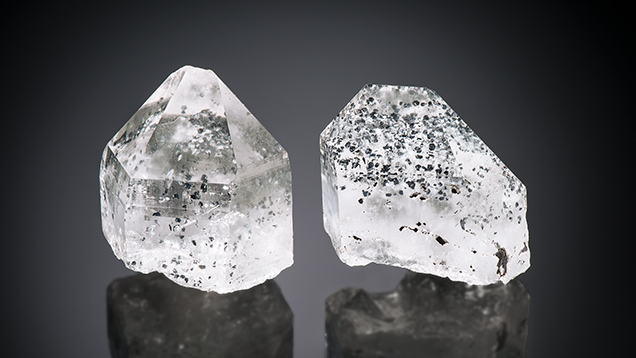
Quartz is the most abundant mineral found in the earth’s crust. When it forms as solid single crystals, it can serve as a transparent and durable host for a wide variety of mineral inclusions. The two crystals seen in figure 1 came from collector Terry Szenics (Massapequa, New York), who found them in 2004 as part of a very small discovery at the Confianza mine in the Coquimbo region of Chile.
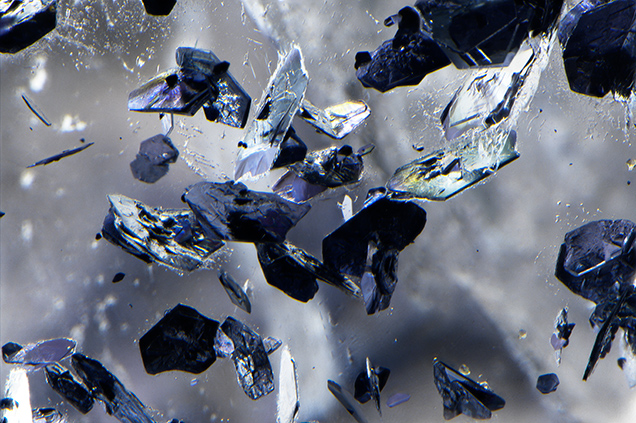
At a glance, the inclusions in the two crystals looked as though they might be hematite, a common iron oxide. However, laser Raman microspectrometry identified them as molybdenite (figure 2), a hexagonal molybdenum sulfide and a much more unusual inclusion than hematite. The inclusions were situated in the quartz crystals in the form of phantoms that developed through the deposition of the molybdenite on the surface of the quartz. The host then continued to grow, enveloping the molybdenite as inclusion planes tracing the form of the original quartz host.
Quartz is the most abundant mineral found in the earth’s crust. When it forms as solid single crystals, it can serve as a transparent and durable host for a wide variety of mineral inclusions. The two crystals seen in figure 1 came from collector Terry Szenics (Massapequa, New York), who found them in 2004 as part of a very small discovery at the Confianza mine in the Coquimbo region of Chile.
At a glance, the inclusions in the two crystals looked as though they might be hematite, a common iron oxide. However, laser Raman microspectrometry identified them as molybdenite (figure 2), a hexagonal molybdenum sulfide and a much more unusual inclusion than hematite. The inclusions were situated in the quartz crystals in the form of phantoms that developed through the deposition of the molybdenite on the surface of the quartz. The host then continued to grow, enveloping the molybdenite as inclusion planes tracing the form of the original quartz host.