

GIA’s Hong Kong laboratory recently received 26 yellow laboratory-grown diamonds, ranging from 1.03 ct to 2.32 ct with VVS to VS clarity. They were all color graded as Fancy Vivid yellow except for one that was Fancy Intense yellow. It had a very attractive yellow color with no other color components. As shown in figure 1, the diamonds were cut into different shapes: ovals, cushions, hearts, and a pear. These were undisclosed as laboratory-grown diamonds when submitted for examination. Examination confirmed that all were grown by high-pressure, high-temperature (HPHT).
Diamonds grown by the HPHT process have been commercially available since the mid-1990s (U.F.S. D’Haenens-Johansson et al., “Large colorless HPHT-grown synthetic gem diamonds from New Diamond Technology, Russia,” Fall 2015 G&G, pp. 260–279). To produce yellow diamonds, isolated nitrogen is incorporated into the crystal. As the growth processes continue to improve, consistent production of larger size and better color diamonds is now possible (Winter 2016 Lab Notes, p. 416). The submission of these 26 laboratory-grown diamonds, which possessed a similar intensity of yellow color, caught our attention.
Fourier-transform infrared spectroscopy confirmed that 25 of the samples were type Ib diamonds, with a sharp peak at 1344 cm–1 and a broader absorption at 1130 cm–1 and no detectable A-center. The concentration of isolated nitrogen was within 4–16 ppm. Only one sample with Fancy Intense color showed an additional 2800 cm–1 boron-related feature (3 ppb in B0 concentration) in two orientations besides 1344 and 1130 cm–1. This special sample was a mixed-type diamond. Since the concentration of isolated nitrogen determined the color of this diamond, it must be well controlled to produce an attractive, vivid yellow color.
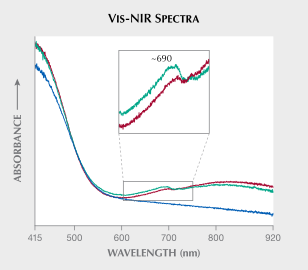
Ultraviolet/visible/near-infrared (UV-Vis-NIR) spectroscopy showed a very strong absorption by isolated nitrogen occurring in the ultraviolet range and extending into the visible range, creating a yellow hue. Among the 26 samples, 24 showed very similar Vis-NIR spectra, represented by the blue curve in figure 2. Two showed slightly different Vis-NIR spectra (the red and green curves in figure 2), with the additional absorption at ~690 nm indicating nickel-related defects (W. Wang et al., “Natural type Ia diamond with green-yellow color due to Ni-related defects,” Fall 2007 G&G, pp. 240–243).
Photoluminescence (PL) spectroscopy was conducted at liquid nitrogen temperature with several laser excitations. PL spectra features for these HPHT-grown diamonds were predominantly nitrogen-related defects. H3 was present in the 457 nm PL spectrum with varying intensities. Around half of the samples had moderate H3 intensity, and ~23% had strong H3. More than half showed H2 in the 830 PL spectrum. All these emission features were exceptionally sharp and consistent with HPHT growth with very low dislocations. Moreover, nitrogen vacancy centers (NV0, NV–) were present in the 514 nm spectrum. Approximately 73% of the samples showed an 882.7/884.4 nm doublet in 830 nm PL from the well-known nickel-related defect. (Two samples showed an extremely strong 883/884 nm doublet; these same two showed a 690 nm peak in the Vis-NIR spectrum.)
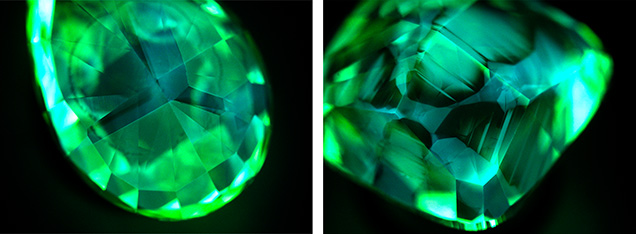
Fluorescence images collected using the DiamondView revealed a distinctive cuboctahedral growth pattern typical of HPHT-grown diamond (figure 3). The strong green fluorescence color observed was due to the presence of H3. This color is different from the weak green/yellow fluorescence of natural type Ib diamond. Green phosphorescence was also detected.
Microscopic examination with crossed polarizers revealed no strain patterns (anomalous birefringence) except for small strain fields around some metallic flux inclusions. Lack of strain indicates a very low dislocation density, which is also a characteristic of HPHT-grown diamonds. Magnification exposed the presence of color zoning with a banded structure. Also observed were some pinpoints and fractures.
All 26 stones were concluded as HPHT-grown diamonds with similar gemological properties. To consistently produce this attractive Fancy Vivid yellow color, isolated nitrogen concentration, temperature and pressure, and growth environment must be carefully controlled. This indicates that the manufacturer knew the growth parameters to produce these attractive yellow diamonds.
GIA’s Hong Kong laboratory recently received 26 yellow laboratory-grown diamonds, ranging from 1.03 ct to 2.32 ct with VVS to VS clarity. They were all color graded as Fancy Vivid yellow except for one that was Fancy Intense yellow. It had a very attractive yellow color with no other color components. As shown in figure 1, the diamonds were cut into different shapes: ovals, cushions, hearts, and a pear. These were undisclosed as laboratory-grown diamonds when submitted for examination. Examination confirmed that all were grown by high-pressure, high-temperature (HPHT).
Diamonds grown by the HPHT process have been commercially available since the mid-1990s (U.F.S. D’Haenens-Johansson et al., “Large colorless HPHT-grown synthetic gem diamonds from New Diamond Technology, Russia,” Fall 2015 G&G, pp. 260–279). To produce yellow diamonds, isolated nitrogen is incorporated into the crystal. As the growth processes continue to improve, consistent production of larger size and better color diamonds is now possible (Winter 2016 Lab Notes, p. 416). The submission of these 26 laboratory-grown diamonds, which possessed a similar intensity of yellow color, caught our attention.
Fourier-transform infrared spectroscopy confirmed that 25 of the samples were type Ib diamonds, with a sharp peak at 1344 cm–1 and a broader absorption at 1130 cm–1 and no detectable A-center. The concentration of isolated nitrogen was within 4–16 ppm. Only one sample with Fancy Intense color showed an additional 2800 cm–1 boron-related feature (3 ppb in B0 concentration) in two orientations besides 1344 and 1130 cm–1. This special sample was a mixed-type diamond. Since the concentration of isolated nitrogen determined the color of this diamond, it must be well controlled to produce an attractive, vivid yellow color.
Ultraviolet/visible/near-infrared (UV-Vis-NIR) spectroscopy showed a very strong absorption by isolated nitrogen occurring in the ultraviolet range and extending into the visible range, creating a yellow hue. Among the 26 samples, 24 showed very similar Vis-NIR spectra, represented by the blue curve in figure 2. Two showed slightly different Vis-NIR spectra (the red and green curves in figure 2), with the additional absorption at ~690 nm indicating nickel-related defects (W. Wang et al., “Natural type Ia diamond with green-yellow color due to Ni-related defects,” Fall 2007 G&G, pp. 240–243).
Photoluminescence (PL) spectroscopy was conducted at liquid nitrogen temperature with several laser excitations. PL spectra features for these HPHT-grown diamonds were predominantly nitrogen-related defects. H3 was present in the 457 nm PL spectrum with varying intensities. Around half of the samples had moderate H3 intensity, and ~23% had strong H3. More than half showed H2 in the 830 PL spectrum. All these emission features were exceptionally sharp and consistent with HPHT growth with very low dislocations. Moreover, nitrogen vacancy centers (NV0, NV–) were present in the 514 nm spectrum. Approximately 73% of the samples showed an 882.7/884.4 nm doublet in 830 nm PL from the well-known nickel-related defect. (Two samples showed an extremely strong 883/884 nm doublet; these same two showed a 690 nm peak in the Vis-NIR spectrum.)
Fluorescence images collected using the DiamondView revealed a distinctive cuboctahedral growth pattern typical of HPHT-grown diamond (figure 3). The strong green fluorescence color observed was due to the presence of H3. This color is different from the weak green/yellow fluorescence of natural type Ib diamond. Green phosphorescence was also detected.
Microscopic examination with crossed polarizers revealed no strain patterns (anomalous birefringence) except for small strain fields around some metallic flux inclusions. Lack of strain indicates a very low dislocation density, which is also a characteristic of HPHT-grown diamonds. Magnification exposed the presence of color zoning with a banded structure. Also observed were some pinpoints and fractures.
All 26 stones were concluded as HPHT-grown diamonds with similar gemological properties. To consistently produce this attractive Fancy Vivid yellow color, isolated nitrogen concentration, temperature and pressure, and growth environment must be carefully controlled. This indicates that the manufacturer knew the growth parameters to produce these attractive yellow diamonds.