
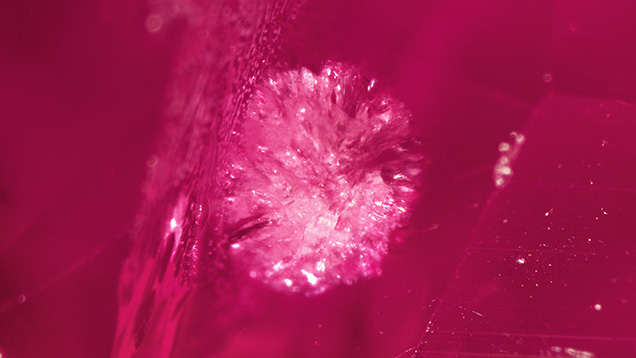
The author recently examined a 1.34 ct red stone with a three-dimensional radial inclusion resembling a sea urchin, or uni in Japanese (see above). The stone was identified as a heated ruby from Mong Hsu, Myanmar, based on trace element chemistry, chalky fluorescence under short-wave (254 nm) UV radiation, and the altered state of diagnostic inclusions (A.C. Palke et al., “Geographic origin determination of ruby,” Winter 2019 G&G, pp. 580–613). Mong Hsu rubies rarely contain such large crystals, indicating that this was an aggregate of tension fissures and not a crystal at all. These fissures likely formed when an isolated, relatively small inclusion expanded during heating. If an inclusion has a thermal expansion coefficient greater than that of corundum, fissures may form around the inclusion during heating, such as common discoidal decrepitation fissures. The fissures usually develop in the direction of maximum compression stress of the residual strain inside the ruby (e.g., T.L. Anderson, Fracture Mechanics: Fundamentals and Applications, Third Edition, CRC Press, 2005). In this case, the radial fissures developed almost isotropically in three dimensions, suggesting that the surroundings of the inclusion were in a quasi-hydrostatic pressure state with almost no differential stress. The unexpected local stress state in the ruby formed the fissure aggregates in this exciting and unusual shape.
Taku Okada is a staff gemologist at GIA in Tokyo.
The author recently examined a 1.34 ct red stone with a three-dimensional radial inclusion resembling a sea urchin, or uni in Japanese (see above). The stone was identified as a heated ruby from Mong Hsu, Myanmar, based on trace element chemistry, chalky fluorescence under short-wave (254 nm) UV radiation, and the altered state of diagnostic inclusions (A.C. Palke et al., “Geographic origin determination of ruby,” Winter 2019 G&G, pp. 580–613). Mong Hsu rubies rarely contain such large crystals, indicating that this was an aggregate of tension fissures and not a crystal at all. These fissures likely formed when an isolated, relatively small inclusion expanded during heating. If an inclusion has a thermal expansion coefficient greater than that of corundum, fissures may form around the inclusion during heating, such as common discoidal decrepitation fissures. The fissures usually develop in the direction of maximum compression stress of the residual strain inside the ruby (e.g., T.L. Anderson, Fracture Mechanics: Fundamentals and Applications, Third Edition, CRC Press, 2005). In this case, the radial fissures developed almost isotropically in three dimensions, suggesting that the surroundings of the inclusion were in a quasi-hydrostatic pressure state with almost no differential stress. The unexpected local stress state in the ruby formed the fissure aggregates in this exciting and unusual shape.
Taku Okada is a staff gemologist at GIA in Tokyo.