
While examining a 59.32 ct transparent colorless freeform shield-shaped step cut from Kara-Oba in the Karagandy Province of Kazakhstan, the authors noticed something curious. Using optical microscopy, X-ray powder diffraction, and standard gemological testing, we identified the sample as transparent rock crystal quartz and its eye-visible inclusions as the isometric nickel arsenic sulfide, gersdorffite.
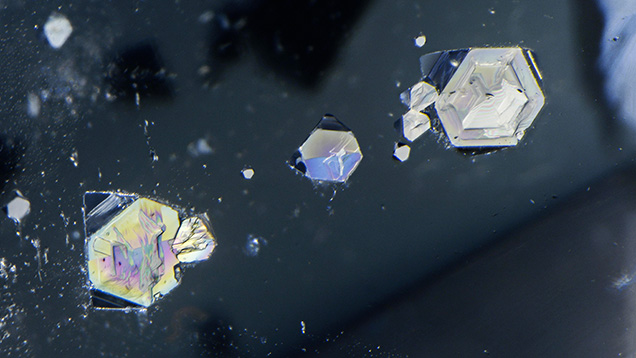
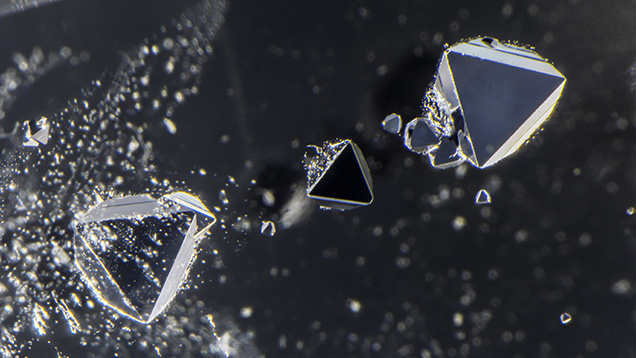
What made this quartz subject particularly interesting to study was the euhedral morphology of the opaque, silvery gray, highly reflective, cubically modified octahedral crystals of gersdorffite. From one side of the quartz host, the inclusions with octahedral faces reflected as triangles (figure 1). Through the opposite side of the host, the faces of the very same inclusions appeared as hexagons (figure 2). In this sample, the perceived shape of the inclusions—triangles or hexagons—depends entirely on viewing direction.
John I. Koivula is analytical microscopist, and Nathan Renfro is senior manager of colored stone identification, at GIA in Carlsbad, California.
While examining a 59.32 ct transparent colorless freeform shield-shaped step cut from Kara-Oba in the Karagandy Province of Kazakhstan, the authors noticed something curious. Using optical microscopy, X-ray powder diffraction, and standard gemological testing, we identified the sample as transparent rock crystal quartz and its eye-visible inclusions as the isometric nickel arsenic sulfide, gersdorffite.
What made this quartz subject particularly interesting to study was the euhedral morphology of the opaque, silvery gray, highly reflective, cubically modified octahedral crystals of gersdorffite. From one side of the quartz host, the inclusions with octahedral faces reflected as triangles (figure 1). Through the opposite side of the host, the faces of the very same inclusions appeared as hexagons (figure 2). In this sample, the perceived shape of the inclusions—triangles or hexagons—depends entirely on viewing direction.
John I. Koivula is analytical microscopist, and Nathan Renfro is senior manager of colored stone identification, at GIA in Carlsbad, California.