
Pearls with low heft are always of interest as they usually exhibit a large size relative to their weight, and it is often difficult to ascertain whether they are hollow or have been filled. GIA’s Mumbai laboratory recently received for identification a dark gray and brown semi-baroque pearl weighing 2.89 ct and measuring 11.13 × 10.47 × 10.16 mm (figure 1). Chemical analysis using energy-dispersive X-ray fluorescence determined no measurable manganese but a strontium content of 934 ppm, indicating a saltwater origin. Under long-wave (365 nm) and short-wave (254 nm) ultraviolet radiation, the pearl was inert.
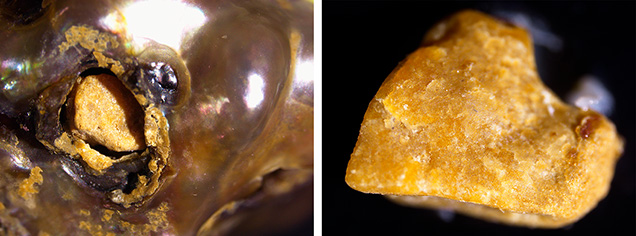
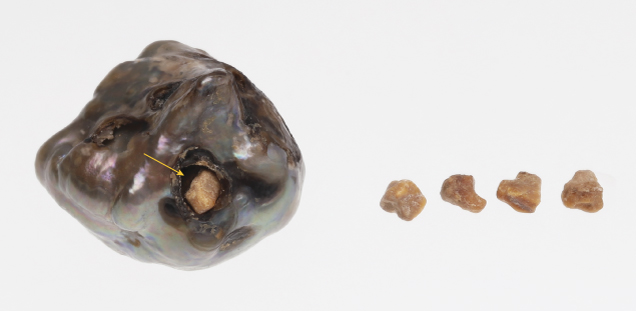
The pearl contained a surface opening measuring approximately 2.46 × 1.94 mm, forming a window into the pearl where light brown fragments could be observed (figure 2, left). During transport and through the course of testing, four angular-shaped fragments with slightly rounded edges emerged from the opening, each weighing approximately 0.01 ct (figure 2, right), suggesting they had fractured within the pearl.
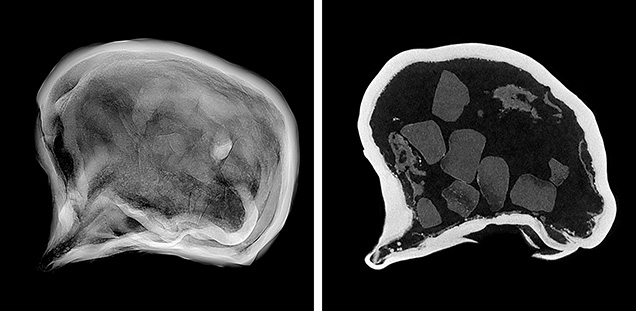
Real-time X-ray microradiography (RTX) revealed a large void with a dark gray radiolucent material inside, surrounded by a lighter gray outer rim of nacre (figure 3, left). The structure was more apparent using X-ray computed microtomography (μ-CT) imaging (figure 3, right), where many radiolucent fragments were visible inside the large void.
Further microscopic observation suggested that the dislodged fragments were made of an organic-rich resinous substance that appeared brownish yellow, similar to the fragments inside the opening and the organic material around it. However, due to the fragile nature of the pearl, Raman spectroscopy to conclusively identify this material was not possible.
Although some hollow pearls are intentionally filled with foreign materials to increase their weight and durability (Summer 2019 Lab Notes, pp. 251–254), the material inside this pearl appeared to be an organic-rich substance that naturally formed within the pearl. In addition, the void’s shape followed the outline of the pearl, which has been previously observed in natural pearls (“Pearls with unpleasant odors,” GIA Research News, March 23, 2009). The opening on the pearl’s surface provided a rare glimpse into its natural filling, allowing the observation of organic-rich material as it became dislodged—a fascinating and significant occurrence.
Nishka Vaz is a senior gemologist at GIA in Mumbai. Abeer Al-Alawi is a consultant to GIA.
Pearls with low heft are always of interest as they usually exhibit a large size relative to their weight, and it is often difficult to ascertain whether they are hollow or have been filled. GIA’s Mumbai laboratory recently received for identification a dark gray and brown semi-baroque pearl weighing 2.89 ct and measuring 11.13 × 10.47 × 10.16 mm (figure 1). Chemical analysis using energy-dispersive X-ray fluorescence determined no measurable manganese but a strontium content of 934 ppm, indicating a saltwater origin. Under long-wave (365 nm) and short-wave (254 nm) ultraviolet radiation, the pearl was inert.
The pearl contained a surface opening measuring approximately 2.46 × 1.94 mm, forming a window into the pearl where light brown fragments could be observed (figure 2, left). During transport and through the course of testing, four angular-shaped fragments with slightly rounded edges emerged from the opening, each weighing approximately 0.01 ct (figure 2, right), suggesting they had fractured within the pearl.
Real-time X-ray microradiography (RTX) revealed a large void with a dark gray radiolucent material inside, surrounded by a lighter gray outer rim of nacre (figure 3, left). The structure was more apparent using X-ray computed microtomography (μ-CT) imaging (figure 3, right), where many radiolucent fragments were visible inside the large void.
Further microscopic observation suggested that the dislodged fragments were made of an organic-rich resinous substance that appeared brownish yellow, similar to the fragments inside the opening and the organic material around it. However, due to the fragile nature of the pearl, Raman spectroscopy to conclusively identify this material was not possible.
Although some hollow pearls are intentionally filled with foreign materials to increase their weight and durability (Summer 2019 Lab Notes, pp. 251–254), the material inside this pearl appeared to be an organic-rich substance that naturally formed within the pearl. In addition, the void’s shape followed the outline of the pearl, which has been previously observed in natural pearls (“Pearls with unpleasant odors,” GIA Research News, March 23, 2009). The opening on the pearl’s surface provided a rare glimpse into its natural filling, allowing the observation of organic-rich material as it became dislodged—a fascinating and significant occurrence.
Nishka Vaz is a senior gemologist at GIA in Mumbai. Abeer Al-Alawi is a consultant to GIA.