
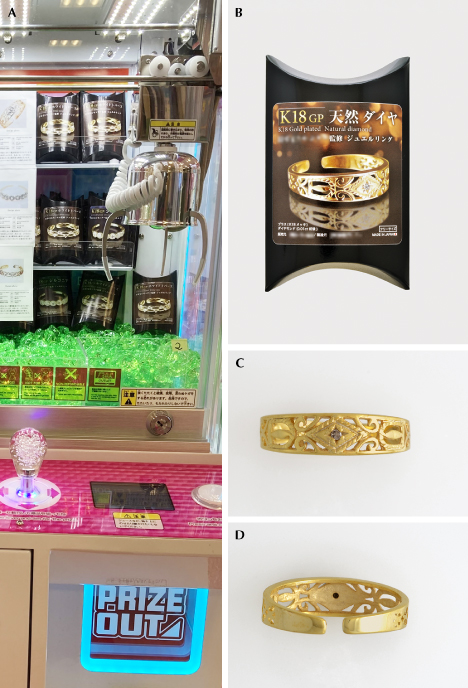
In Tokyo, the author recently had the opportunity to play a coin-operated claw game (figure 1A) for 100 yen (approximately US$0.70). The prizes offered were gold-colored rings set with natural diamond, cubic zirconia, or white topaz. After 24 attempts, the ring shown in figure 1 (C and D) was captured. The label on the box noted the following: adjustable-size brass ring with 18K gold plating, natural diamond of approximately 0.01 ct, made in Japan, along with the names of the manufacturer and distributor (figure 1B).
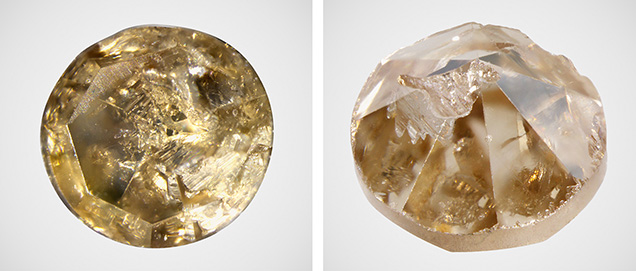
The ring itself, weighing 1.28 g, had a simple open-band design, with a diameter of about 18 mm and a width ranging from 5.6 to 2.4 mm. For closer inspection, the stone was removed, which damaged the ring’s prongs and surrounding areas of metal. The small melee stone weighed 0.0119 ct—consistent with the “approximately 0.01 ct” packaging claim—and measured around 1.37–1.38 mm in diameter and 0.88 mm in depth (figure 2). Internal fractures were observed in the brownish orange-yellow stone, which exhibited poor clarity. The crown featured a table surrounded by eight facets, while the pavilion also displayed eight facets, suggesting a single-cut stone, with visible chips on the girdle and culet.
Standard gemological testing, including photoluminescence and ultraviolet/visible spectroscopy, confirmed that the stone was indeed a natural untreated diamond. Energy dispersive X-ray fluorescence spectroscopy revealed that the metal was a gold-plated alloy of copper, zinc, and nickel, matching the gold-plated brass description on the package.
Interestingly, the promotional poster inside the machine described the diamonds as “transparent” and “colorless,” which was clearly not the case with this ring. The tested sample featured on the poster may have been colorless, but colored diamonds could have been mixed in during mass production. Japanese regulations limit the market value of claw machine prizes to around 1,000 yen (approximately US$7) (Summer 2024 GNI, pp. 256–257), making it impossible for each prize to include a gem report confirming its features.
In a previous attempt with another machine, the author won a 0.06 ct “yellow diamond” for about 800 yen (approximately US$5.60). Testing indicated it was a treated, artificially irradiated, natural brownish greenish yellow diamond. Though a prize may be labeled simply as “diamond,” considering the possibility of treatments is advised.
Mari Sasaki is an analytics technician at GIA in Tokyo.
In Tokyo, the author recently had the opportunity to play a coin-operated claw game (figure 1A) for 100 yen (approximately US$0.70). The prizes offered were gold-colored rings set with natural diamond, cubic zirconia, or white topaz. After 24 attempts, the ring shown in figure 1 (C and D) was captured. The label on the box noted the following: adjustable-size brass ring with 18K gold plating, natural diamond of approximately 0.01 ct, made in Japan, along with the names of the manufacturer and distributor (figure 1B).
The ring itself, weighing 1.28 g, had a simple open-band design, with a diameter of about 18 mm and a width ranging from 5.6 to 2.4 mm. For closer inspection, the stone was removed, which damaged the ring’s prongs and surrounding areas of metal. The small melee stone weighed 0.0119 ct—consistent with the “approximately 0.01 ct” packaging claim—and measured around 1.37–1.38 mm in diameter and 0.88 mm in depth (figure 2). Internal fractures were observed in the brownish orange-yellow stone, which exhibited poor clarity. The crown featured a table surrounded by eight facets, while the pavilion also displayed eight facets, suggesting a single-cut stone, with visible chips on the girdle and culet.
Standard gemological testing, including photoluminescence and ultraviolet/visible spectroscopy, confirmed that the stone was indeed a natural untreated diamond. Energy dispersive X-ray fluorescence spectroscopy revealed that the metal was a gold-plated alloy of copper, zinc, and nickel, matching the gold-plated brass description on the package.
Interestingly, the promotional poster inside the machine described the diamonds as “transparent” and “colorless,” which was clearly not the case with this ring. The tested sample featured on the poster may have been colorless, but colored diamonds could have been mixed in during mass production. Japanese regulations limit the market value of claw machine prizes to around 1,000 yen (approximately US$7) (Summer 2024 GNI, pp. 256–257), making it impossible for each prize to include a gem report confirming its features.
In a previous attempt with another machine, the author won a 0.06 ct “yellow diamond” for about 800 yen (approximately US$5.60). Testing indicated it was a treated, artificially irradiated, natural brownish greenish yellow diamond. Though a prize may be labeled simply as “diamond,” considering the possibility of treatments is advised.
Mari Sasaki is an analytics technician at GIA in Tokyo.