
Japan began producing pearls in the early 1900s with the successful cultivation of akoya pearls, which are deeply intertwined with the nation’s customs. Once used in engagement rings in Japan, akoya pearls remain a jewelry staple for weddings, funerals, and other important occasions. Combining entertainment and product promotion, akoya pearl jewelry began showing up as a prize in Japanese arcades in 2019.
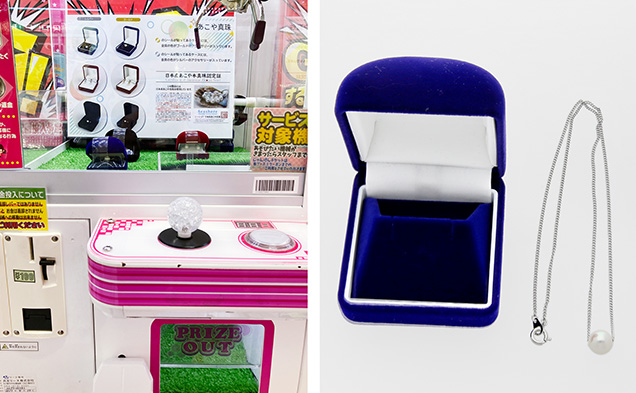
Author MS recently had the opportunity to play a coin-operated “claw” game (figure 1, left) for 100 yen (approximately US$0.65). The prizes offered included earrings, one-size-fits-all unclosed rings, and pendants, all containing akoya pearls. Gold or silver stickers on top of each box indicated the jewelry metal color. After 14 attempts, the author captured the prize shown in figure 1 (right): a pearl set in a 40 cm white metal necklace weighing 2.20 g, contained in a blue jewelry box with a silver sticker but no metal information. According to metal testing by energy-dispersive X-ray fluorescence (EDXRF) spectroscopy, the metal was composed mainly of copper, zinc, and nickel, suggesting an alloy of these metals.


The 8.20 × 8.01 × 7.92 mm pearl had a white bodycolor with pink overtone and was fully drilled with an approximately 1 mm drill hole. The bead was observed through the drill hole. A bumpy surface near the drill hole (figure 2, left) resulted in the pearl’s semi-baroque shape. Nacre and terrace structures were observed on the surface (figure 2, right). The pearl’s saltwater chemistry was confirmed by EDXRF. Its luster was excellent, and the surface was clean. The pearl fluoresced weak bluish yellow under short-wave UV and moderate bluish yellow under long-wave UV. The fluorescence feature indicates that the pearl had been subjected to a routine set of traditional processes for improving the appearance of cultured pearls (R. Shor, “From single source to global free market: the transformation of the cultured pearl industry,” Fall 2007 G&G, pp. 200–226). The nacre thickness was measured by optical coherent tomography (OCT), a nondestructive technique for cross-sectional imaging of various materials, including pearl and jade (J. Liu et al., “Pearl thickness measurements from optical coherence tomography images,” Applied Mechanics and Materials, Vol. 421, 2013, pp. 415–420; S. Chang et al., “Detection and analysis of jade material using optical coherence tomography,” Photonics North 2010, Vol. 7750, 2010, SPIE). The center of the pearl was round with a homogeneous nacre thickness of 0.35 mm ± 0.01 mm (figure 3, left). Toward the drill hole, the thickness was uneven, with some bumpy areas in the thinnest part measuring ~0.23 mm (figure 3, right). Although the quality was very good, the shape was not round and the size was less than 8 mm, which is probably why this pearl became a prize in the claw game.
In addition to arcade games, toy capsule vending machines in commercial locations throughout Japan offer jewelry prizes such as earrings, rings, and pendants using akoya pearls, rough and faceted colored stones, and even diamonds. These machines charge anywhere from 500 to 1,000 yen (approximately US$3.25–$6.50) per try. While claw games allow players to attempt to win the prize of their choice, often unsuccessfully, toy capsule machines dispense a prize every time but by luck of the draw. According to Japanese regulations, the value limit of prizes in crane games is about one thousand yen, so expensive jewelry is not available.
This may be an interesting new outlet for akoya pearls. Those who might not enter a jewelry store can still win a piece of pearl jewelry for themselves, or as small gifts for family and friends.
Japan began producing pearls in the early 1900s with the successful cultivation of akoya pearls, which are deeply intertwined with the nation’s customs. Once used in engagement rings in Japan, akoya pearls remain a jewelry staple for weddings, funerals, and other important occasions. Combining entertainment and product promotion, akoya pearl jewelry began showing up as a prize in Japanese arcades in 2019.
Author MS recently had the opportunity to play a coin-operated “claw” game (figure 1, left) for 100 yen (approximately US$0.65). The prizes offered included earrings, one-size-fits-all unclosed rings, and pendants, all containing akoya pearls. Gold or silver stickers on top of each box indicated the jewelry metal color. After 14 attempts, the author captured the prize shown in figure 1 (right): a pearl set in a 40 cm white metal necklace weighing 2.20 g, contained in a blue jewelry box with a silver sticker but no metal information. According to metal testing by energy-dispersive X-ray fluorescence (EDXRF) spectroscopy, the metal was composed mainly of copper, zinc, and nickel, suggesting an alloy of these metals.
The 8.20 × 8.01 × 7.92 mm pearl had a white bodycolor with pink overtone and was fully drilled with an approximately 1 mm drill hole. The bead was observed through the drill hole. A bumpy surface near the drill hole (figure 2, left) resulted in the pearl’s semi-baroque shape. Nacre and terrace structures were observed on the surface (figure 2, right). The pearl’s saltwater chemistry was confirmed by EDXRF. Its luster was excellent, and the surface was clean. The pearl fluoresced weak bluish yellow under short-wave UV and moderate bluish yellow under long-wave UV. The fluorescence feature indicates that the pearl had been subjected to a routine set of traditional processes for improving the appearance of cultured pearls (R. Shor, “From single source to global free market: the transformation of the cultured pearl industry,” Fall 2007 G&G, pp. 200–226). The nacre thickness was measured by optical coherent tomography (OCT), a nondestructive technique for cross-sectional imaging of various materials, including pearl and jade (J. Liu et al., “Pearl thickness measurements from optical coherence tomography images,” Applied Mechanics and Materials, Vol. 421, 2013, pp. 415–420; S. Chang et al., “Detection and analysis of jade material using optical coherence tomography,” Photonics North 2010, Vol. 7750, 2010, SPIE). The center of the pearl was round with a homogeneous nacre thickness of 0.35 mm ± 0.01 mm (figure 3, left). Toward the drill hole, the thickness was uneven, with some bumpy areas in the thinnest part measuring ~0.23 mm (figure 3, right). Although the quality was very good, the shape was not round and the size was less than 8 mm, which is probably why this pearl became a prize in the claw game.
In addition to arcade games, toy capsule vending machines in commercial locations throughout Japan offer jewelry prizes such as earrings, rings, and pendants using akoya pearls, rough and faceted colored stones, and even diamonds. These machines charge anywhere from 500 to 1,000 yen (approximately US$3.25–$6.50) per try. While claw games allow players to attempt to win the prize of their choice, often unsuccessfully, toy capsule machines dispense a prize every time but by luck of the draw. According to Japanese regulations, the value limit of prizes in crane games is about one thousand yen, so expensive jewelry is not available.
This may be an interesting new outlet for akoya pearls. Those who might not enter a jewelry store can still win a piece of pearl jewelry for themselves, or as small gifts for family and friends.