

Since entering the market in the late 1980s, Paraíba tourmaline has been sought after for its electric blue-green tone. A product called “Paraíba matrix” or “Paraíba in quartz” emerged about three years ago. Two examples of this material, pear-shaped cabochons weighing 4.23 and 3.67 ct (samples PB1 and PB2, respectively), were purchased from the September 2023 Hong Kong Jewellery and Gem Fair (figure 1). The blue minerals in these samples showed an attractive neon-blue color with low clarity surrounded by opaque or transparent white minerals. Dark red minerals were also scattered in the matrix.
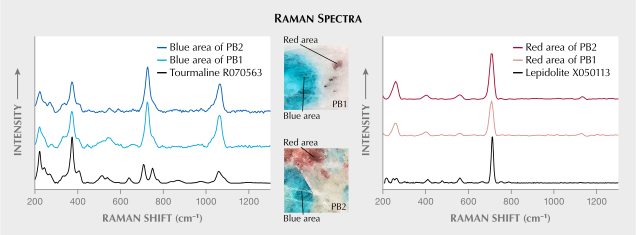
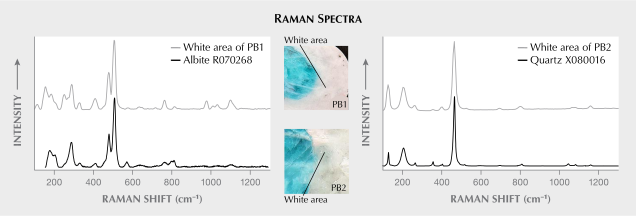
Raman spectroscopy identified the blue mineral as tourmaline (figure 2, left), and X-ray fluorescence (XRF) spectroscopy showed that it contained copper and manganese. These results, combined with the material’s bright neon-blue color, confirmed the blue mineral as Paraíba tourmaline. In both samples, the Paraíba tourmaline displayed color banding, with bluish white cores surrounded by neon-blue rims. The Raman spectra of the dark red mineral in both samples were consistent with that of lepidolite in the RRUFF database (figure 2, right). The Raman spectrum of the opaque white part of PB1 was consistent with albite (figure 3, left), while that of the transparent white part of PB2 was consistent with quartz (figure 3, right).
Based on the Raman and XRF tests of both samples, the “Paraíba matrix” was mainly composed of blue Paraíba tourmaline, dark red lepidolite, opaque white albite, and transparent white quartz. Thus, the white matrix minerals were not all quartz, as suggested by the trade name “Paraíba in quartz.” The Paraíba tourmalines in these samples cannot be cut and polished into faceted gemstones due to their low clarity. Cutting and polishing these unique pieces into cabochons can provide more affordable options for fashion jewelry designers and customers.
Since entering the market in the late 1980s, Paraíba tourmaline has been sought after for its electric blue-green tone. A product called “Paraíba matrix” or “Paraíba in quartz” emerged about three years ago. Two examples of this material, pear-shaped cabochons weighing 4.23 and 3.67 ct (samples PB1 and PB2, respectively), were purchased from the September 2023 Hong Kong Jewellery and Gem Fair (figure 1). The blue minerals in these samples showed an attractive neon-blue color with low clarity surrounded by opaque or transparent white minerals. Dark red minerals were also scattered in the matrix.
Raman spectroscopy identified the blue mineral as tourmaline (figure 2, left), and X-ray fluorescence (XRF) spectroscopy showed that it contained copper and manganese. These results, combined with the material’s bright neon-blue color, confirmed the blue mineral as Paraíba tourmaline. In both samples, the Paraíba tourmaline displayed color banding, with bluish white cores surrounded by neon-blue rims. The Raman spectra of the dark red mineral in both samples were consistent with that of lepidolite in the RRUFF database (figure 2, right). The Raman spectrum of the opaque white part of PB1 was consistent with albite (figure 3, left), while that of the transparent white part of PB2 was consistent with quartz (figure 3, right).
Based on the Raman and XRF tests of both samples, the “Paraíba matrix” was mainly composed of blue Paraíba tourmaline, dark red lepidolite, opaque white albite, and transparent white quartz. Thus, the white matrix minerals were not all quartz, as suggested by the trade name “Paraíba in quartz.” The Paraíba tourmalines in these samples cannot be cut and polished into faceted gemstones due to their low clarity. Cutting and polishing these unique pieces into cabochons can provide more affordable options for fashion jewelry designers and customers.