
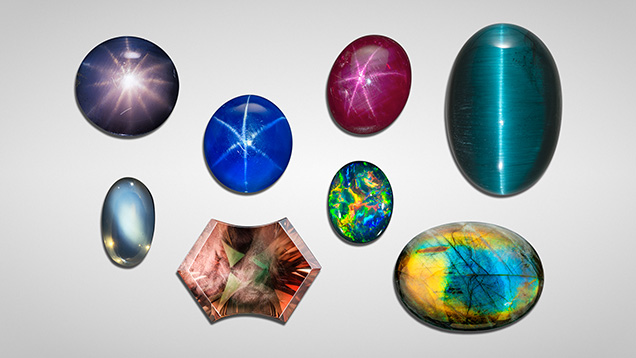
Phenomenal gemstones are gems that display unique optical effects, such as iridescence and asterism. Some gems, such as opal, moonstone and sunstone, are valued primarily for their phenomena. Other gemstones, such as sapphires, rubies and emeralds, are valued primarily for their color, but occasionally have phenomena, such as asterism and chatoyancy (cat’s eye effect), which can add visual interest to the stone.
Many gemstone phenomena are caused by microscopic textures and inclusions within the gems that scatter, reflect or diffract light. Other optical effects, like color-change, are caused by different factors. In this article, we’ll focus on phenomena produced by these tiny internal structures and explain how they work.
Navigate to:
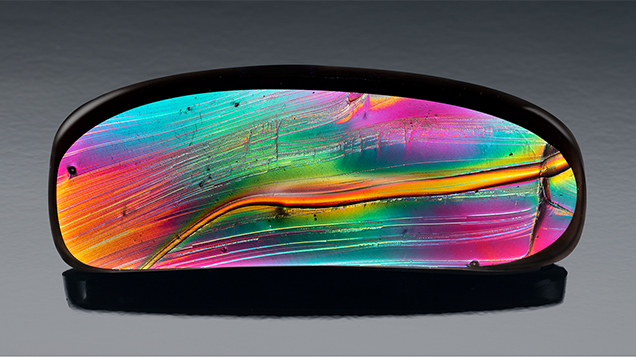
1. IRIDESCENCE
Iridescence is an umbrella term for many phenomena. Different types of iridescence include: play-of-color, labradorescence and orient.
What It Looks Like:
Iridescence is a rainbow-like shimmer or glow that floats on the surface or just below the surface of a gem, creating a shifting play of color as the stone moves.
It often resembles the colorful sheen seen on soap bubbles, oil slicks, peacock feathers or butterfly wings. The effect can range from subtle pastel sheens to intense, metallic rainbows depending on the material.
How It Works:
Iridescence is caused by light interference. When light hits a gemstone that contains thin, layered internal structures—such as platelets, fissures or alternating layers of different minerals—the light waves bounce back, overlapping and interfering with each other as they do. Some wavelengths (colors) reinforce each other and become more intense, while others cancel out. This process, known as thin-film interference, results in the shifting, rainbow colors seen in iridescent stones.
- The exact colors depend on the thickness and spacing of the layers.
- The effect is often strongest when viewed at certain angles.
Why It Matters:
Iridescence adds a captivating, ever-changing quality to gemstones and makes each gemstone unique. No two gems ever look exactly alike—and even the same gem appears different from different angles. For collectors and designers, it offers an opportunity to work with dynamic stones that appear "alive" with color.
Examples of Iridescent Materials:
- Ammolite: An organic gem formed from fossilized ammonite shells, known for intense, multi-color iridescence.
- Fire Obsidian: A rare variety of obsidian with thin layers that create a brilliant, fiery iridescent sheen.
- Mother of Pearl (Nacre): The inner lining of mollusk shells that has a soft, pearly luster and iridescence due to its layered structure.
- Rainbow Garnet: A rare garnet variety (usually from Mexico or Japan) with a metallic rainbow sheen caused by micro-layered crystal structures.
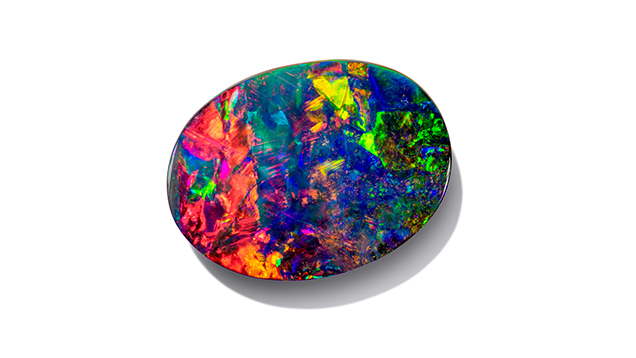
2. PLAY-OF-COLOR
What It Looks Like:
Play-of-color is an optical phenomenon most well-known in precious opal, where bright flashes of spectral colors—like red, green, blue, orange and violet—appear to dance across the stone as it’s moved or as the light source changes. This phenomenon is a form of iridescence producing different colors as the stone is moved. This effect gives opal a dynamic, almost magical quality.
The most highly prized opals are those that display the full spectrum of colors in bold, well-defined patterns. Red is typically the rarest and most valuable color, especially when it appears alongside other hues.
How It Works:
Play-of-color in opal is caused by its internal structure. Precious opal is composed of tiny, uniform silica spheres, tightly packed in a regular, three-dimensional grid. When light enters the stone, it bends and diffracts around these spheres—a process called diffraction—which separates white light into its component colors.
The size and arrangement of the spheres determine which colors are visible, how intense they are, and how they move as the stone is viewed from different angles. Smaller spheres produce blue and violet flashes. Larger spheres produce red, orange and green hues (rarer and more valuable).
Why It Matters:
Play-of-color is the defining feature of precious opal and its primary value factor. No two opals are exactly alike—each one displays a unique pattern and color combination, making it one of the most individualized gemstones. The visual effect gives the impression of movement and life, setting opals apart from all other gems. Opals without this effect are called common opal or potch opal.
Examples of Precious Opal:
- Black Opal: The rarest and most valuable type, with a dark body color that enhances play-of-color.
- Crystal Opal: Transparent to semi-transparent opal with vivid, glowing play-of-color that appears to float inside the gem.
- White Opal (or Light Opal): Has a pale, milky body tone with softer but still vibrant color play.
- Fire Opal: Typically orange to red body color. Some fire opals exhibit play-of-color and are considered precious opal, while others do not.
- Boulder Opal: Attached to ironstone rock matrix. The color play appears in thin seams or patches and can be vivid and striking due to the dark backing.
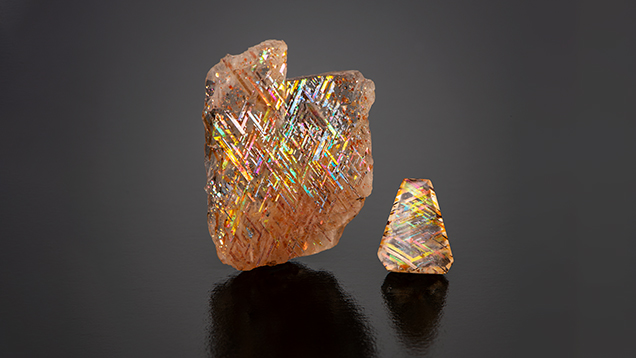
3. AVENTURESCENCE (GLITTERY SPARKLES)
What It Looks Like:
Aventurescence appears as glittering flashes that seem to sparkle inside the gem when it's moved under the light. These sparkles are often golden, coppery or silvery. This phenomenon is most well-known in sunstone, a variety of feldspar.
How It Works:
This effect is caused by light reflecting off small, flat inclusions inside the stone—usually metallic minerals like copper, hematite or goethite. The key is that these inclusions are separate and distinct, so the sparkles appear individually rather than as a solid glow. As the stone turns, light hits different surfaces, creating a brilliant sparkle.
Why It Matters:
Aventurescence adds a lively, playful, magical quality to gemstones. It brings them to life with a shimmer that catches the eye and adds depth to their beauty.
Examples:
- Goldstone (synthetic): A man-made glass with copper inclusions that sparkles constantly, no matter the angle.
- Oregon Sunstone: Displays aventurescent schiller due to aligned copper inclusions that produce strong flashes at certain angles.
- Rainbow Lattice Sunstone: A rare feldspar from Australia containing inclusions of magnetite or hematite. It can display an iridescent aventurescence from these reflective particles.
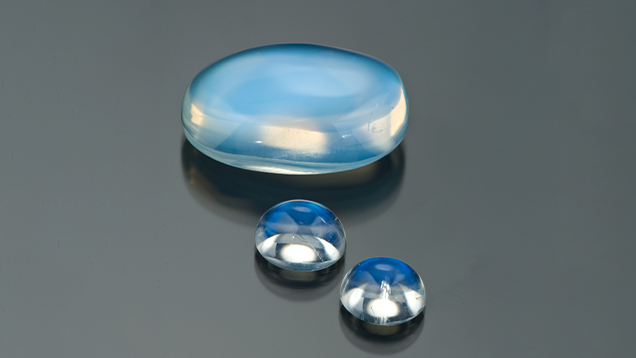
4. ADULARESCENCE (SOFT GLOW LIKE MOONLIGHT)
What It Looks Like
Adularescence appears as a soft, glowing sheen that seems to float just beneath the surface of the gemstone—like moonlight trapped in stone. As you turn the gem, the light appears to move or shimmer from within, creating a dreamy, ethereal effect. Adularescence is the defining feature of moonstone.
How It Works:
This optical phenomenon occurs due to the unique internal structure of the stone. Moonstones are made up of alternating layers of orthoclase and albite feldspar. When light enters the gem, it scatters between these microscopic layers, causing interference and producing that characteristic glowing sheen. The thinner and more uniform the layers, the more intense and beautiful the adularescence.
Why It Matters:
Adularescence is what gives moonstones their signature charm—a soft, romantic glow that has made them prized for centuries. This visual effect evokes feelings of mystery and intuition, making moonstones a favorite in both historical and contemporary jewelry.
Examples:
- Moonstone (Orthoclase Feldspar): The classic example of adularescence, usually found in pale, translucent stones that display a soft, glowing sheen.
5. LABRADORESCENCE (BROAD FLASHES OF COLOR)
What It Looks Like:
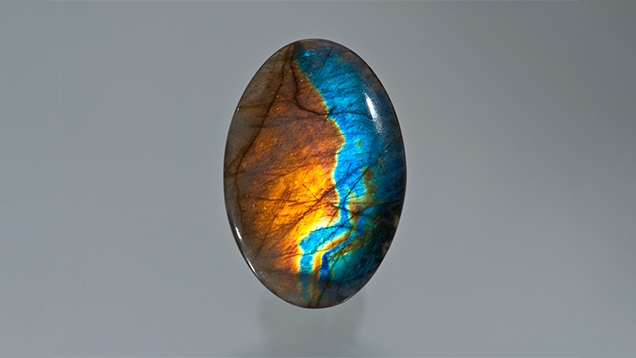
Labradorescence is a mesmerizing optical effect that appears as intense flashes of iridescent color—most commonly blue, but also green, gold, orange and even violet—that dance across the surface of the gem as it's moved in the light. The colors shimmer against a typically dark gray or black background and have a glowing, almost holographic quality. This striking display is one of the defining features of labradorite and its more vibrant cousin, spectrolite.
How It Works:
This phenomenon is caused by light interference reflecting off thin, internal lamellar (layered) structures within the crystal. These layers form during the cooling process of the mineral and are extremely thin—just the right size to scatter and reflect specific wavelengths of light. As light enters the stone, it hits these layers at different angles, and the result is a vibrant, shifting play of color that seems to change with every movement.
Why It Matters:
Labradorescence is what gives labradorite its dramatic and distinct appearance. Unlike the soft glow of moonstone, this effect is bold and energetic, making labradorite an ideal choice for bold, statement jewelry and rugged pieces. The ever-changing flashes of color evoke a sense of mystery and transformation.
Examples:
- Labradorite: The most well-known stone to exhibit labradorescence, typically found in shades of gray to black with flashes of blue or green, though other colors can occur.
- Spectrolite: A rare and highly prized variety of labradorite from Finland, known for its rich, full-spectrum colors and stronger labradorescence. It often displays multiple colors at once and is considered the most vivid and colorful example of this effect.
- “Rainbow Moonstone”: A variety of labradorite with transparency. Despite its name, it is not strictly considered a moonstone species.
6. OVERTONE AND ORIENT (FLOATING SECONDARY COLOR IN PEARLS)
What It Looks Like:
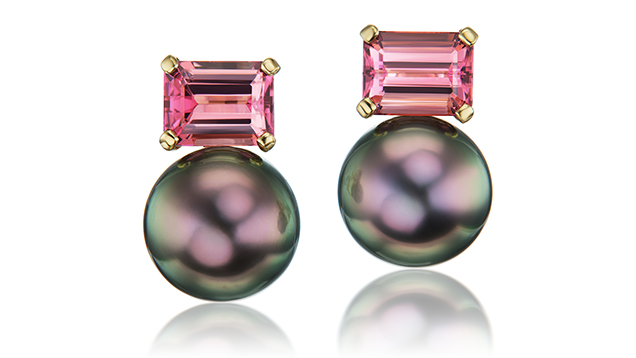
Overtone is a noticeable, translucent wash of color that appears to float over a nacreous pearl’s main body color. For example, a white pearl may have a pink or faint green overtone. The overtone doesn’t replace the body color—it enhances it, giving the pearl a more layered, multidimensional look.
Orient is an iridescent display of two or more overtone colors—often a rainbow-like effect—seen on the surface of a pearl. It is often described as a delicate rainbow-like glow that changes with light angle and the movement of the pearl and can resemble the shifting colors seen in a soap bubble or oil slick.
How It Works:
Overtone and orient are caused by light interference as light reflects off the many thin, transparent layers of nacre that make up the pearl. These microscopic layers bend and scatter light, creating a soft, luminous tint on top of the base color.
The thickness, uniformity and arrangement of nacre layers influence and determine the intensity and range of colors visible on the pearl.
Why It Matters:
Overtone and orient give a vibrant, rich and dynamic appearance to pearls, making each one truly one-of-a-kind. Jewelers and collectors often seek pearls with harmonious or rare overtones. Body color and overtone are key factors in grading and pricing.
The trade has even invented terms for certain popular and desirable combinations of body colors and overtone. For example, “peacock” Tahitians refer to Tahitian pearls with green body color and pink overtone.
Examples:
- Akoya Pearls: Are known for their classic white or cream body colors, often enhanced by a bright, shimmering overlay color of pink overtone or a combination of pink and green.
- South Sea Pearls: Typically white, silver or golden with orient, pink or green overtones. Some golden South Sea pearls from Myanmar (formerly Burma)—marketed as “rainbow gold”—are known for having strong orient.
- Tahitian Pearls: Displaying the broadest range of body colors and overtones, they are renowned for their naturally dark body colors with pink or green overtone, as well as orient.
- Freshwater Pearls: Come in a wide range of body colors and overtones, including pink, purple, orange, violet or green. They can display the widest range of orient colors within the same pearl.
- Baroque Pearls: Are more likely to have a pronounced orient because their irregular, non-spherical shapes create more varied surfaces for light to interact with, producing a more complex and colorful shimmer than is typically seen on smooth symmetrical pearls.
7. CHATOYANCY (“CAT’S-EYE”)
What It Looks Like:
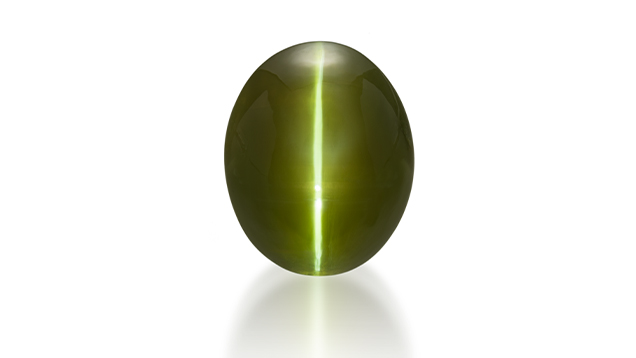
Chatoyancy, also known as the “cat’s-eye” effect, is an optical phenomenon where a bright, narrow band of light appears to glide across the surface of a gemstone as it’s moved—resembling the slit-shaped eye of a cat. This sharp, luminous line typically runs parallel to the gem’s long axis and creates a striking sense of depth and motion, captivating the viewer with its dynamic glow.
How It Works:
Chatoyancy results from light reflecting off aligned needle-like inclusions within the stone—think of light running off a spool of silk. These internal structures act like tiny mirrors, reflecting light in a focused band. To best display chatoyancy, the gem is usually polished into a cabochon (with a domed, rounded top and a flat back), oriented so the needle-like inclusions run perpendicular to the light source, allowing the light to reflect in a sharp line.
Why It Matters:
The cat’s-eye effect adds dynamic movement to gemstones, making them visually striking and unique. This phenomenon is highly prized in fine jewelry. In particular, cat’s-eye chrysoberyl is considered the most valuable and sought-after gem exhibiting chatoyancy due to its sharp, intense eye and rarity. It is highly popular in men’s jewelry.
Examples:
- Chrysoberyl (“cat’s-eye” variety): The most famous and valuable chatoyant gem, prized for its sharp, bright eye and excellent clarity. Chatoyant chrysoberyl may also show a color change effect, creating cat’s-eye alexandrite.
- Tiger’s Eye: Known for its soft, silky golden-brown chatoyancy caused by parallel fibers of crocidolite.
- Tourmaline: Some varieties exhibit a shimmering cat’s-eye effect, but typically with a coarser, less sharp eye due to the width of the internal tubes causing this effect.
- Apatite, Aquamarine, Emerald, Scapolite, Moonstone, Zircon: Other gemstones that may show chatoyancy depending on their internal structure and cut.
8. ASTERISM (“STAR EFFECT”)
What It Looks Like:
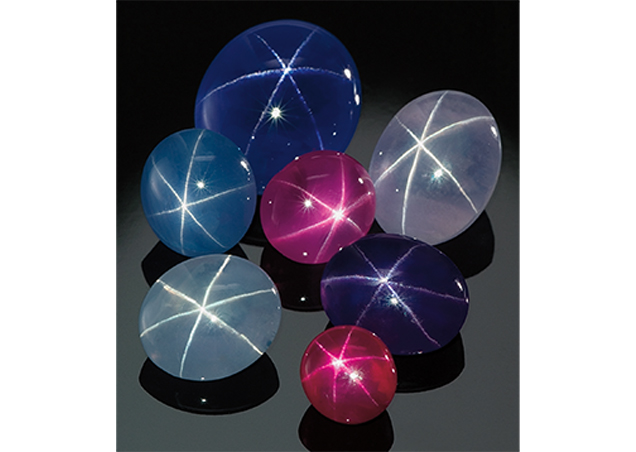
Asterism is a rare optical phenomenon where a star-shaped pattern of light—typically with four, six or, occasionally, 12 rays—appears to float on or just beneath the surface of a gemstone. This glowing star shifts and moves as the stone is rotated or the light changes, creating a mesmerizing effect.
Star gems are most highly valued when the gem has saturated color, high transparency and a sharp, centered star.
How It Works:
The star effect occurs when multiple bands of chatoyancy (cat’s-eye lines) intersect. These bands are caused by fine, needle-like inclusions (often rutile) arranged in two or three different directions inside the gem. These intersecting inclusions reflect light in precise, linear patterns that combine to form the star shape. These gems are typically cut into cabochons to best display the effect, with the dome oriented so the star is clearly visible.
Why It Matters:
Asterism is a highly prized and rare phenomenon that adds a dramatic and celestial quality to gemstones. It enhances the gem’s uniqueness and sometimes value, making these stones especially sought after by collectors and designers who want to create standout jewelry pieces. The star effect also evokes feelings of mystery and wonder, often symbolizing guidance and protection.
Examples:
- Star Sapphire: The most famous asteriated gem, known for its vibrant blue color and sharp star patterns, typically displays a six-rayed star or, very rarely, a 12-rayed star.
- Star Ruby: Prized for their deep color and distinct stars, typically displays a six-rayed star. Star rubies are rarer than star sapphires.
- Star Garnet: A rare variety with deep red or purple hues and a noticeable four- to six-ray star effect.
- Star Diopside: Known for having a striking four-rayed star and rich green color.
- Star Rose Quartz: Displays a subtle six-ray star over soft pink bodycolor.
QUICK GUIDE TO GEMSTONE PHENOMENA
| Phenomenon | What it Looks Like | Key Gems |
| Iridescence | Glowing rainbow colors | Fire obsidian, fire agate, mother-of-pearl, ammolite |
| Play-of-Color | Shifting rainbow colors | Precious opal, iris agate |
| Aventurescence | Glittering sparkle | Sunstone |
| Adularescence | Soft moonlight glow | Moonstone |
| Labradorescence | Bold blue/green flashes, sometimes gold, orange or violet | Labradorite, spectrolite |
| Overtone & Orient (Pearl) | Single-color or multi-color iridescent overlay | Pearls |
| Chatoyancy (Cat’s Eye) | Line of light across gem surface | Chrysoberyl, tiger’s eye, tourmaline |
| Asterism | Star pattern on gem surface | Star sapphire, star ruby, star garnet |
GIA COLORED STONE REPORTS PROVIDE CONFIDENCE FOR PHENOMENAL GEMSTONE BUYERS
Looking to purchase a phenomenal gem? Due to the growing popularity of phenomenal gemstones, there has been a noticeable rise in the availability of laboratory-grown versions—such as star rubies, star sapphires, alexandrites and opals. While these lab-created gems can display similar optical effects, they often differ significantly in value compared to their natural counterparts.
A trusted GIA Colored Stone Identification Report gives clients confidence in their purchase by clearly identifying what they are purchasing. These reports provide detailed, expert analysis of a gemstone’s identity, treatments, and whether it is natural or lab-grown. A GIA Colored Stone Identification and Origin Report can also identify the country of origin for gemstones such as rubies, sapphires, opals and alexandrites. For both consumers and retailers, they offer essential trust and clarity.
CONCLUSION
From bright stars to soft moonlight, phenomenal gemstones offer a captivating play of light that comes from deep within their crystal structures. These fascinating phenomena also reflect the incredible geological processes that shape these gems over time.
Understanding how these effects work helps you and your clients connect more deeply with these remarkable gems, adding meaning and appreciation to every piece.
Phenomenal gemstones are gems that display unique optical effects, such as iridescence and asterism. Some gems, such as opal, moonstone and sunstone, are valued primarily for their phenomena. Other gemstones, such as sapphires, rubies and emeralds, are valued primarily for their color, but occasionally have phenomena, such as asterism and chatoyancy (cat’s eye effect), which can add visual interest to the stone.
Many gemstone phenomena are caused by microscopic textures and inclusions within the gems that scatter, reflect or diffract light. Other optical effects, like color-change, are caused by different factors. In this article, we’ll focus on phenomena produced by these tiny internal structures and explain how they work.
Navigate to:
1. IRIDESCENCE
Iridescence is an umbrella term for many phenomena. Different types of iridescence include: play-of-color, labradorescence and orient.
What It Looks Like:
Iridescence is a rainbow-like shimmer or glow that floats on the surface or just below the surface of a gem, creating a shifting play of color as the stone moves.
It often resembles the colorful sheen seen on soap bubbles, oil slicks, peacock feathers or butterfly wings. The effect can range from subtle pastel sheens to intense, metallic rainbows depending on the material.
How It Works:
Iridescence is caused by light interference. When light hits a gemstone that contains thin, layered internal structures—such as platelets, fissures or alternating layers of different minerals—the light waves bounce back, overlapping and interfering with each other as they do. Some wavelengths (colors) reinforce each other and become more intense, while others cancel out. This process, known as thin-film interference, results in the shifting, rainbow colors seen in iridescent stones.
- The exact colors depend on the thickness and spacing of the layers.
- The effect is often strongest when viewed at certain angles.
Why It Matters:
Iridescence adds a captivating, ever-changing quality to gemstones and makes each gemstone unique. No two gems ever look exactly alike—and even the same gem appears different from different angles. For collectors and designers, it offers an opportunity to work with dynamic stones that appear "alive" with color.
Examples of Iridescent Materials:
- Ammolite: An organic gem formed from fossilized ammonite shells, known for intense, multi-color iridescence.
- Fire Obsidian: A rare variety of obsidian with thin layers that create a brilliant, fiery iridescent sheen.
- Mother of Pearl (Nacre): The inner lining of mollusk shells that has a soft, pearly luster and iridescence due to its layered structure.
- Rainbow Garnet: A rare garnet variety (usually from Mexico or Japan) with a metallic rainbow sheen caused by micro-layered crystal structures.
2. PLAY-OF-COLOR
What It Looks Like:
Play-of-color is an optical phenomenon most well-known in precious opal, where bright flashes of spectral colors—like red, green, blue, orange and violet—appear to dance across the stone as it’s moved or as the light source changes. This phenomenon is a form of iridescence producing different colors as the stone is moved. This effect gives opal a dynamic, almost magical quality.
The most highly prized opals are those that display the full spectrum of colors in bold, well-defined patterns. Red is typically the rarest and most valuable color, especially when it appears alongside other hues.
How It Works:
Play-of-color in opal is caused by its internal structure. Precious opal is composed of tiny, uniform silica spheres, tightly packed in a regular, three-dimensional grid. When light enters the stone, it bends and diffracts around these spheres—a process called diffraction—which separates white light into its component colors.
The size and arrangement of the spheres determine which colors are visible, how intense they are, and how they move as the stone is viewed from different angles. Smaller spheres produce blue and violet flashes. Larger spheres produce red, orange and green hues (rarer and more valuable).
Why It Matters:
Play-of-color is the defining feature of precious opal and its primary value factor. No two opals are exactly alike—each one displays a unique pattern and color combination, making it one of the most individualized gemstones. The visual effect gives the impression of movement and life, setting opals apart from all other gems. Opals without this effect are called common opal or potch opal.
Examples of Precious Opal:
- Black Opal: The rarest and most valuable type, with a dark body color that enhances play-of-color.
- Crystal Opal: Transparent to semi-transparent opal with vivid, glowing play-of-color that appears to float inside the gem.
- White Opal (or Light Opal): Has a pale, milky body tone with softer but still vibrant color play.
- Fire Opal: Typically orange to red body color. Some fire opals exhibit play-of-color and are considered precious opal, while others do not.
- Boulder Opal: Attached to ironstone rock matrix. The color play appears in thin seams or patches and can be vivid and striking due to the dark backing.
3. AVENTURESCENCE (GLITTERY SPARKLES)
What It Looks Like:
Aventurescence appears as glittering flashes that seem to sparkle inside the gem when it's moved under the light. These sparkles are often golden, coppery or silvery. This phenomenon is most well-known in sunstone, a variety of feldspar.
How It Works:
This effect is caused by light reflecting off small, flat inclusions inside the stone—usually metallic minerals like copper, hematite or goethite. The key is that these inclusions are separate and distinct, so the sparkles appear individually rather than as a solid glow. As the stone turns, light hits different surfaces, creating a brilliant sparkle.
Why It Matters:
Aventurescence adds a lively, playful, magical quality to gemstones. It brings them to life with a shimmer that catches the eye and adds depth to their beauty.
Examples:
- Goldstone (synthetic): A man-made glass with copper inclusions that sparkles constantly, no matter the angle.
- Oregon Sunstone: Displays aventurescent schiller due to aligned copper inclusions that produce strong flashes at certain angles.
- Rainbow Lattice Sunstone: A rare feldspar from Australia containing inclusions of magnetite or hematite. It can display an iridescent aventurescence from these reflective particles.
4. ADULARESCENCE (SOFT GLOW LIKE MOONLIGHT)
What It Looks Like
Adularescence appears as a soft, glowing sheen that seems to float just beneath the surface of the gemstone—like moonlight trapped in stone. As you turn the gem, the light appears to move or shimmer from within, creating a dreamy, ethereal effect. Adularescence is the defining feature of moonstone.
How It Works:
This optical phenomenon occurs due to the unique internal structure of the stone. Moonstones are made up of alternating layers of orthoclase and albite feldspar. When light enters the gem, it scatters between these microscopic layers, causing interference and producing that characteristic glowing sheen. The thinner and more uniform the layers, the more intense and beautiful the adularescence.
Why It Matters:
Adularescence is what gives moonstones their signature charm—a soft, romantic glow that has made them prized for centuries. This visual effect evokes feelings of mystery and intuition, making moonstones a favorite in both historical and contemporary jewelry.
Examples:
- Moonstone (Orthoclase Feldspar): The classic example of adularescence, usually found in pale, translucent stones that display a soft, glowing sheen.
5. LABRADORESCENCE (BROAD FLASHES OF COLOR)
What It Looks Like:
Labradorescence is a mesmerizing optical effect that appears as intense flashes of iridescent color—most commonly blue, but also green, gold, orange and even violet—that dance across the surface of the gem as it's moved in the light. The colors shimmer against a typically dark gray or black background and have a glowing, almost holographic quality. This striking display is one of the defining features of labradorite and its more vibrant cousin, spectrolite.
How It Works:
This phenomenon is caused by light interference reflecting off thin, internal lamellar (layered) structures within the crystal. These layers form during the cooling process of the mineral and are extremely thin—just the right size to scatter and reflect specific wavelengths of light. As light enters the stone, it hits these layers at different angles, and the result is a vibrant, shifting play of color that seems to change with every movement.
Why It Matters:
Labradorescence is what gives labradorite its dramatic and distinct appearance. Unlike the soft glow of moonstone, this effect is bold and energetic, making labradorite an ideal choice for bold, statement jewelry and rugged pieces. The ever-changing flashes of color evoke a sense of mystery and transformation.
Examples:
- Labradorite: The most well-known stone to exhibit labradorescence, typically found in shades of gray to black with flashes of blue or green, though other colors can occur.
- Spectrolite: A rare and highly prized variety of labradorite from Finland, known for its rich, full-spectrum colors and stronger labradorescence. It often displays multiple colors at once and is considered the most vivid and colorful example of this effect.
- “Rainbow Moonstone”: A variety of labradorite with transparency. Despite its name, it is not strictly considered a moonstone species.
6. OVERTONE AND ORIENT (FLOATING SECONDARY COLOR IN PEARLS)
What It Looks Like:
Overtone is a noticeable, translucent wash of color that appears to float over a nacreous pearl’s main body color. For example, a white pearl may have a pink or faint green overtone. The overtone doesn’t replace the body color—it enhances it, giving the pearl a more layered, multidimensional look.
Orient is an iridescent display of two or more overtone colors—often a rainbow-like effect—seen on the surface of a pearl. It is often described as a delicate rainbow-like glow that changes with light angle and the movement of the pearl and can resemble the shifting colors seen in a soap bubble or oil slick.
How It Works:
Overtone and orient are caused by light interference as light reflects off the many thin, transparent layers of nacre that make up the pearl. These microscopic layers bend and scatter light, creating a soft, luminous tint on top of the base color.
The thickness, uniformity and arrangement of nacre layers influence and determine the intensity and range of colors visible on the pearl.
Why It Matters:
Overtone and orient give a vibrant, rich and dynamic appearance to pearls, making each one truly one-of-a-kind. Jewelers and collectors often seek pearls with harmonious or rare overtones. Body color and overtone are key factors in grading and pricing.
The trade has even invented terms for certain popular and desirable combinations of body colors and overtone. For example, “peacock” Tahitians refer to Tahitian pearls with green body color and pink overtone.
Examples:
- Akoya Pearls: Are known for their classic white or cream body colors, often enhanced by a bright, shimmering overlay color of pink overtone or a combination of pink and green.
- South Sea Pearls: Typically white, silver or golden with orient, pink or green overtones. Some golden South Sea pearls from Myanmar (formerly Burma)—marketed as “rainbow gold”—are known for having strong orient.
- Tahitian Pearls: Displaying the broadest range of body colors and overtones, they are renowned for their naturally dark body colors with pink or green overtone, as well as orient.
- Freshwater Pearls: Come in a wide range of body colors and overtones, including pink, purple, orange, violet or green. They can display the widest range of orient colors within the same pearl.
- Baroque Pearls: Are more likely to have a pronounced orient because their irregular, non-spherical shapes create more varied surfaces for light to interact with, producing a more complex and colorful shimmer than is typically seen on smooth symmetrical pearls.
7. CHATOYANCY (“CAT’S-EYE”)
What It Looks Like:
Chatoyancy, also known as the “cat’s-eye” effect, is an optical phenomenon where a bright, narrow band of light appears to glide across the surface of a gemstone as it’s moved—resembling the slit-shaped eye of a cat. This sharp, luminous line typically runs parallel to the gem’s long axis and creates a striking sense of depth and motion, captivating the viewer with its dynamic glow.
How It Works:
Chatoyancy results from light reflecting off aligned needle-like inclusions within the stone—think of light running off a spool of silk. These internal structures act like tiny mirrors, reflecting light in a focused band. To best display chatoyancy, the gem is usually polished into a cabochon (with a domed, rounded top and a flat back), oriented so the needle-like inclusions run perpendicular to the light source, allowing the light to reflect in a sharp line.
Why It Matters:
The cat’s-eye effect adds dynamic movement to gemstones, making them visually striking and unique. This phenomenon is highly prized in fine jewelry. In particular, cat’s-eye chrysoberyl is considered the most valuable and sought-after gem exhibiting chatoyancy due to its sharp, intense eye and rarity. It is highly popular in men’s jewelry.
Examples:
- Chrysoberyl (“cat’s-eye” variety): The most famous and valuable chatoyant gem, prized for its sharp, bright eye and excellent clarity. Chatoyant chrysoberyl may also show a color change effect, creating cat’s-eye alexandrite.
- Tiger’s Eye: Known for its soft, silky golden-brown chatoyancy caused by parallel fibers of crocidolite.
- Tourmaline: Some varieties exhibit a shimmering cat’s-eye effect, but typically with a coarser, less sharp eye due to the width of the internal tubes causing this effect.
- Apatite, Aquamarine, Emerald, Scapolite, Moonstone, Zircon: Other gemstones that may show chatoyancy depending on their internal structure and cut.
8. ASTERISM (“STAR EFFECT”)
What It Looks Like:
Asterism is a rare optical phenomenon where a star-shaped pattern of light—typically with four, six or, occasionally, 12 rays—appears to float on or just beneath the surface of a gemstone. This glowing star shifts and moves as the stone is rotated or the light changes, creating a mesmerizing effect.
Star gems are most highly valued when the gem has saturated color, high transparency and a sharp, centered star.
How It Works:
The star effect occurs when multiple bands of chatoyancy (cat’s-eye lines) intersect. These bands are caused by fine, needle-like inclusions (often rutile) arranged in two or three different directions inside the gem. These intersecting inclusions reflect light in precise, linear patterns that combine to form the star shape. These gems are typically cut into cabochons to best display the effect, with the dome oriented so the star is clearly visible.
Why It Matters:
Asterism is a highly prized and rare phenomenon that adds a dramatic and celestial quality to gemstones. It enhances the gem’s uniqueness and sometimes value, making these stones especially sought after by collectors and designers who want to create standout jewelry pieces. The star effect also evokes feelings of mystery and wonder, often symbolizing guidance and protection.
Examples:
- Star Sapphire: The most famous asteriated gem, known for its vibrant blue color and sharp star patterns, typically displays a six-rayed star or, very rarely, a 12-rayed star.
- Star Ruby: Prized for their deep color and distinct stars, typically displays a six-rayed star. Star rubies are rarer than star sapphires.
- Star Garnet: A rare variety with deep red or purple hues and a noticeable four- to six-ray star effect.
- Star Diopside: Known for having a striking four-rayed star and rich green color.
- Star Rose Quartz: Displays a subtle six-ray star over soft pink bodycolor.
QUICK GUIDE TO GEMSTONE PHENOMENA
| Phenomenon | What it Looks Like | Key Gems |
| Iridescence | Glowing rainbow colors | Fire obsidian, fire agate, mother-of-pearl, ammolite |
| Play-of-Color | Shifting rainbow colors | Precious opal, iris agate |
| Aventurescence | Glittering sparkle | Sunstone |
| Adularescence | Soft moonlight glow | Moonstone |
| Labradorescence | Bold blue/green flashes, sometimes gold, orange or violet | Labradorite, spectrolite |
| Overtone & Orient (Pearl) | Single-color or multi-color iridescent overlay | Pearls |
| Chatoyancy (Cat’s Eye) | Line of light across gem surface | Chrysoberyl, tiger’s eye, tourmaline |
| Asterism | Star pattern on gem surface | Star sapphire, star ruby, star garnet |
GIA COLORED STONE REPORTS PROVIDE CONFIDENCE FOR PHENOMENAL GEMSTONE BUYERS
Looking to purchase a phenomenal gem? Due to the growing popularity of phenomenal gemstones, there has been a noticeable rise in the availability of laboratory-grown versions—such as star rubies, star sapphires, alexandrites and opals. While these lab-created gems can display similar optical effects, they often differ significantly in value compared to their natural counterparts.
A trusted GIA Colored Stone Identification Report gives clients confidence in their purchase by clearly identifying what they are purchasing. These reports provide detailed, expert analysis of a gemstone’s identity, treatments, and whether it is natural or lab-grown. A GIA Colored Stone Identification and Origin Report can also identify the country of origin for gemstones such as rubies, sapphires, opals and alexandrites. For both consumers and retailers, they offer essential trust and clarity.
CONCLUSION
From bright stars to soft moonlight, phenomenal gemstones offer a captivating play of light that comes from deep within their crystal structures. These fascinating phenomena also reflect the incredible geological processes that shape these gems over time.
Understanding how these effects work helps you and your clients connect more deeply with these remarkable gems, adding meaning and appreciation to every piece.