
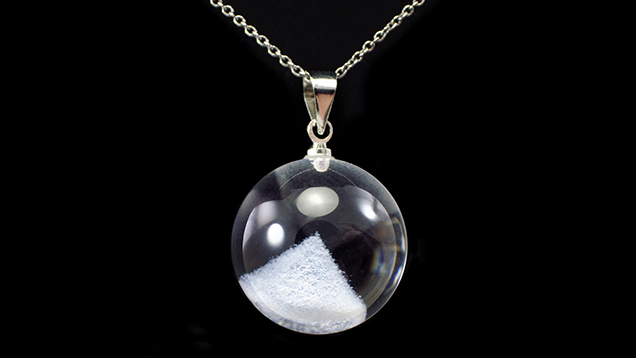
Phantom quartz generally refers to a rock crystal with inclusions of prismatic or pyramidal growth zonation, which represents early crystal faces covered by minerals, such as clinochlore, clay minerals, limonite, or fuchsite. Recently, a new type of phantom quartz imitation has appeared in the market, most of which is sold in the form of beads, pendants, or crystal spheres. A package of these imitation phantom quartz products was sent to the Taiwan Union Lab of Gem Research (TULAB) for identification services (figure 1).
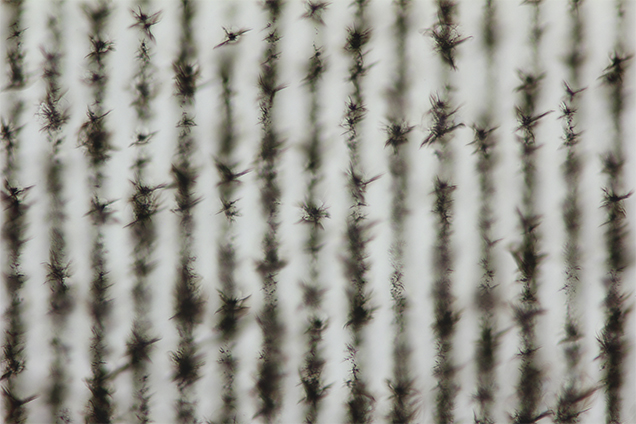
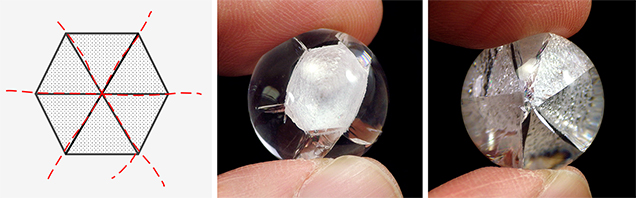
These samples submitted as phantom quartz had a powdery white growth zonation in the form of a hexagonal pyramid. The host crystal was confirmed to be natural quartz by infrared absorption spectroscopy. The samples had an abnormal appearance for phantom quartz, of which the internal growth zonation was composed of regular and oriented small cracks (figure 2). Similar inclusions are often found in crafts made of glass or synthetic quartz engraved with a laser. According to the client, one of these samples had fractures along the ridgeline of the apparent pseudo-hexagonal pyramid (figure 3), which were possibly self-propagated due to the internal stress from the oriented small cracks.
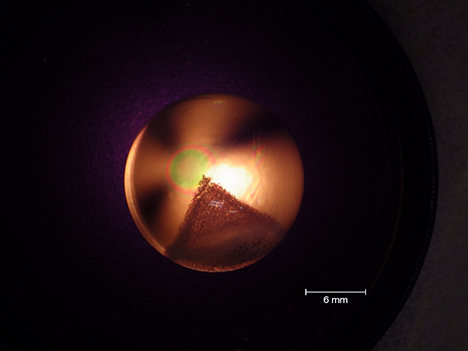
In a true phantom, the axial direction of the host crystal is identical to that of the phantom crystal inside; however, the interference images through a polariscope revealed that the c-axis direction of these phantom quartz products was mostly inconsistent with what appeared to be their internal growth zonation (figure 4). In consideration of the morphological characteristics of inclusions as well as the interference images, these phantoms are imitations made of natural “rock crystal” with artificial growth zonation produced by laser engraving, irrespective of the crystallographic orientation of the host crystal.
Although internal laser engraving can imitate the appearance of a phantom quartz inclusion, such products can be easily identified through a microscope and a polariscope. More controversially, the internal stress generated by the regular and oriented cracks seems to reduce the toughness of the host crystal; therefore, consumers should be aware of the risk of such imitations.
Shu-Hong Lin is director of Taiwan Union Lab of Gem Research in Taipei. Yu-Ho Li is a PhD candidate at the Institute of Earth Sciences, National Taiwan Ocean University in Keelung. Huei-Fen Chen is professor at the Institute of Earth Sciences and Center of Excellence for Oceans at National Taiwan Ocean University in Keelung.
Phantom quartz generally refers to a rock crystal with inclusions of prismatic or pyramidal growth zonation, which represents early crystal faces covered by minerals, such as clinochlore, clay minerals, limonite, or fuchsite. Recently, a new type of phantom quartz imitation has appeared in the market, most of which is sold in the form of beads, pendants, or crystal spheres. A package of these imitation phantom quartz products was sent to the Taiwan Union Lab of Gem Research (TULAB) for identification services (figure 1).
These samples submitted as phantom quartz had a powdery white growth zonation in the form of a hexagonal pyramid. The host crystal was confirmed to be natural quartz by infrared absorption spectroscopy. The samples had an abnormal appearance for phantom quartz, of which the internal growth zonation was composed of regular and oriented small cracks (figure 2). Similar inclusions are often found in crafts made of glass or synthetic quartz engraved with a laser. According to the client, one of these samples had fractures along the ridgeline of the apparent pseudo-hexagonal pyramid (figure 3), which were possibly self-propagated due to the internal stress from the oriented small cracks.
In a true phantom, the axial direction of the host crystal is identical to that of the phantom crystal inside; however, the interference images through a polariscope revealed that the c-axis direction of these phantom quartz products was mostly inconsistent with what appeared to be their internal growth zonation (figure 4). In consideration of the morphological characteristics of inclusions as well as the interference images, these phantoms are imitations made of natural “rock crystal” with artificial growth zonation produced by laser engraving, irrespective of the crystallographic orientation of the host crystal.
Although internal laser engraving can imitate the appearance of a phantom quartz inclusion, such products can be easily identified through a microscope and a polariscope. More controversially, the internal stress generated by the regular and oriented cracks seems to reduce the toughness of the host crystal; therefore, consumers should be aware of the risk of such imitations.
Shu-Hong Lin is director of Taiwan Union Lab of Gem Research in Taipei. Yu-Ho Li is a PhD candidate at the Institute of Earth Sciences, National Taiwan Ocean University in Keelung. Huei-Fen Chen is professor at the Institute of Earth Sciences and Center of Excellence for Oceans at National Taiwan Ocean University in Keelung.