
Asterism, the optical phenomenon producing a star-like pattern on the surface of a cabochon, arises from the reflection and scattering of light due to the presence of oriented groups of parallel needle-like inclusions. In quartz, two distinct forms of asterism have been reported: the star effect in rose quartz, typically caused by multiple sets of oriented fibrous inclusions (K. Schmetzer and M. Krzemnicki, “The orientation and symmetry of light spots and asterism in rose quartz spheres from Madagascar,” Journal of Gemmology, Vol. 30, No. 4, 2006, pp. 183–191), and three-rayed asterism induced by intersecting rutile needles (Summer 2022 GNI, pp. 249–252).
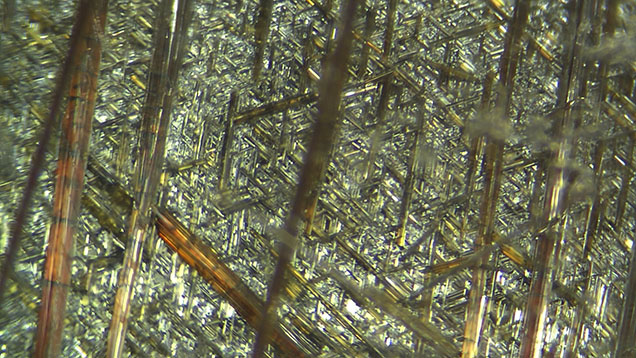
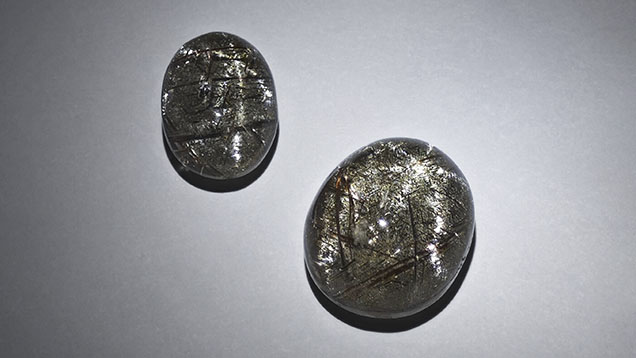
Recently, author JL acquired two quartz specimens from the Donghai Crystal Market in Jiangsu Province, China, each displaying a well-defined six-rayed star under point-source illumination (figure 1). Standard gemological analysis yielded a refractive index of 1.54 and a specific gravity of 2.68, with Raman spectroscopy confirming the specimens as quartz. Microscopic observation revealed reflective layers composed of three mutually interlaced sets of parallel acicular inclusions oriented at approximately 120° to one another (figure 2). These inclusions caused the observed asterism and consisted of two morphologically distinct types: fine silvery white needles and thicker yellowish brown needles.
Both the silvery white and yellowish brown needles exhibited Raman peaks at 142, 238, 446, and 614 cm–1, characteristic of rutile, whereas certain inclusions displayed additional peaks at 225, 244, 290, 410, 493, 614, and 663 cm–1, consistent with hematite. These findings suggested that some rutile needles contained hematite precipitates. This coexistence likely originated from titanium- and iron-rich hydrothermal fluids; under highly oxidizing conditions, titanium crystallized preferentially as rutile, followed by iron oxidation and subsequent hematite precipitation, resulting in a tightly intergrown microstructure responsible for the distinct six-rayed star effect.
Although rutile-induced asterism is common in quartz and the three-rayed star effect associated with asteriated rutile networks has been previously reported, the phenomenon observed in this specimen—arising from the synergistic presence of hematite and rutile needles—is both attractive and unique. To the best of the authors’ knowledge, it has not been documented previously.
Jie Luo, Xiaoxu Yan, Xia Deng, and Zida Tong are affiliated with Guangzhou City University of Technology, and Suwei Yue is affiliated with Guangzhou Polytechnic University, in China.
Asterism, the optical phenomenon producing a star-like pattern on the surface of a cabochon, arises from the reflection and scattering of light due to the presence of oriented groups of parallel needle-like inclusions. In quartz, two distinct forms of asterism have been reported: the star effect in rose quartz, typically caused by multiple sets of oriented fibrous inclusions (K. Schmetzer and M. Krzemnicki, “The orientation and symmetry of light spots and asterism in rose quartz spheres from Madagascar,” Journal of Gemmology, Vol. 30, No. 4, 2006, pp. 183–191), and three-rayed asterism induced by intersecting rutile needles (Summer 2022 GNI, pp. 249–252).
Recently, author JL acquired two quartz specimens from the Donghai Crystal Market in Jiangsu Province, China, each displaying a well-defined six-rayed star under point-source illumination (figure 1). Standard gemological analysis yielded a refractive index of 1.54 and a specific gravity of 2.68, with Raman spectroscopy confirming the specimens as quartz. Microscopic observation revealed reflective layers composed of three mutually interlaced sets of parallel acicular inclusions oriented at approximately 120° to one another (figure 2). These inclusions caused the observed asterism and consisted of two morphologically distinct types: fine silvery white needles and thicker yellowish brown needles.
Both the silvery white and yellowish brown needles exhibited Raman peaks at 142, 238, 446, and 614 cm–1, characteristic of rutile, whereas certain inclusions displayed additional peaks at 225, 244, 290, 410, 493, 614, and 663 cm–1, consistent with hematite. These findings suggested that some rutile needles contained hematite precipitates. This coexistence likely originated from titanium- and iron-rich hydrothermal fluids; under highly oxidizing conditions, titanium crystallized preferentially as rutile, followed by iron oxidation and subsequent hematite precipitation, resulting in a tightly intergrown microstructure responsible for the distinct six-rayed star effect.
Although rutile-induced asterism is common in quartz and the three-rayed star effect associated with asteriated rutile networks has been previously reported, the phenomenon observed in this specimen—arising from the synergistic presence of hematite and rutile needles—is both attractive and unique. To the best of the authors’ knowledge, it has not been documented previously.
Jie Luo, Xiaoxu Yan, Xia Deng, and Zida Tong are affiliated with Guangzhou City University of Technology, and Suwei Yue is affiliated with Guangzhou Polytechnic University, in China.