
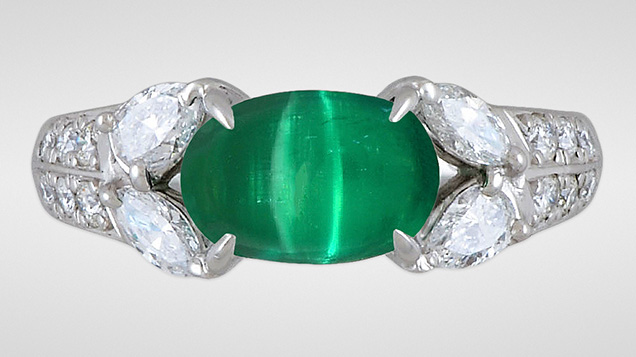
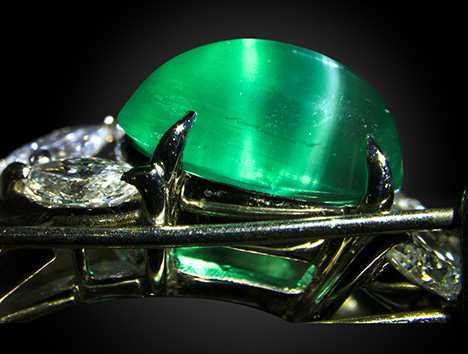
GIA’s Tokyo laboratory recently received for origin service a ring with an emerald displaying dual-color double chatoyancy (figure 1). One band showed white chatoyancy, while the other exhibited greenish chatoyancy similar to the bodycolor. The emerald had an oval double-cabochon shape with a polished crown and pavilion and contained parallel tubes slightly oblique to the polished pavilion, resulting in semitransparency. The dual-color double chatoyancy was caused by the same mechanism identified in dual-color star corundum and quartz by Schmetzer et al. (“Dual-color double stars in ruby, sapphire, and quartz: Cause and historical account,” Summer 2015 G&G;, pp. 112–143). The white chatoyancy was caused by the linear reflection of the parallel tube inclusions from the upper cabochon surface. The greenish chatoyancy was caused by the linear reflection of the polished curved base through the interior of the stone to the surface (figure 2). Double chatoyancy is occasionally observed, but it is rare to find a very clear example of dual-color double chatoyancy.
GIA’s Tokyo laboratory recently received for origin service a ring with an emerald displaying dual-color double chatoyancy (figure 1). One band showed white chatoyancy, while the other exhibited greenish chatoyancy similar to the bodycolor. The emerald had an oval double-cabochon shape with a polished crown and pavilion and contained parallel tubes slightly oblique to the polished pavilion, resulting in semitransparency. The dual-color double chatoyancy was caused by the same mechanism identified in dual-color star corundum and quartz by Schmetzer et al. (“Dual-color double stars in ruby, sapphire, and quartz: Cause and historical account,” Summer 2015 G&G;, pp. 112–143). The white chatoyancy was caused by the linear reflection of the parallel tube inclusions from the upper cabochon surface. The greenish chatoyancy was caused by the linear reflection of the polished curved base through the interior of the stone to the surface (figure 2). Double chatoyancy is occasionally observed, but it is rare to find a very clear example of dual-color double chatoyancy.