
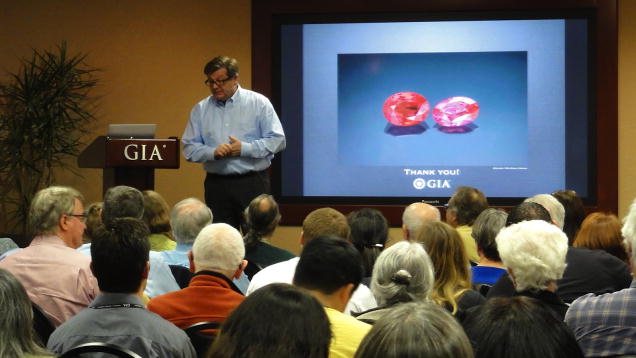
The 2013 Sinkankas Symposium was held April 6 at GIA’s world headquarters in Carlsbad, California. The annual symposium honoring John Sinkankas was organized by the San Diego Mineral & Gem Society (SDMG) and GIA. Ruby was the theme of the conference, which drew more than 150 attendees.
Following convener Roger Merk’s opening remarks, Dr. George Harlow , curator of earth and planetary sciences at the American Museum of Natural History in New York, gave the first presentation of the day. “The Mineralogy and Geochemistry of Ruby from the Mogok Belt” discussed the geology and trace-element origin indicators of these gems. Dr. Harlow also pointed out that gemological journals should publish full data sets rather than data summaries. Dr. James Shigley , GIA’s distinguished research fellow, summarized the conditions and environments of ruby formation and reviewed the major localities worldwide. Bill Larson of Pala International gave a virtual tour of the world’s important localities and showed outstanding rough samples. Elise Skalwold of Cornell University shared the life story of Dr. Allen M. Bassett, who spent some 30 years in Nepal studying its geology and developing an integrated jewelry industry there. Next, explorer and author Gary Bowersox presented “The Rubies of Afghanistan and Tajikistan,” which featured numerous maps and photos based on more than 40 years of experience traveling in this area. In “Pigeon’s Blood: Burma’s Mogok Ruby Mines,” Richard W. Hughes related the history of operations there and clarified the real meaning of the term “pigeon’s blood,” which is derived not from the blood of pigeons but from the bright red ring in the iris of their eyes.
Nathan Renfro , GIA Carlsbad’s lead analytical specialist of colored stones, explained how to use computer-aided techniques plus spectra-aided color prediction to optimize the face-up color of faceted rubies. Mr. Renfro also shared some fascinating photomicrographs of rare inclusions in rubies. Robert Weldon , GIA’s manager of photography and laboratory publications, reviewed the history of ruby photography and gave the attendees three simple tips on correcting the gem’s color using Adobe Photoshop. GIA’s West Coast identification services director, Shane McClure , concluded the day with a review of ruby treatment techniques such as heating, dyeing, fracture filling, and lattice diffusion. Cal Tech’s Dr. George Rossman was scheduled to be the last speaker of the day but could not attend. Mr. Merk gave a brief summary of Dr. Rossman’s presentation “Why Rubies Are Red” to close the event.
The 2013 Sinkankas Symposium was held April 6 at GIA’s world headquarters in Carlsbad, California. The annual symposium honoring John Sinkankas was organized by the San Diego Mineral & Gem Society (SDMG) and GIA. Ruby was the theme of the conference, which drew more than 150 attendees.
Following convener Roger Merk’s opening remarks, Dr. George Harlow , curator of earth and planetary sciences at the American Museum of Natural History in New York, gave the first presentation of the day. “The Mineralogy and Geochemistry of Ruby from the Mogok Belt” discussed the geology and trace-element origin indicators of these gems. Dr. Harlow also pointed out that gemological journals should publish full data sets rather than data summaries. Dr. James Shigley , GIA’s distinguished research fellow, summarized the conditions and environments of ruby formation and reviewed the major localities worldwide. Bill Larson of Pala International gave a virtual tour of the world’s important localities and showed outstanding rough samples. Elise Skalwold of Cornell University shared the life story of Dr. Allen M. Bassett, who spent some 30 years in Nepal studying its geology and developing an integrated jewelry industry there. Next, explorer and author Gary Bowersox presented “The Rubies of Afghanistan and Tajikistan,” which featured numerous maps and photos based on more than 40 years of experience traveling in this area. In “Pigeon’s Blood: Burma’s Mogok Ruby Mines,” Richard W. Hughes related the history of operations there and clarified the real meaning of the term “pigeon’s blood,” which is derived not from the blood of pigeons but from the bright red ring in the iris of their eyes.
Nathan Renfro , GIA Carlsbad’s lead analytical specialist of colored stones, explained how to use computer-aided techniques plus spectra-aided color prediction to optimize the face-up color of faceted rubies. Mr. Renfro also shared some fascinating photomicrographs of rare inclusions in rubies. Robert Weldon , GIA’s manager of photography and laboratory publications, reviewed the history of ruby photography and gave the attendees three simple tips on correcting the gem’s color using Adobe Photoshop. GIA’s West Coast identification services director, Shane McClure , concluded the day with a review of ruby treatment techniques such as heating, dyeing, fracture filling, and lattice diffusion. Cal Tech’s Dr. George Rossman was scheduled to be the last speaker of the day but could not attend. Mr. Merk gave a brief summary of Dr. Rossman’s presentation “Why Rubies Are Red” to close the event.