
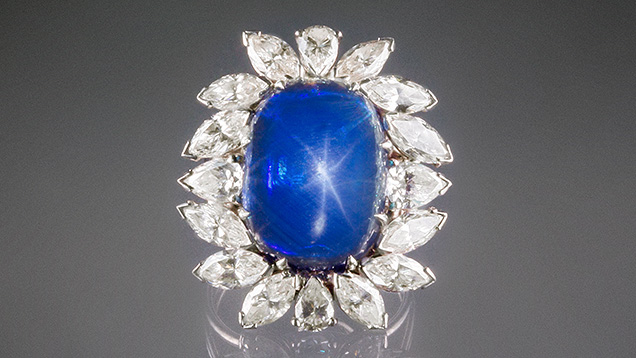
A rare star sapphire of Kashmir origin, mounted in a combination ring and pendant (figure 1), was recently examined in the New York laboratory. Kashmir has long been regarded as the most sought-after source of blue sapphire since the deposit’s discovery in the late nineteenth century. Words such as “sleepy” or “velvety” are often used to describe their characteristic appearance, which can be attributed to the scattering of light as it interacts with “milky” bands of microscopic particles within the stone. Due to the locality’s limited production, Kashmir sapphires are scarce in the market, and star sapphires are particularly uncommon (R.W. Hughes et al., Ruby & Sapphire: A Gemologist’s Guide, 2017, RWH Publishing/Lotus Publishing, Bangkok, p. 477).
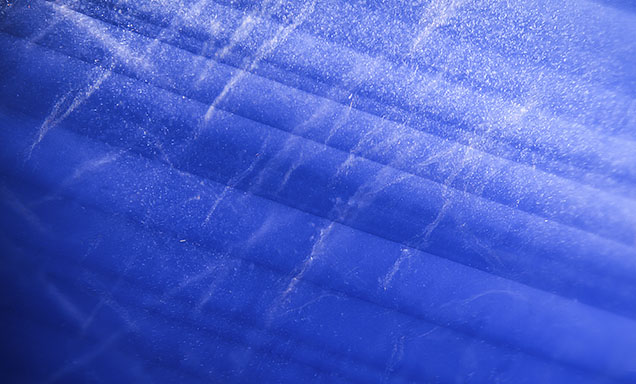
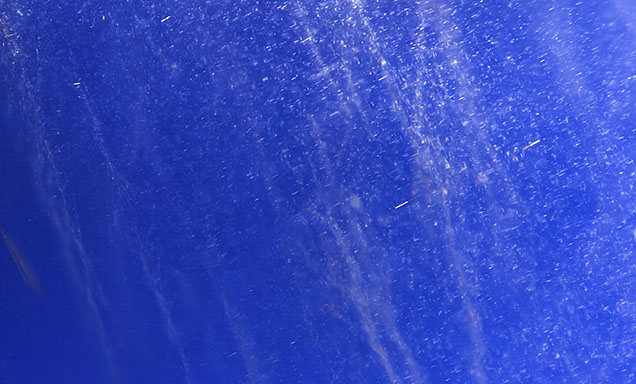
This blue cabochon star sapphire was estimated to weigh around 15 ct. A spot reading gave an approximate refractive index of 1.76, matching corundum. Microscopic inspection revealed sharp, angular milky bands and particle streamers (figure 2), both features that are typical of Kashmir sapphires. Several sparse short silk needles were also observed (figure 3). Asterism in corundum is generally caused by the reflection of light off of exsolution rutile silk needles. This sapphire’s star, however, was generated by light reflected from the crystallographically oriented bands of minute particles.
Further testing of the sapphire’s spectral and chemical properties was carried out to help determine its geographic origin. Laser ablation–inductively coupled plasma–mass spectrometry revealed a trace element chemistry consistent with stones of known Kashmir origin, based on GIA’s internal reference data. This, coupled with the material’s internal characteristics, confirmed that the star sapphire was in fact from Kashmir. No evidence of heat treatment was detected. While the majority of corundum on the market is heated to improve color, high-quality sapphires from Kashmir are generally left untreated.
Kashmir sapphires are rare enough in their own right. Furthermore, a large star sapphire from this historic locality is truly an extraordinary sight, and certainly a first for the author.
A rare star sapphire of Kashmir origin, mounted in a combination ring and pendant (figure 1), was recently examined in the New York laboratory. Kashmir has long been regarded as the most sought-after source of blue sapphire since the deposit’s discovery in the late nineteenth century. Words such as “sleepy” or “velvety” are often used to describe their characteristic appearance, which can be attributed to the scattering of light as it interacts with “milky” bands of microscopic particles within the stone. Due to the locality’s limited production, Kashmir sapphires are scarce in the market, and star sapphires are particularly uncommon (R.W. Hughes et al., Ruby & Sapphire: A Gemologist’s Guide, 2017, RWH Publishing/Lotus Publishing, Bangkok, p. 477).
This blue cabochon star sapphire was estimated to weigh around 15 ct. A spot reading gave an approximate refractive index of 1.76, matching corundum. Microscopic inspection revealed sharp, angular milky bands and particle streamers (figure 2), both features that are typical of Kashmir sapphires. Several sparse short silk needles were also observed (figure 3). Asterism in corundum is generally caused by the reflection of light off of exsolution rutile silk needles. This sapphire’s star, however, was generated by light reflected from the crystallographically oriented bands of minute particles.
Further testing of the sapphire’s spectral and chemical properties was carried out to help determine its geographic origin. Laser ablation–inductively coupled plasma–mass spectrometry revealed a trace element chemistry consistent with stones of known Kashmir origin, based on GIA’s internal reference data. This, coupled with the material’s internal characteristics, confirmed that the star sapphire was in fact from Kashmir. No evidence of heat treatment was detected. While the majority of corundum on the market is heated to improve color, high-quality sapphires from Kashmir are generally left untreated.
Kashmir sapphires are rare enough in their own right. Furthermore, a large star sapphire from this historic locality is truly an extraordinary sight, and certainly a first for the author.