
The market for cultured saltwater pearls has softened this year as growth in Chinese demand has slowed, according to dealers at the recent September Hong Kong Gem and Jewellery Fair.
Demand from China had pushed prices up some 30% in the previous two years, while expenses remained relatively flat, so dealers noted that they could weather the corrections in the market.
Demand for Akoya, white and gold South Sea pearls, and Tahitian black pearls was down several percentage points through the first half of the year. Prices and demand were starting to “edge upward” at the Paspaley Pearling Company Hong Kong auction, however, said the company officials who oversaw the sale.
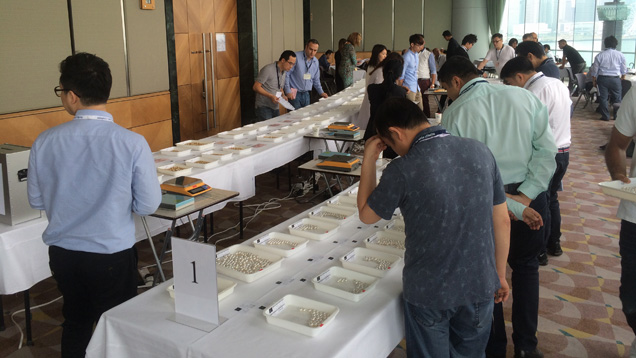
The company invited 141 pearl dealers – regular clients – to the annual three-day, invitation-only auction. Officials said 110 from Japan, China, the U.S. and Europe registered by the middle of the second day, and more were expected, which they said was good sign for the fall.
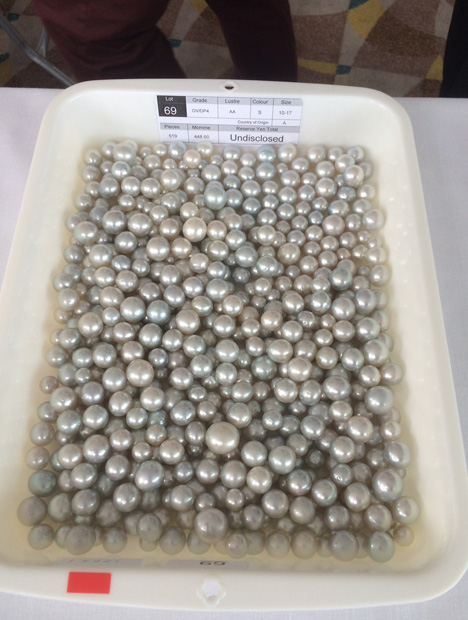
Producers such as Paspaley, whose main output is high-end white South Sea goods, sell most of their productions at such auctions. The goods are separated into lots according to size, weight and quality, including shape, color, luster and orient.
Because the Japanese Yen is the dominant currency for the industry – tracing back to the period when that country was the only major pearl culturing center – it is how reserve prices are given.
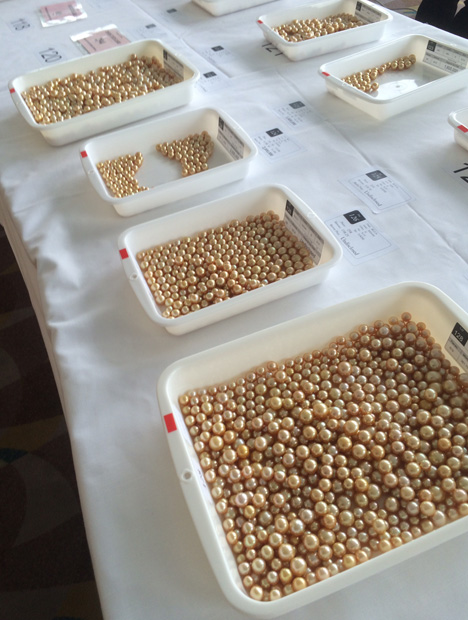
Paspaley’s offerings included white goods from the company’s farm in Northern Australia, contract producers in Indonesia and golden cultured pearls from a farm in the Philippines, which the company owns with Japanese and Chinese partners.
Pearl dealers agreed with Paspaley that the market had grown increasingly dependent on China in the past four years as demand for higher-end pearls grew very slowly or not at all in Japan and Western countries. In addition, competition is increasing from Chinese freshwater pearls, which are continually improving in quality and variety.
Russell Shor is senior industry analyst at GIA in Carlsbad.
Loading video player...
The market for cultured saltwater pearls has softened this year as growth in Chinese demand has slowed, according to dealers at the recent September Hong Kong Gem and Jewellery Fair.
Demand from China had pushed prices up some 30% in the previous two years, while expenses remained relatively flat, so dealers noted that they could weather the corrections in the market.
Demand for Akoya, white and gold South Sea pearls, and Tahitian black pearls was down several percentage points through the first half of the year. Prices and demand were starting to “edge upward” at the Paspaley Pearling Company Hong Kong auction, however, said the company officials who oversaw the sale.
The company invited 141 pearl dealers – regular clients – to the annual three-day, invitation-only auction. Officials said 110 from Japan, China, the U.S. and Europe registered by the middle of the second day, and more were expected, which they said was good sign for the fall.
Producers such as Paspaley, whose main output is high-end white South Sea goods, sell most of their productions at such auctions. The goods are separated into lots according to size, weight and quality, including shape, color, luster and orient.
Because the Japanese Yen is the dominant currency for the industry – tracing back to the period when that country was the only major pearl culturing center – it is how reserve prices are given.
Paspaley’s offerings included white goods from the company’s farm in Northern Australia, contract producers in Indonesia and golden cultured pearls from a farm in the Philippines, which the company owns with Japanese and Chinese partners.
Pearl dealers agreed with Paspaley that the market had grown increasingly dependent on China in the past four years as demand for higher-end pearls grew very slowly or not at all in Japan and Western countries. In addition, competition is increasing from Chinese freshwater pearls, which are continually improving in quality and variety.
Russell Shor is senior industry analyst at GIA in Carlsbad.
Loading video player...