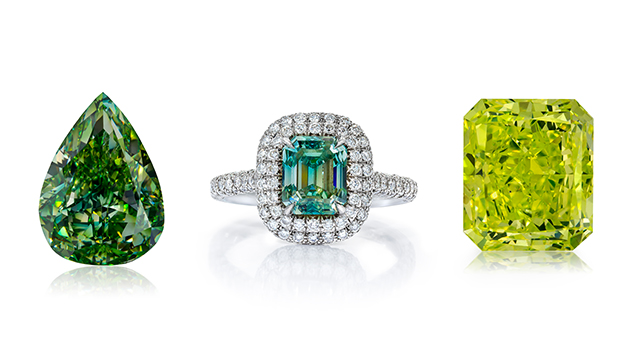
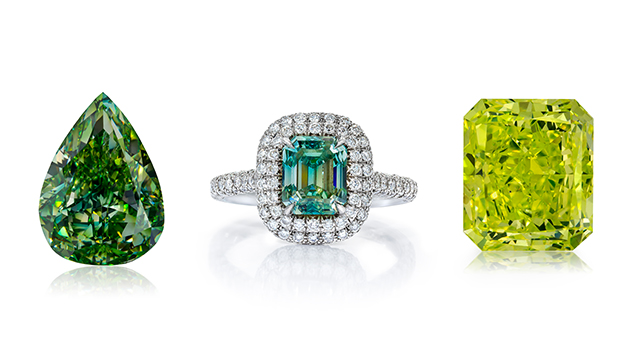
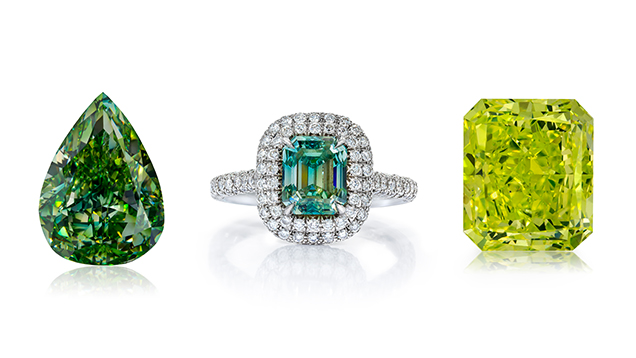
Green is among the rarest colors found in natural diamond; this hue is caused by gamma radiation while the stones are still deep within the earth. Since there are comparatively few of these specimens available, it is remarkable to find an entire exhibition dedicated to them. Green Diamonds: Natural Radiance , at the Natural History Museum of Los Angeles (NHMLA), showcases eight displays of more than 60 loose and mounted diamonds in various shades of green (figure 1). The exhibition was curated in partnership with New York–based Optimum Diamonds, which specializes in rare and exotic natural-color diamonds. The stones on display were collected over the course of 20 years as part of Optimum’s Gamma Green collection.
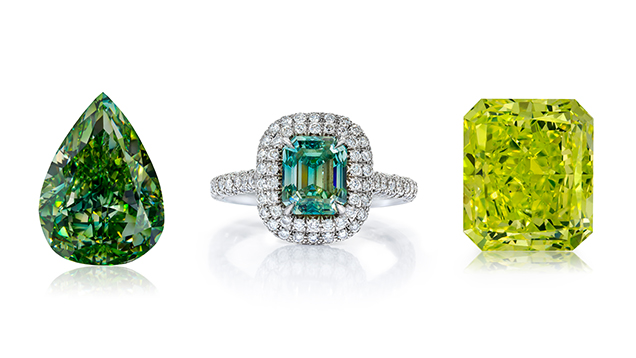
The exhibit itself is in a private room in the back of the museum’s esteemed Gem and Mineral Vault. While other gem materials are displayed in the room, the green diamonds rightfully take center stage. More than 30 loose faceted stones are on display, in hues ranging from greenish blue to green-yellow (figure 2), a valid representation given how rarely these colors are found in natural diamond. One display was set aside for chameleon diamonds, which change from their natural greenish yellow color to brown or orange when exposed to heat or light. Of particular interest among these rarest of gemstones was a 3.08 ct Fancy Dark gray greenish yellow chameleon diamond (figure 3).
The jewelry pieces chosen to showcase these diamonds—mostly rings—are nothing less than exquisite. While some, like the Wild Orchid ring and the Caribbean earrings (figure 4) use stones of multiple colors, shapes, and sizes to achieve a striking effect, many others use simple, classic-cut colorless stones as accents, allowing the green diamond to be the true centerpiece. Figure 5 shows two such examples: a 2.01 ct Fancy Vivid green-yellow square cut surrounded by a square border of colorless stones, and 4.94 ct Fancy Deep yellowish green oval in a timeless, elegant setting. The Nautilus ring and matching earrings merge these concepts, with a freeform design that features a Fancy Vivid blue-green stone at its center, to great effect (figure 6).
The displays provide details about the general nature of diamonds and the causes of their color, along with each specimen’s carat weight. The museum notes briefly that radiation was identified as the source of the green color in 1904, when “an unnamed scientist” (Sir William Crookes) buried white diamonds in radioactive salts; there are also brief explanations of diamond geology and the nature of chameleon diamonds. It was a pleasant surprise to find this information available in both English and Spanish. However, it would have been nice to have more information on the formation and radiation of these rare stones, perhaps in the form of wall signage. The room is also rather darkly paneled and dimly lit; a brighter environment might have shown these stones to their best advantage. And while there are only a few well-known green diamonds, some basic information to educate the visitor on famous gemstones such as the Dresden Green, the Ocean Dream, and the Aurora Green would have been a welcome addition.
Green Diamonds: Natural Radiance adds a bit of panache to an already delightful trip to NHMLA. The exhibition is a must for any diamond aficionado with an eye toward color.
Green Diamonds: Natural Radiance is on view at the Natural History Museum of Los Angeles until April 1, 2018. Admission is $15 for adults; $12 for seniors 62 and over, students with school IDs, and youths ages 13–17; and $7 for children ages 3–12. Los Angeles County residents receive free museum admission Monday–Friday from 3:00 to 5:00 p.m. The museum is open from 9:30 to 5:00 p.m. seven days a week; it is closed New Year’s Day, Fourth of July, Thanksgiving, and Christmas Day.
Jennifer-Lynn Archuleta is the editor of Gems & Gemology.
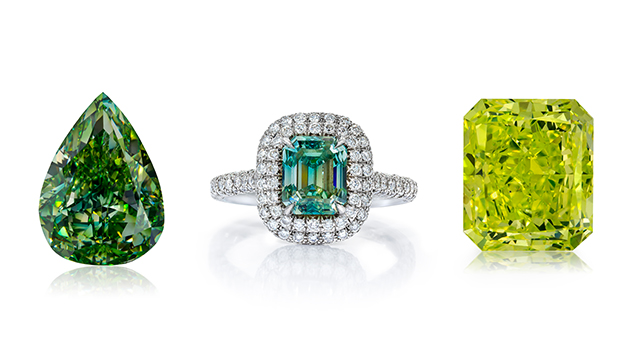
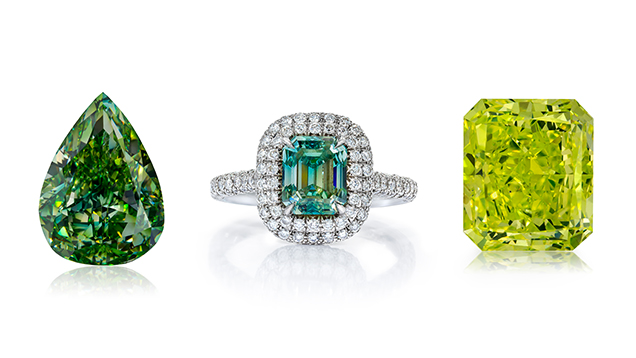
Green is among the rarest colors found in natural diamond; this hue is caused by gamma radiation while the stones are still deep within the earth. Since there are comparatively few of these specimens available, it is remarkable to find an entire exhibition dedicated to them. Green Diamonds: Natural Radiance , at the Natural History Museum of Los Angeles (NHMLA), showcases eight displays of more than 60 loose and mounted diamonds in various shades of green (figure 1). The exhibition was curated in partnership with New York–based Optimum Diamonds, which specializes in rare and exotic natural-color diamonds. The stones on display were collected over the course of 20 years as part of Optimum’s Gamma Green collection.
The exhibit itself is in a private room in the back of the museum’s esteemed Gem and Mineral Vault. While other gem materials are displayed in the room, the green diamonds rightfully take center stage. More than 30 loose faceted stones are on display, in hues ranging from greenish blue to green-yellow (figure 2), a valid representation given how rarely these colors are found in natural diamond. One display was set aside for chameleon diamonds, which change from their natural greenish yellow color to brown or orange when exposed to heat or light. Of particular interest among these rarest of gemstones was a 3.08 ct Fancy Dark gray greenish yellow chameleon diamond (figure 3).
The jewelry pieces chosen to showcase these diamonds—mostly rings—are nothing less than exquisite. While some, like the Wild Orchid ring and the Caribbean earrings (figure 4) use stones of multiple colors, shapes, and sizes to achieve a striking effect, many others use simple, classic-cut colorless stones as accents, allowing the green diamond to be the true centerpiece. Figure 5 shows two such examples: a 2.01 ct Fancy Vivid green-yellow square cut surrounded by a square border of colorless stones, and 4.94 ct Fancy Deep yellowish green oval in a timeless, elegant setting. The Nautilus ring and matching earrings merge these concepts, with a freeform design that features a Fancy Vivid blue-green stone at its center, to great effect (figure 6).
The displays provide details about the general nature of diamonds and the causes of their color, along with each specimen’s carat weight. The museum notes briefly that radiation was identified as the source of the green color in 1904, when “an unnamed scientist” (Sir William Crookes) buried white diamonds in radioactive salts; there are also brief explanations of diamond geology and the nature of chameleon diamonds. It was a pleasant surprise to find this information available in both English and Spanish. However, it would have been nice to have more information on the formation and radiation of these rare stones, perhaps in the form of wall signage. The room is also rather darkly paneled and dimly lit; a brighter environment might have shown these stones to their best advantage. And while there are only a few well-known green diamonds, some basic information to educate the visitor on famous gemstones such as the Dresden Green, the Ocean Dream, and the Aurora Green would have been a welcome addition.
Green Diamonds: Natural Radiance adds a bit of panache to an already delightful trip to NHMLA. The exhibition is a must for any diamond aficionado with an eye toward color.
Green Diamonds: Natural Radiance is on view at the Natural History Museum of Los Angeles until April 1, 2018. Admission is $15 for adults; $12 for seniors 62 and over, students with school IDs, and youths ages 13–17; and $7 for children ages 3–12. Los Angeles County residents receive free museum admission Monday–Friday from 3:00 to 5:00 p.m. The museum is open from 9:30 to 5:00 p.m. seven days a week; it is closed New Year’s Day, Fourth of July, Thanksgiving, and Christmas Day.
Jennifer-Lynn Archuleta is the editor of Gems & Gemology.