
Russell Shor, senior industry analyst
Russell Shor, senior industry analyst
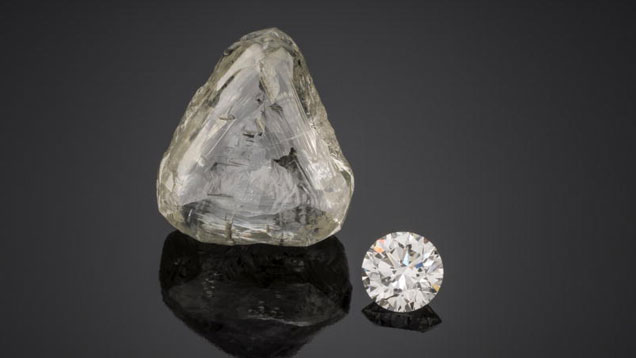
These diamonds – 22.32 ct macle, left, and 1.01 ct round brilliant – are from the Oppenheimer Collection. Gift of DeBeers, photo by Robert Weldon/GIA
This week’s De Beers’ sight is unlikely to feature significant price increases, but company executives are laying out a series of major changes in the sight system that will begin in January.
First, De Beers will tighten the credit reporting requirements for each client. The company has reportedly backed away from a more strict policy proposed by major industry banks that would sharply reduce a client’s acceptable debt-to-equity ratio. Many major clients, however, continue to struggle with high debts and slow collections and would be unable to meet those more stringent requirements.
Earlier this year, the banks financing the diamond industry sharply reduced their credit exposure. They began to require that sightholders and other rough dealers fund a minimum of 30% of their purchases themselves, instead of the banks providing 100% funding. In addition, they trimmed their lending ratio to as little as 60% of receivables.
Second, the company reportedly introduced new client selection criteria for existing sightholders based, in part, on previous buying. During the past several years, clients have been refusing some rough diamond assortments they believe are too expensive for the market. Some also deferred purchases in hopes that De Beers would lower prices on those goods in future sights.
De Beers also is reportedly introducing a new class of client, an Accredited Buyer, who will be able to purchase rough that is not contracted to existing clients. It is likely that most of the Accredited Buyers will be selected from buyers who participate in De Beers’ rough diamond auctions. The company already has appointed three sightholders from its auction buyer list.
SYNTHETICS: Concern over the infiltration of undisclosed synthetics into the diamond pipeline has prompted the Indian government, at the urging of the leading Indian industry organization, to propose a 10% import duty on synthetic polished diamonds.
All, or nearly all, synthetic diamonds are manufactured outside of India. The Gem and Jewellery Export Promotion Council in India is pushing the extra duty to reduce the price differential between natural and synthetic diamonds, it said in a statement. The government is also considering a 5% duty on synthetic rough diamond imports.
Although concern over the advent of synthetics is rising following several reported discoveries of undisclosed stones mixed in parcels of naturals, GIA remains confident it can differentiate all lab-grown diamonds from natural stones. In addition, GIA and other firms have developed detection equipment to screen parcels of diamonds that are generally too small to be sent to gemological labs for grading.
Russell Shor, senior industry analyst
Russell Shor, senior industry analyst
These diamonds – 22.32 ct macle, left, and 1.01 ct round brilliant – are from the Oppenheimer Collection. Gift of DeBeers, photo by Robert Weldon/GIA
This week’s De Beers’ sight is unlikely to feature significant price increases, but company executives are laying out a series of major changes in the sight system that will begin in January.
First, De Beers will tighten the credit reporting requirements for each client. The company has reportedly backed away from a more strict policy proposed by major industry banks that would sharply reduce a client’s acceptable debt-to-equity ratio. Many major clients, however, continue to struggle with high debts and slow collections and would be unable to meet those more stringent requirements.
Earlier this year, the banks financing the diamond industry sharply reduced their credit exposure. They began to require that sightholders and other rough dealers fund a minimum of 30% of their purchases themselves, instead of the banks providing 100% funding. In addition, they trimmed their lending ratio to as little as 60% of receivables.
Second, the company reportedly introduced new client selection criteria for existing sightholders based, in part, on previous buying. During the past several years, clients have been refusing some rough diamond assortments they believe are too expensive for the market. Some also deferred purchases in hopes that De Beers would lower prices on those goods in future sights.
De Beers also is reportedly introducing a new class of client, an Accredited Buyer, who will be able to purchase rough that is not contracted to existing clients. It is likely that most of the Accredited Buyers will be selected from buyers who participate in De Beers’ rough diamond auctions. The company already has appointed three sightholders from its auction buyer list.
SYNTHETICS: Concern over the infiltration of undisclosed synthetics into the diamond pipeline has prompted the Indian government, at the urging of the leading Indian industry organization, to propose a 10% import duty on synthetic polished diamonds.
All, or nearly all, synthetic diamonds are manufactured outside of India. The Gem and Jewellery Export Promotion Council in India is pushing the extra duty to reduce the price differential between natural and synthetic diamonds, it said in a statement. The government is also considering a 5% duty on synthetic rough diamond imports.
Although concern over the advent of synthetics is rising following several reported discoveries of undisclosed stones mixed in parcels of naturals, GIA remains confident it can differentiate all lab-grown diamonds from natural stones. In addition, GIA and other firms have developed detection equipment to screen parcels of diamonds that are generally too small to be sent to gemological labs for grading.