

Recently, the Mumbai laboratory received a parcel of loose white to light cream baroque pearls identified as filled natural hollow saltwater pearls after visual and chemical examination. Four of these pearls exhibited notable heart-like shapes and an unusual red X-ray fluorescence (figure 1).
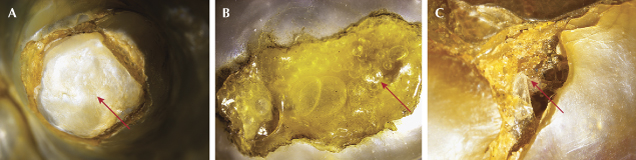
The four pearls ranged from 22.47 × 22.00 × 15.73 mm to 35.46 × 27.27 × 24.22 mm in size and weighed 34.30, 52.75, 75.86, and 98.53 ct. They appeared worn and fragile, and their heft slightly exceeded the typical weight for pearls of similar size (Winter 2022 Lab Notes, pp. 480–481). Their surfaces were characterized by significant cracks, grooves, and plugged areas. When viewed under higher magnification, all four pearls revealed areas that were sealed with a piece of shell, bonded together using a yellowish brown resinous adhesive (figure 2A). This adhesive was visible within the cracks and fissures and contained trapped air bubbles (figure 2, B and C). While some surface areas exhibited an overlapping nacre terrace structure, there was also evidence of working observed near the plugged areas.
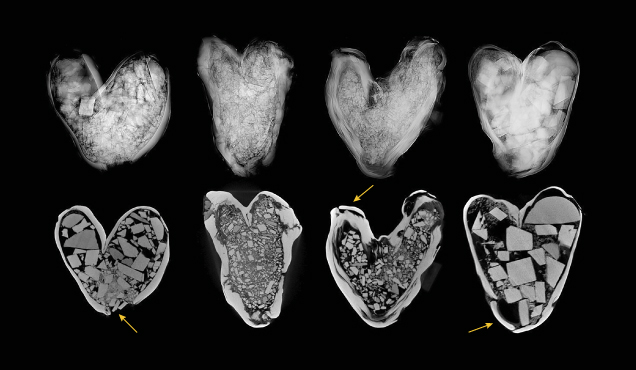
Real-time X-ray microradiography (RTX) and X-ray computed microtomography (μ-CT) analyses revealed the presence of large cavities filled with foreign materials, with a radiopacity similar to the pearls’ nacre. Rectangular and tabular fragments of different sizes used as fillers were visible in the μ-CT images, as well as pieces of cut shell to seal the pearls’ openings (figure 3). The smooth outline of these large cavities blended with the external shape of the pearls. In addition, the growth arc pattern of the surrounding nacre was an indicator of their natural formation. GIA has previously encountered similar pearls (Summer 2019 Lab Notes, pp. 251–254).
Energy dispersive X-ray fluorescence spectroscopy showed manganese levels below detection limits and strontium levels ranging from 790 to 1297 ppm, indicating a saltwater origin. When viewed under X-ray fluorescence, all four pearls showed red emission of varying intensity. Although most saltwater pearls are inert, this unusual red reaction could potentially be attributed to the unidentified material inside these filled natural hollow pearls. Under long-wave UV, the pearls showed a moderate bluish reaction, and an inert reaction under short-wave UV radiation.
All four pearls displayed evidence of considerable efforts to improve their durability, including cavity filling, plugging, and working their surfaces to smooth the areas around the plugs. However, despite these interventions, the overall shape, external appearance, and internal structures of the pearls indicate their natural origin. The unique shape and modifications applied to certain areas raise a degree of uncertainty regarding whether they are whole or blister pearls. Nevertheless, their distinctive heart shapes, along with their striking red fluorescence, make these pearls particularly noteworthy.
Eram Shaikh is an analytics technician, and Nishka Vaz is a senior gemologist, at GIA in Mumbai. Abeer Al-Alawi is a consultant to GIA.
Recently, the Mumbai laboratory received a parcel of loose white to light cream baroque pearls identified as filled natural hollow saltwater pearls after visual and chemical examination. Four of these pearls exhibited notable heart-like shapes and an unusual red X-ray fluorescence (figure 1).
The four pearls ranged from 22.47 × 22.00 × 15.73 mm to 35.46 × 27.27 × 24.22 mm in size and weighed 34.30, 52.75, 75.86, and 98.53 ct. They appeared worn and fragile, and their heft slightly exceeded the typical weight for pearls of similar size (Winter 2022 Lab Notes, pp. 480–481). Their surfaces were characterized by significant cracks, grooves, and plugged areas. When viewed under higher magnification, all four pearls revealed areas that were sealed with a piece of shell, bonded together using a yellowish brown resinous adhesive (figure 2A). This adhesive was visible within the cracks and fissures and contained trapped air bubbles (figure 2, B and C). While some surface areas exhibited an overlapping nacre terrace structure, there was also evidence of working observed near the plugged areas.
Real-time X-ray microradiography (RTX) and X-ray computed microtomography (μ-CT) analyses revealed the presence of large cavities filled with foreign materials, with a radiopacity similar to the pearls’ nacre. Rectangular and tabular fragments of different sizes used as fillers were visible in the μ-CT images, as well as pieces of cut shell to seal the pearls’ openings (figure 3). The smooth outline of these large cavities blended with the external shape of the pearls. In addition, the growth arc pattern of the surrounding nacre was an indicator of their natural formation. GIA has previously encountered similar pearls (Summer 2019 Lab Notes, pp. 251–254).
Energy dispersive X-ray fluorescence spectroscopy showed manganese levels below detection limits and strontium levels ranging from 790 to 1297 ppm, indicating a saltwater origin. When viewed under X-ray fluorescence, all four pearls showed red emission of varying intensity. Although most saltwater pearls are inert, this unusual red reaction could potentially be attributed to the unidentified material inside these filled natural hollow pearls. Under long-wave UV, the pearls showed a moderate bluish reaction, and an inert reaction under short-wave UV radiation.
All four pearls displayed evidence of considerable efforts to improve their durability, including cavity filling, plugging, and working their surfaces to smooth the areas around the plugs. However, despite these interventions, the overall shape, external appearance, and internal structures of the pearls indicate their natural origin. The unique shape and modifications applied to certain areas raise a degree of uncertainty regarding whether they are whole or blister pearls. Nevertheless, their distinctive heart shapes, along with their striking red fluorescence, make these pearls particularly noteworthy.
Eram Shaikh is an analytics technician, and Nishka Vaz is a senior gemologist, at GIA in Mumbai. Abeer Al-Alawi is a consultant to GIA.