

Gems are universally admired for their exquisite beauty and alluring interaction with light. For geologists searching for clues about Earth’s processes, gems are scientific treasures as much as visual ones. Rubies and sapphires are evidence of enormous heat and pressure deep underground; aquamarines are products of continental (tectonic) collisions. Inclusions in billion-year-old diamonds offer rare glimpses into Earth’s inaccessible mantle.
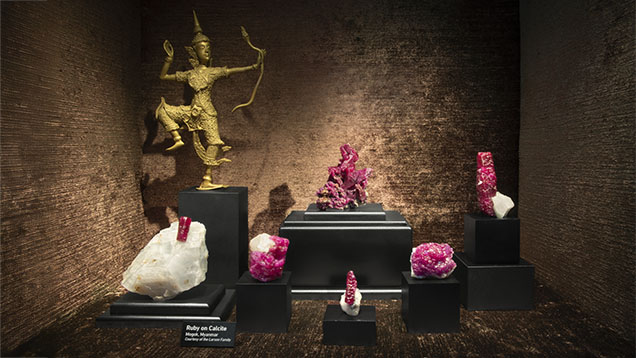
GIA’s museum team recently explored another dimension of gem appreciation: the bridges between human beings and higher powers. This exhibit in the Rotunda gallery at GIA in Carlsbad, California, showcases the extraordinary crystals and gems central to the cultures of southern Asia. In this region, gems symbolize connections to celestial bodies and the divine. As sacred talismans, they are seen to provide protection and wield powerful influence in every aspect of life.
Thus, when we admire a gem, we partake in a tradition almost as old as humanity. A single stone can embody beauty, wealth, Earth’s history, and spiritual meaning all at once. This layering of significance gives gems their enduring power—and explains why, from ancient temples to modern museums, they continue to captivate us.
The following pages highlight some of the displays and items in the exhibit, which will be at GIA headquarters in Carlsbad until May 2026. All photos by Emily Lane. Exhibit case design by McKenzie Santimer, MCKmetal; exhibit graphics by Tom Kwolik, Ikon Ideas, Inc.
Gems are universally admired for their exquisite beauty and alluring interaction with light. For geologists searching for clues about Earth’s processes, gems are scientific treasures as much as visual ones. Rubies and sapphires are evidence of enormous heat and pressure deep underground; aquamarines are products of continental (tectonic) collisions. Inclusions in billion-year-old diamonds offer rare glimpses into Earth’s inaccessible mantle.
GIA’s museum team recently explored another dimension of gem appreciation: the bridges between human beings and higher powers. This exhibit in the Rotunda gallery at GIA in Carlsbad, California, showcases the extraordinary crystals and gems central to the cultures of southern Asia. In this region, gems symbolize connections to celestial bodies and the divine. As sacred talismans, they are seen to provide protection and wield powerful influence in every aspect of life.
Thus, when we admire a gem, we partake in a tradition almost as old as humanity. A single stone can embody beauty, wealth, Earth’s history, and spiritual meaning all at once. This layering of significance gives gems their enduring power—and explains why, from ancient temples to modern museums, they continue to captivate us.
The following pages highlight some of the displays and items in the exhibit, which will be at GIA headquarters in Carlsbad until May 2026. All photos by Emily Lane. Exhibit case design by McKenzie Santimer, MCKmetal; exhibit graphics by Tom Kwolik, Ikon Ideas, Inc.