
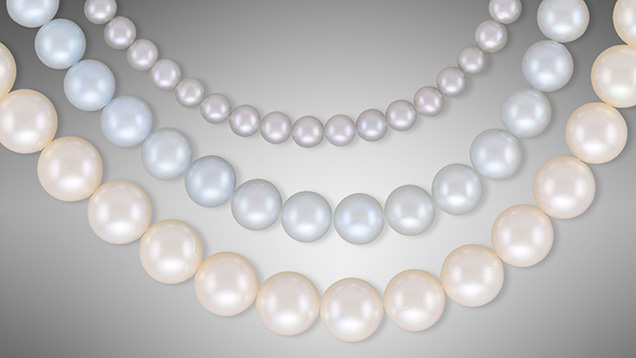
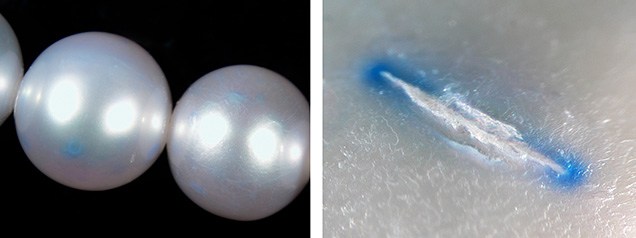
Recently, the Carlsbad laboratory received a strand of 78 light bluish gray near-round pearls for identification. The strand (figure 1, middle) weighed 16.75 g (gross), and the pearls measured approximately 5.45 mm in diameter. Upon first impression, they looked like akoya bead cultured (BC) pearls due to their small size and shell bead nuclei observed down the drill holes with a 10× loupe. Their light bluish gray bodycolor also resembled the unprocessed and untreated akoya BC pearls that have become more popular in the market. However, microscopic observation revealed light blue color concentrations under the surface of many pearls (figure 2, left) and blue dye around a surface-reaching feature on one sample (figure 2, right), suggesting that the colors had been artificially modified.
Energy-dispersive X-ray fluorescence chemical analysis showed high levels of manganese, indicating a freshwater origin, as opposed to the saltwater origin of akoya. In 2023, at the AGTA GemFair in Tucson and the Hong Kong International Jewellery show, we saw small near-round to round Chinese freshwater BC pearls around 2–4 mm gaining popularity in the market (Spring 2023 Gem News International, pp. 109–110). These Chinese cultured pearls were available in various colors that were either natural or modified. A strand consisting of 126 small light gray freshwater BC pearls approximately 3.50 mm in diameter (figure 1, top) was acquired at the Hong Kong show to study the internal structures. The light gray bodycolor, likely caused by irradiation considering the dark gray bead nuclei seen in the drill holes, was atypical for natural colored freshwater pearls.
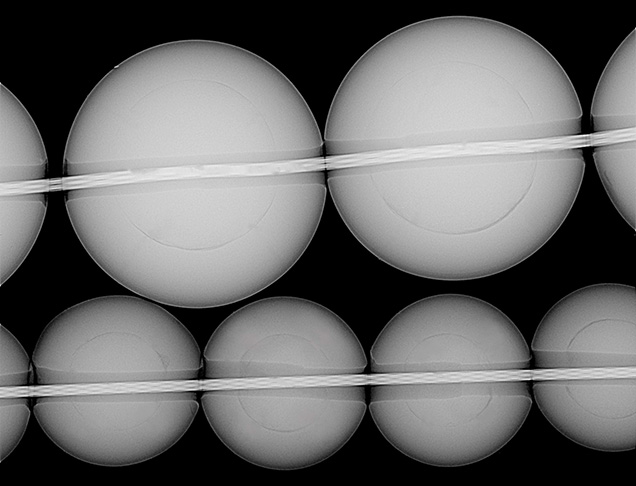
Real-time microradiography (RTX) revealed a distinct bead nucleus in each pearl in both the strands submitted for identification (figure 3, top) and the strand obtained from the Hong Kong show (figure 3, bottom), confirming they were bead cultured. All the pearls displayed relatively thick nacre, averaging about 1 mm for the larger strand and 0.8 mm for the smaller strand. The bead nuclei measured approximately 3.5 mm and 2.7 mm in diameter, respectively.
Although this type of small freshwater BC pearl is generally smaller than typical akoya BC pearls, there are also very small akoya BC pearls below 3 mm in the market (Spring 2018 Gem News International, pp. 103–105). Due to the popularity of very small round BC pearls, the size range of these types of freshwater and akoya pearls can be very similar. It could be difficult to separate them through visual inspection, and more advanced methods are likely needed to verify the environmental origin. The slightly flat surface feature previously encountered on white freshwater BC pearls was not present on the samples studied here (Spring 2023 Gem News International, pp. 109–110). Moreover, our freshwater BC pearl samples showed thicker nacre compared with the very small akoya pearls previously reported, with a nacre that was above the usual commercially accepted range (0.15–0.50 mm) for akoya.
Chinese freshwater cultured pearls are widely available in various sizes, shapes, colors, and qualities and have become a major part of the global market. This was GIA’s first examination of such small freshwater BC pearls, demonstrating the versatility of Chinese freshwater culturing methods in adapting to consumer demands.
Recently, the Carlsbad laboratory received a strand of 78 light bluish gray near-round pearls for identification. The strand (figure 1, middle) weighed 16.75 g (gross), and the pearls measured approximately 5.45 mm in diameter. Upon first impression, they looked like akoya bead cultured (BC) pearls due to their small size and shell bead nuclei observed down the drill holes with a 10× loupe. Their light bluish gray bodycolor also resembled the unprocessed and untreated akoya BC pearls that have become more popular in the market. However, microscopic observation revealed light blue color concentrations under the surface of many pearls (figure 2, left) and blue dye around a surface-reaching feature on one sample (figure 2, right), suggesting that the colors had been artificially modified.
Energy-dispersive X-ray fluorescence chemical analysis showed high levels of manganese, indicating a freshwater origin, as opposed to the saltwater origin of akoya. In 2023, at the AGTA GemFair in Tucson and the Hong Kong International Jewellery show, we saw small near-round to round Chinese freshwater BC pearls around 2–4 mm gaining popularity in the market (Spring 2023 Gem News International, pp. 109–110). These Chinese cultured pearls were available in various colors that were either natural or modified. A strand consisting of 126 small light gray freshwater BC pearls approximately 3.50 mm in diameter (figure 1, top) was acquired at the Hong Kong show to study the internal structures. The light gray bodycolor, likely caused by irradiation considering the dark gray bead nuclei seen in the drill holes, was atypical for natural colored freshwater pearls.
Real-time microradiography (RTX) revealed a distinct bead nucleus in each pearl in both the strands submitted for identification (figure 3, top) and the strand obtained from the Hong Kong show (figure 3, bottom), confirming they were bead cultured. All the pearls displayed relatively thick nacre, averaging about 1 mm for the larger strand and 0.8 mm for the smaller strand. The bead nuclei measured approximately 3.5 mm and 2.7 mm in diameter, respectively.
Although this type of small freshwater BC pearl is generally smaller than typical akoya BC pearls, there are also very small akoya BC pearls below 3 mm in the market (Spring 2018 Gem News International, pp. 103–105). Due to the popularity of very small round BC pearls, the size range of these types of freshwater and akoya pearls can be very similar. It could be difficult to separate them through visual inspection, and more advanced methods are likely needed to verify the environmental origin. The slightly flat surface feature previously encountered on white freshwater BC pearls was not present on the samples studied here (Spring 2023 Gem News International, pp. 109–110). Moreover, our freshwater BC pearl samples showed thicker nacre compared with the very small akoya pearls previously reported, with a nacre that was above the usual commercially accepted range (0.15–0.50 mm) for akoya.
Chinese freshwater cultured pearls are widely available in various sizes, shapes, colors, and qualities and have become a major part of the global market. This was GIA’s first examination of such small freshwater BC pearls, demonstrating the versatility of Chinese freshwater culturing methods in adapting to consumer demands.