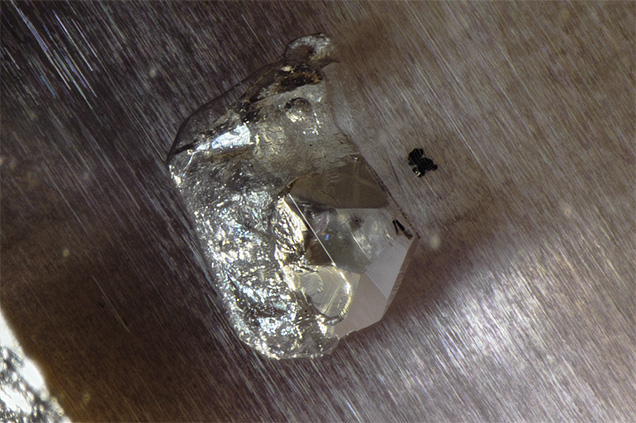
Routine investigation of a parcel of sapphires from Ohn Bin Yee Htwet near Mogok in Myanmar revealed something unexpected. Unusual composite inclusions were observed where one part of the inclusion exhibited flat, crisp, angular planes, while the other part showed an irregular and rough surface (figure 1). Raman spectroscopy identified the two phases as apatite (the flat, crystalline-looking area) and CO2 (the rough and irregular surface).
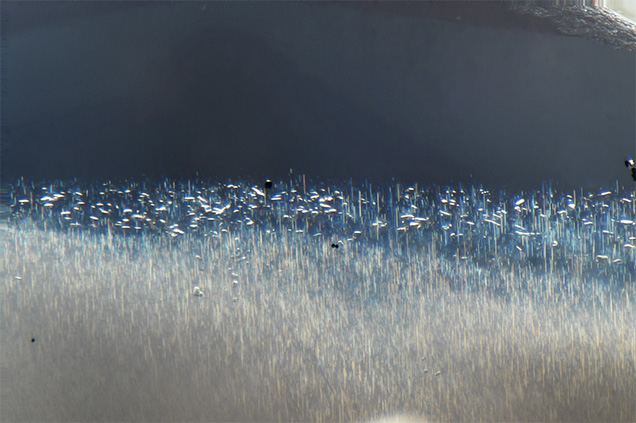
The rough and irregular part of the inclusion also showed a gas bubble within the fluid CO2, which disappeared when warmed in the well light of the microscope as the gas and liquid homogenized. These inclusions generally sit atop a dense nest of rutile silk. The rutile silk is tightly clustered in the core of the sapphire crystals and terminates rather abruptly. A myriad of inclusions is often found at the boundary between the dense, silky core and the unincluded rim (figure 2).
While both apatite and CO2 are routinely observed in sapphires from a variety of sources, finding both phases in a single inclusion is unexpected and has not been previously reported, to the author’s knowledge. It is hypothesized that these inclusions formed when apatite was trapped within the sapphire and created a growth blockage, thus allowing the fluid present (CO2) to adhere to the surface of the apatite and sapphire to become included as well.
Routine investigation of a parcel of sapphires from Ohn Bin Yee Htwet near Mogok in Myanmar revealed something unexpected. Unusual composite inclusions were observed where one part of the inclusion exhibited flat, crisp, angular planes, while the other part showed an irregular and rough surface (figure 1). Raman spectroscopy identified the two phases as apatite (the flat, crystalline-looking area) and CO2 (the rough and irregular surface).
The rough and irregular part of the inclusion also showed a gas bubble within the fluid CO2, which disappeared when warmed in the well light of the microscope as the gas and liquid homogenized. These inclusions generally sit atop a dense nest of rutile silk. The rutile silk is tightly clustered in the core of the sapphire crystals and terminates rather abruptly. A myriad of inclusions is often found at the boundary between the dense, silky core and the unincluded rim (figure 2).
While both apatite and CO2 are routinely observed in sapphires from a variety of sources, finding both phases in a single inclusion is unexpected and has not been previously reported, to the author’s knowledge. It is hypothesized that these inclusions formed when apatite was trapped within the sapphire and created a growth blockage, thus allowing the fluid present (CO2) to adhere to the surface of the apatite and sapphire to become included as well.