
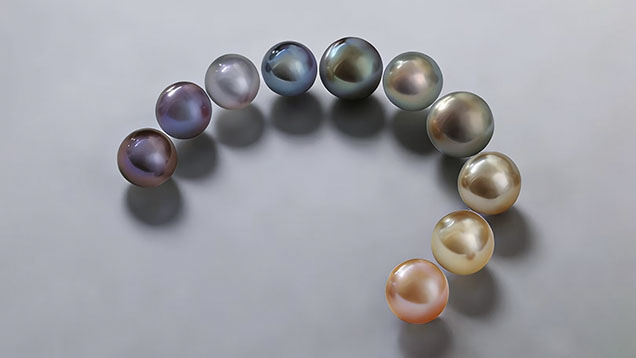
The Gemmological Institute at the China University of Geosciences recently received 53 freshwater cultured pearls displaying rare colors (figure 1): 21 purple, 7 green, 7 blue, and 18 orange pearls with rich hues. While white, orange, pink, and purple freshwater cultured pearls are common in the market, green, blue, and yellow colors are scarce. These pearls were nearly round, ranging from 7 to 14 mm in diameter, with most exhibiting good luster and smooth surfaces. The pearls were sourced from Menghao Jewelry, a supplier working directly with local pearl farmers in Zhejiang Province. With the increasing advancement of nucleated freshwater pearl cultivation technology in China, dozens of farms are capable of producing such rare-colored pearls, which typically range from 4 to 15 mm in diameter and require one to two years to grow. The main mollusk species used for their cultivation are Hyriopsis cumingii and Hyriopsis schlegelii.
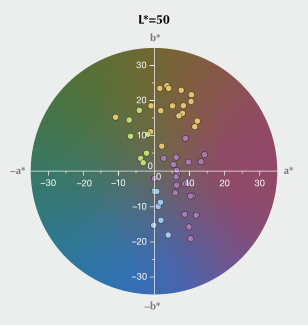
Microscopic observation of the studied pearls revealed clear surface contour textures with no artificial staining. The ultraviolet/visible spectroscopy analysis exhibited a stable characteristic absorption peak at 280 nm, typical of natural pearls, with no abnormal absorption signals, thus confirming the natural coloration of the samples. L*a*b* color parameters were collected for all samples, captured under a standard D65 light source and measured from the edges of pearl images. The L*a*b* parameters were widely distributed in CIE L*a*b* color space. The L* values of the purple-hued pearls were relatively lower than those of the orange-yellow-hued pearls. To provide an intuitive understanding of the color distribution, the data points were projected onto a two-dimensional cross section at L* = 50 (figure 2). The a* values of the 53 studied pearls ranged from a more greenish hue (a* = –11) to a more reddish hue (a* = 15). The b* values ranged from –20 to 25, covering both yellow and blue tones.
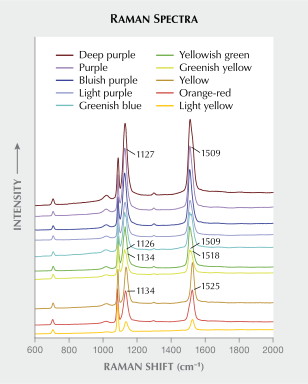
Of the 53 pearls, 10 representative samples were selected for Raman analysis (again, see figure 1). Two sets of Raman peaks related to natural polyenic pigments were detected in the pearls, including 1127/1509 cm–1 and 1134/1525 cm–1 (figure 3). The former is associated with purple pigment, while the latter is linked to orange pigment. Interestingly, the pearls with 1509 cm–1 Raman peaks not only exhibited the common hue of purple, but also rare hues of green and blue. The pearls with 1525 cm–1 Raman peaks were not limited to the yellow color, but presented a gradient series ranging from light yellow to orange-red. Additionally, two unusual Raman peaks were detected. The greenish yellow and greenish blue pearls exhibited double peaks at 1509 and 1518 cm–1, indicating the presence of mixed pigments within the pearls (S. Karampelas et al., “Role of polyenes in the coloration of cultured freshwater pearls,” European Journal of Mineralogy, Vol. 21, No. 1, 2009, pp. 85–97).
According to scientific studies, the rare colors of these types of pearls are primarily determined by the donor oyster’s nacre color (S. Karampelas and A. Lombard, “Gemological characteristics of saltwater cultured pearls produced after xenotransplantation,” Spring 2013 G&G, pp. 36–41; Z. Wang et al., “How cultured pearls acquire their colour,” Aquaculture Research, Vol. 51, No. 10, 2020, pp. 3925–3934). For example, Hyriopsis cumingii “Shenzi No. 1,” cultivated in China, can grow purple pearls, while another golden strain of Hyriopsis cumingii can grow yellow pearls.
However, some artificial treatments, such as dyeing, irradiation, bleaching, or coating, may be used to change the natural color to rare yellow, green, or blue colors, thus misleading less experienced buyers. Therefore, careful analysis is required to accurately distinguish between natural and artificial colors.
Chuting Zhang, Jing Yu, and Kexin Zhang are affiliated with the Gemmological Institute, China University of Geosciences, Wuhan.
The Gemmological Institute at the China University of Geosciences recently received 53 freshwater cultured pearls displaying rare colors (figure 1): 21 purple, 7 green, 7 blue, and 18 orange pearls with rich hues. While white, orange, pink, and purple freshwater cultured pearls are common in the market, green, blue, and yellow colors are scarce. These pearls were nearly round, ranging from 7 to 14 mm in diameter, with most exhibiting good luster and smooth surfaces. The pearls were sourced from Menghao Jewelry, a supplier working directly with local pearl farmers in Zhejiang Province. With the increasing advancement of nucleated freshwater pearl cultivation technology in China, dozens of farms are capable of producing such rare-colored pearls, which typically range from 4 to 15 mm in diameter and require one to two years to grow. The main mollusk species used for their cultivation are Hyriopsis cumingii and Hyriopsis schlegelii.
Microscopic observation of the studied pearls revealed clear surface contour textures with no artificial staining. The ultraviolet/visible spectroscopy analysis exhibited a stable characteristic absorption peak at 280 nm, typical of natural pearls, with no abnormal absorption signals, thus confirming the natural coloration of the samples. L*a*b* color parameters were collected for all samples, captured under a standard D65 light source and measured from the edges of pearl images. The L*a*b* parameters were widely distributed in CIE L*a*b* color space. The L* values of the purple-hued pearls were relatively lower than those of the orange-yellow-hued pearls. To provide an intuitive understanding of the color distribution, the data points were projected onto a two-dimensional cross section at L* = 50 (figure 2). The a* values of the 53 studied pearls ranged from a more greenish hue (a* = –11) to a more reddish hue (a* = 15). The b* values ranged from –20 to 25, covering both yellow and blue tones.
Of the 53 pearls, 10 representative samples were selected for Raman analysis (again, see figure 1). Two sets of Raman peaks related to natural polyenic pigments were detected in the pearls, including 1127/1509 cm–1 and 1134/1525 cm–1 (figure 3). The former is associated with purple pigment, while the latter is linked to orange pigment. Interestingly, the pearls with 1509 cm–1 Raman peaks not only exhibited the common hue of purple, but also rare hues of green and blue. The pearls with 1525 cm–1 Raman peaks were not limited to the yellow color, but presented a gradient series ranging from light yellow to orange-red. Additionally, two unusual Raman peaks were detected. The greenish yellow and greenish blue pearls exhibited double peaks at 1509 and 1518 cm–1, indicating the presence of mixed pigments within the pearls (S. Karampelas et al., “Role of polyenes in the coloration of cultured freshwater pearls,” European Journal of Mineralogy, Vol. 21, No. 1, 2009, pp. 85–97).
According to scientific studies, the rare colors of these types of pearls are primarily determined by the donor oyster’s nacre color (S. Karampelas and A. Lombard, “Gemological characteristics of saltwater cultured pearls produced after xenotransplantation,” Spring 2013 G&G, pp. 36–41; Z. Wang et al., “How cultured pearls acquire their colour,” Aquaculture Research, Vol. 51, No. 10, 2020, pp. 3925–3934). For example, Hyriopsis cumingii “Shenzi No. 1,” cultivated in China, can grow purple pearls, while another golden strain of Hyriopsis cumingii can grow yellow pearls.
However, some artificial treatments, such as dyeing, irradiation, bleaching, or coating, may be used to change the natural color to rare yellow, green, or blue colors, thus misleading less experienced buyers. Therefore, careful analysis is required to accurately distinguish between natural and artificial colors.
Chuting Zhang, Jing Yu, and Kexin Zhang are affiliated with the Gemmological Institute, China University of Geosciences, Wuhan.