
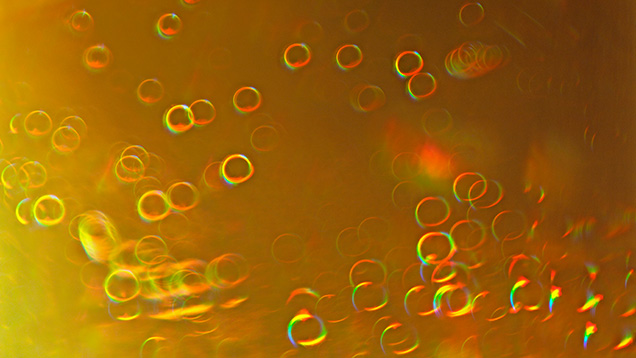
Sphene, better known to mineralogists as titanite (CaTiSiO5), is typically yellow, green, orange, or brown in color and is known for its incredible fire resulting from high dispersion. Recently, the author examined a 6.28 ct yellow cushion-cut stone displaying fire and strong eye-visible doubling. Its over-the-limit refractive index reading and visual appearance, as well as Raman spectroscopy, identified the specimen as sphene. Internal growth features, healed fissures, and a cloud of reflective particles were observed. Interestingly, the reflection of light from minute particles within the doubly-refractive sphene resulted in the appearance of a cloud of soap bubble–like inclusions, displaying interference colors in some crown facets (see above). The inclusions were best viewed with oblique fiber-optic lighting, creating a fantastic scene in this yellow sphene.
Ungkhana Atikarnsakul is a senior staff gemologist at GIA in Bangkok.
Sphene, better known to mineralogists as titanite (CaTiSiO5), is typically yellow, green, orange, or brown in color and is known for its incredible fire resulting from high dispersion. Recently, the author examined a 6.28 ct yellow cushion-cut stone displaying fire and strong eye-visible doubling. Its over-the-limit refractive index reading and visual appearance, as well as Raman spectroscopy, identified the specimen as sphene. Internal growth features, healed fissures, and a cloud of reflective particles were observed. Interestingly, the reflection of light from minute particles within the doubly-refractive sphene resulted in the appearance of a cloud of soap bubble–like inclusions, displaying interference colors in some crown facets (see above). The inclusions were best viewed with oblique fiber-optic lighting, creating a fantastic scene in this yellow sphene.
Ungkhana Atikarnsakul is a senior staff gemologist at GIA in Bangkok.