
A set of emeralds and beryl from Kazakhstan and Ukraine were analyzed at GIA’s Carlsbad laboratory as part of an ongoing beryl characterization research project. These stones were generously provided by Dr. Gerhard Franz of Technical University Berlin, and Dr. Oleksii Vyshnevskyi of Institute of Geochemistry, Mineralogy and Ore Formation, Ukraine.
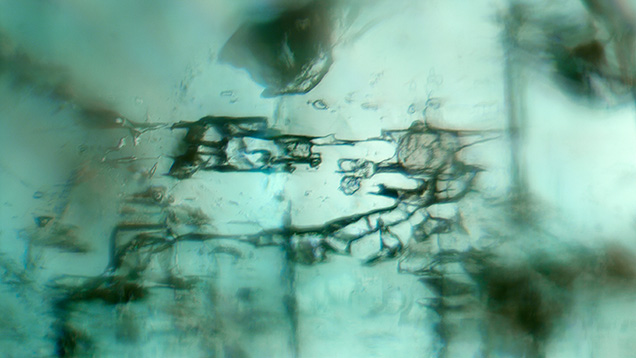
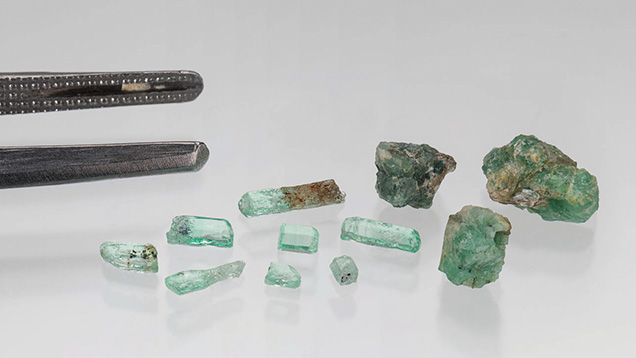
The study included eight euhedral samples of emerald from the Delbegetey locality in eastern Kazakhstan, and three anhedral beryl and emerald samples from Kruta Balka in southeast Ukraine (figure 1). The Kazakhstani emeralds were light green and had high clarity; they were nearly eye-clean, with small colorless or weakly colored fluid and two-phase inclusions (figure 2). Several had etching and stained surfaces at the base. Due to their high clarity and lively color, they were of gem quality, despite being quite small (only several millimeters in length). The Ukrainian emerald and beryl specimens were bright green and blue-green intergrown anhedral crystals with associated mica, appearing opaque as hand samples.
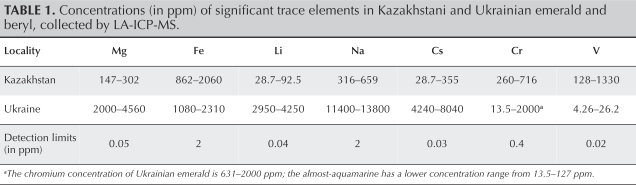
Chemical analysis by laser ablation–inductively coupled plasma–mass spectrometry (LA-ICP-MS; table 1) revealed distinct compositions based upon a few trace elements, setting them apart from commercially significant deposits. The data also revealed insights into the geological environment in which they formed.
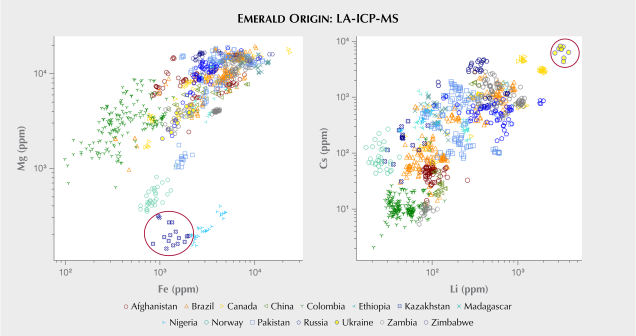
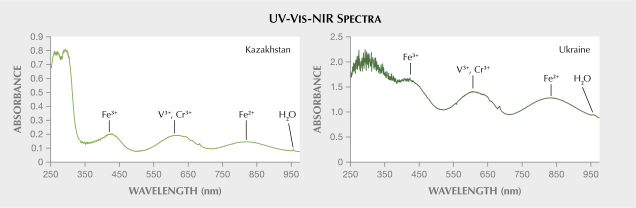
The Kazakhstani emeralds had some of the lowest documented magnesium, iron, and sodium concentrations for emerald, forming a unique data cluster adjacent to that of emeralds from Norway and Nigeria when comparing magnesium and iron (figure 3, left). The Kazakhstani samples were also among the few emeralds with more iron than magnesium, an indicator of their origin at the greisen intersection of the Delbegetey granitic pluton and a Carboniferous sandstone (E.V. Gavrilenko et al., “Emeralds from the Delbegetey deposit (Kazakhstan): Mineralogical characteristics and fluid-inclusion study,” Mineralogical Magazine, Vol. 70, No. 2, 2006, pp. 159–173), neither of which have significant magnesium to contribute to beryl. While the source of their chromium and vanadium (which contribute to their emerald-green hue in similar proportions) is unknown, some researchers have suggested other regional sedimentary layers as a potential source. Their exceptionally low ratio of magnesium to iron and low but variable cesium to sodium ratio (up to ~0.125 Cs/Na, based on atoms per formula unit) are consistent with formation in a mildly differentiated granite (C. Liu et al., “Continuous Be mineralization from two-mica granite to pegmatite: Critical element enrichment processes in a Himalayan leucogranite pluton,” American Mineralogist, Vol. 108, No. 2, 2023, pp. 31–41). This formation environment, which is uncommon in emeralds, most closely matches Nigerian emeralds, which have a similar mint green hue. It is possible that the small size of these emeralds contributes to the perception of paleness, as they have sufficient chromium and vanadium content to provide a distinct green hue that would classify them as emeralds. The ultraviolet/visible/near-infrared (UV-Vis-NIR) spectrum in figure 4 (left) confirms the contribution of these two chromophores.
The Ukrainian beryl and emerald samples are the product of a chemically evolved pegmatite intersecting with an ultramafic host rock, consistent with recent research findings (G. Franz et al., “A new emerald occurrence from Kruta Balka, Western Peri-Azovian region, Ukraine: Implications for understanding the crystal chemistry of emerald,” American Mineralogist, Vol. 105. No. 2, 2020, pp. 162–181). They had high cesium and lithium (figure 3, right)—higher than what this author recently reported for similar emeralds from Newfoundland, Canada, which form in a similar geological setting (Spring 2024 GNI, pp. 123–125). Only one emerald sample known to the author has had higher cesium content, though it was of uncertain origin, while emeralds from Hiddenite, North Carolina, are rumored to have higher lithium content. The elevated cesium and lithium together are strong indicators of a pegmatitic origin.
The Ukrainian emerald samples had an elevated Cs/Na ratio compared to their Mg/Fe ratio, setting them apart from most other emeralds, though a similar relationship between the two ratios exists in emeralds from Newfoundland, Curlew in Western Australia, and to some extent, Zimbabwe. The green hue of these specimens is attributed more to chromium than vanadium, with a slight influence from iron. The three Ukrainian emeralds also had high zinc compared to other studied emeralds. One had more of a blue hue with lower chromium and vanadium, placing it chemically between an aquamarine and an emerald, but the other two specimens were distinctly emerald based on their significant chromium content and green hue. The UV-Vis-NIR absorption spectrum of one of the green specimens (figure 4, right) confirmed the role of chromium and vanadium in the hue, though the sample’s poor transparency contributed to elevated absorbance.
These specimens expand our understanding of emerald beyond the traditional commercial deposits. With their unique characteristics, these two groups push the boundaries of emerald as a beryl variety. Following the present research project, these rare emerald and beryl specimens will join the GIA Museum collection.
A set of emeralds and beryl from Kazakhstan and Ukraine were analyzed at GIA’s Carlsbad laboratory as part of an ongoing beryl characterization research project. These stones were generously provided by Dr. Gerhard Franz of Technical University Berlin, and Dr. Oleksii Vyshnevskyi of Institute of Geochemistry, Mineralogy and Ore Formation, Ukraine.
The study included eight euhedral samples of emerald from the Delbegetey locality in eastern Kazakhstan, and three anhedral beryl and emerald samples from Kruta Balka in southeast Ukraine (figure 1). The Kazakhstani emeralds were light green and had high clarity; they were nearly eye-clean, with small colorless or weakly colored fluid and two-phase inclusions (figure 2). Several had etching and stained surfaces at the base. Due to their high clarity and lively color, they were of gem quality, despite being quite small (only several millimeters in length). The Ukrainian emerald and beryl specimens were bright green and blue-green intergrown anhedral crystals with associated mica, appearing opaque as hand samples.
Chemical analysis by laser ablation–inductively coupled plasma–mass spectrometry (LA-ICP-MS; table 1) revealed distinct compositions based upon a few trace elements, setting them apart from commercially significant deposits. The data also revealed insights into the geological environment in which they formed.
The Kazakhstani emeralds had some of the lowest documented magnesium, iron, and sodium concentrations for emerald, forming a unique data cluster adjacent to that of emeralds from Norway and Nigeria when comparing magnesium and iron (figure 3, left). The Kazakhstani samples were also among the few emeralds with more iron than magnesium, an indicator of their origin at the greisen intersection of the Delbegetey granitic pluton and a Carboniferous sandstone (E.V. Gavrilenko et al., “Emeralds from the Delbegetey deposit (Kazakhstan): Mineralogical characteristics and fluid-inclusion study,” Mineralogical Magazine, Vol. 70, No. 2, 2006, pp. 159–173), neither of which have significant magnesium to contribute to beryl. While the source of their chromium and vanadium (which contribute to their emerald-green hue in similar proportions) is unknown, some researchers have suggested other regional sedimentary layers as a potential source. Their exceptionally low ratio of magnesium to iron and low but variable cesium to sodium ratio (up to ~0.125 Cs/Na, based on atoms per formula unit) are consistent with formation in a mildly differentiated granite (C. Liu et al., “Continuous Be mineralization from two-mica granite to pegmatite: Critical element enrichment processes in a Himalayan leucogranite pluton,” American Mineralogist, Vol. 108, No. 2, 2023, pp. 31–41). This formation environment, which is uncommon in emeralds, most closely matches Nigerian emeralds, which have a similar mint green hue. It is possible that the small size of these emeralds contributes to the perception of paleness, as they have sufficient chromium and vanadium content to provide a distinct green hue that would classify them as emeralds. The ultraviolet/visible/near-infrared (UV-Vis-NIR) spectrum in figure 4 (left) confirms the contribution of these two chromophores.
The Ukrainian beryl and emerald samples are the product of a chemically evolved pegmatite intersecting with an ultramafic host rock, consistent with recent research findings (G. Franz et al., “A new emerald occurrence from Kruta Balka, Western Peri-Azovian region, Ukraine: Implications for understanding the crystal chemistry of emerald,” American Mineralogist, Vol. 105. No. 2, 2020, pp. 162–181). They had high cesium and lithium (figure 3, right)—higher than what this author recently reported for similar emeralds from Newfoundland, Canada, which form in a similar geological setting (Spring 2024 GNI, pp. 123–125). Only one emerald sample known to the author has had higher cesium content, though it was of uncertain origin, while emeralds from Hiddenite, North Carolina, are rumored to have higher lithium content. The elevated cesium and lithium together are strong indicators of a pegmatitic origin.
The Ukrainian emerald samples had an elevated Cs/Na ratio compared to their Mg/Fe ratio, setting them apart from most other emeralds, though a similar relationship between the two ratios exists in emeralds from Newfoundland, Curlew in Western Australia, and to some extent, Zimbabwe. The green hue of these specimens is attributed more to chromium than vanadium, with a slight influence from iron. The three Ukrainian emeralds also had high zinc compared to other studied emeralds. One had more of a blue hue with lower chromium and vanadium, placing it chemically between an aquamarine and an emerald, but the other two specimens were distinctly emerald based on their significant chromium content and green hue. The UV-Vis-NIR absorption spectrum of one of the green specimens (figure 4, right) confirmed the role of chromium and vanadium in the hue, though the sample’s poor transparency contributed to elevated absorbance.
These specimens expand our understanding of emerald beyond the traditional commercial deposits. With their unique characteristics, these two groups push the boundaries of emerald as a beryl variety. Following the present research project, these rare emerald and beryl specimens will join the GIA Museum collection.