

With silicon and oxygen as its building blocks, quartz is the single most abundant mineral in the earth’s crust. When it forms as transparent crystals, it serves as an excellent and durable host for inclusions.
The 178.42 ct terminated smoky brown quartz crystal on a pegmatitic albite and muscovite matrix, measuring 44.00 mm long and shown in figure 1, came from the collection of noted gemologist, collector, and author Dr. John Sinkankas of San Diego, California. Dr. Sinkankas found the specimen at the Little Three mine in Ramona, near San Diego, while doing field research for his three-volume Gemstones of North America.
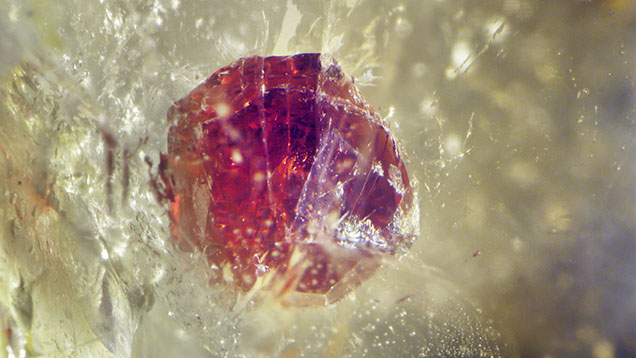
As shown microscopically in figure 2, the translucent, relatively large 3.3 mm dark reddish orange isometric inclusion appeared to be a garnet, since the pegmatitic Little Three mine is known to produce both quartz and spessartine. Raman analysis yielded an identification as spessartine, confirming our microscopic identification.
With silicon and oxygen as its building blocks, quartz is the single most abundant mineral in the earth’s crust. When it forms as transparent crystals, it serves as an excellent and durable host for inclusions.
The 178.42 ct terminated smoky brown quartz crystal on a pegmatitic albite and muscovite matrix, measuring 44.00 mm long and shown in figure 1, came from the collection of noted gemologist, collector, and author Dr. John Sinkankas of San Diego, California. Dr. Sinkankas found the specimen at the Little Three mine in Ramona, near San Diego, while doing field research for his three-volume Gemstones of North America.
As shown microscopically in figure 2, the translucent, relatively large 3.3 mm dark reddish orange isometric inclusion appeared to be a garnet, since the pegmatitic Little Three mine is known to produce both quartz and spessartine. Raman analysis yielded an identification as spessartine, confirming our microscopic identification.