
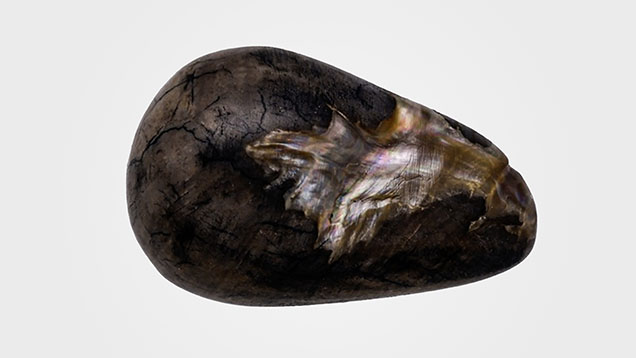
Recently, GIA’s Mumbai laboratory received a parcel of brown and black non-nacreous pearls for identification. Among these, the largest dark brown drop-shaped specimen, weighing 17.99 ct and measuring 19.58 × 12.25 mm (figure 1), exhibited visual and structural features inconsistent with the other examined pearls.
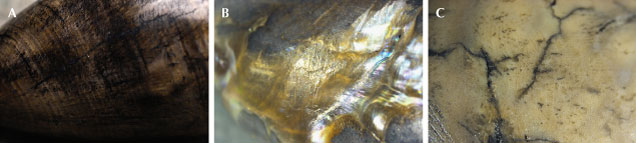
Externally, the specimen displayed fine banding across its dark brown non-nacreous surface (figure 2A), with an irregular light brown nacre covering one area. Microscopic examination using fiber-optic illumination revealed working and polishing lines on both the nacreous and non-nacreous portions, with the lines more distinct on the nacreous surface (figure 2B). The non-nacreous area showed a mosaic-like cellular pattern, with black concentrated along the banding and surface fractures attributable to the presence of a dye (figure 2C) (Fall 2021 Lab Notes, pp. 264–266), making it difficult to determine the mollusk species. When exposed to X-ray excitation, the specimen was inert. In addition, chemical analysis using energy-dispersive X-ray fluorescence detected no measurable manganese and a strontium level of 1283 ppm, indicating its saltwater origin.
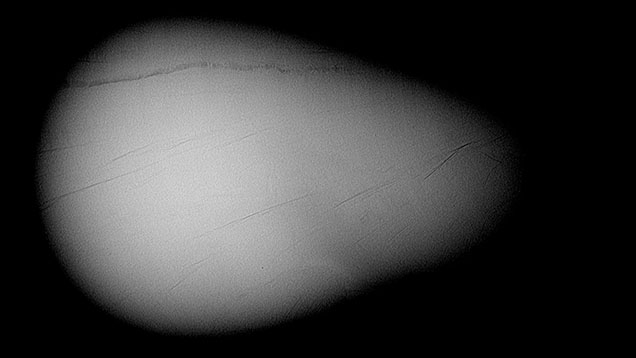
Under long-wave ultraviolet radiation, the specimen showed a weak greenish yellow reaction on its light brown areas, while darker portions remained inert. Raman spectroscopy using a 514 nm laser on the lighter brown nacreous area produced a doublet at 701 and 704 cm–1 and a peak at 1086 cm–1, indicative of aragonite. In contrast, no spectral peaks were detected on the dyed, darker brown non-nacreous area due to high fluorescence interference. Real-time X-ray microradiography (RTX) revealed distinctive internal parallel banding and fine surface-reaching cracks (figure 3), typical of shell material.
Collectively, these observations confirmed that the examined specimen was fashioned out of shell, carefully shaped and polished to imitate the appearance of a non-nacreous pearl, such as those produced from the Pinnidae family (N. Sturman et al., “Observations on pearls reportedly from the Pinnidae family (pen pearls),” Fall 2014 G&G, pp. 202–215). The presence of dye, combined with deliberate shaping and polishing, significantly enhanced its resemblance to a natural pearl. With the increasing market presence of imitations, continued caution and thorough analytical examination are essential for ensuring accuracy in pearl identification
Anukul Belanke is an analytics technician, Roxane Bhot Jain is manager of pearl, melee, and AGSI technical and market development, and Nishka Vaz is a senior gemologist, at GIA in Mumbai. Abeer Al-Alawi is a consultant to GIA.
Recently, GIA’s Mumbai laboratory received a parcel of brown and black non-nacreous pearls for identification. Among these, the largest dark brown drop-shaped specimen, weighing 17.99 ct and measuring 19.58 × 12.25 mm (figure 1), exhibited visual and structural features inconsistent with the other examined pearls.
Externally, the specimen displayed fine banding across its dark brown non-nacreous surface (figure 2A), with an irregular light brown nacre covering one area. Microscopic examination using fiber-optic illumination revealed working and polishing lines on both the nacreous and non-nacreous portions, with the lines more distinct on the nacreous surface (figure 2B). The non-nacreous area showed a mosaic-like cellular pattern, with black concentrated along the banding and surface fractures attributable to the presence of a dye (figure 2C) (Fall 2021 Lab Notes, pp. 264–266), making it difficult to determine the mollusk species. When exposed to X-ray excitation, the specimen was inert. In addition, chemical analysis using energy-dispersive X-ray fluorescence detected no measurable manganese and a strontium level of 1283 ppm, indicating its saltwater origin.
Under long-wave ultraviolet radiation, the specimen showed a weak greenish yellow reaction on its light brown areas, while darker portions remained inert. Raman spectroscopy using a 514 nm laser on the lighter brown nacreous area produced a doublet at 701 and 704 cm–1 and a peak at 1086 cm–1, indicative of aragonite. In contrast, no spectral peaks were detected on the dyed, darker brown non-nacreous area due to high fluorescence interference. Real-time X-ray microradiography (RTX) revealed distinctive internal parallel banding and fine surface-reaching cracks (figure 3), typical of shell material.
Collectively, these observations confirmed that the examined specimen was fashioned out of shell, carefully shaped and polished to imitate the appearance of a non-nacreous pearl, such as those produced from the Pinnidae family (N. Sturman et al., “Observations on pearls reportedly from the Pinnidae family (pen pearls),” Fall 2014 G&G, pp. 202–215). The presence of dye, combined with deliberate shaping and polishing, significantly enhanced its resemblance to a natural pearl. With the increasing market presence of imitations, continued caution and thorough analytical examination are essential for ensuring accuracy in pearl identification
Anukul Belanke is an analytics technician, Roxane Bhot Jain is manager of pearl, melee, and AGSI technical and market development, and Nishka Vaz is a senior gemologist, at GIA in Mumbai. Abeer Al-Alawi is a consultant to GIA.