
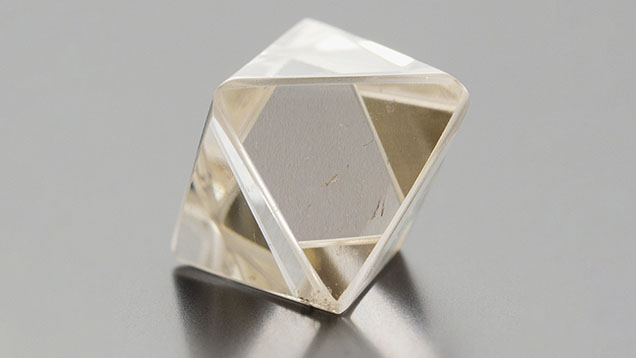
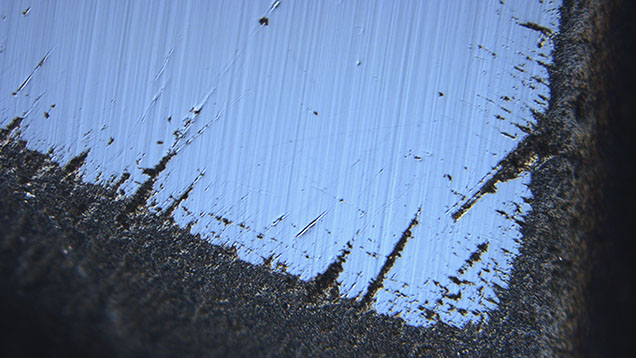
This report covers the first instance, to the authors’ knowledge, of a synthetic diamond grown by chemical vapor deposition (CVD) being deliberately fashioned into the approximate shape of a rough natural diamond crystal. The authors recently examined a 6.87 ct near-colorless crystal (figure 1). Raman spectroscopy confirmed the stone as diamond, and the near-octahedral shape was similar to the morphology of a natural rough diamond. Further examination revealed that it was not a genuine octahedron, with only one set of opposite faces being parallel. Microscopic observation using differential interference contrast showed extremely flat faces with a series of parallel polishing lines as the only significant feature (figure 2), unlike the growth steps and trigons typical of octahedral faces in natural diamond. The junctions between the facets were extremely rough, possibly due to graphitization during heat treatment to improve the color of the stone, with the main faces having been repolished after the heat treatment.
X-ray Laue diffraction was used to confirm the orientation of the faces. In a natural diamond octahedron, all eight faces are parallel to {111} planes. None of the faces of this stone were parallel to {111} planes. Two of the opposite faces were parallel to {100} planes, consistent with the preparation of a stone from a block of CVD-grown synthetic diamond. The favored direction of growth in CVD synthesis is in a (100) direction on a substrate with a planar face in a {100} plane. An octahedral block maximizing the height of the as-grown material could be prepared from this with two {100} faces aligned with the substrate interface and the final growth surface. Producing a stone such as this one from a block of CVD material grown in a (100) direction requires careful processing, and any resultant polished diamond would have a much lower yield than one produced directly from the as-grown block of material. The only motivation for such an action appears to be a deliberate attempt at deceit.
Infrared absorption measurements indicated that this was a type IIa diamond (i.e., one that contains no detectable nitrogen-related absorption). Around 1 to 2% of natural diamonds are type IIa, but they are usually irregular in shape (I. Sunagawa, “A discussion on the origin of irregular shapes of type II diamonds,” Journal of Gemmology, Vol. 27, No. 7, 2001, pp. 417–425). Natural octahedral diamonds with a well-formed crystal habit are almost always type Ia, making the type and morphology combination observed for this stone inconsistent with natural diamond. All colorless synthetic diamonds are type IIa or very weak type IIb due to the presence of a small concentration of uncompensated boron.
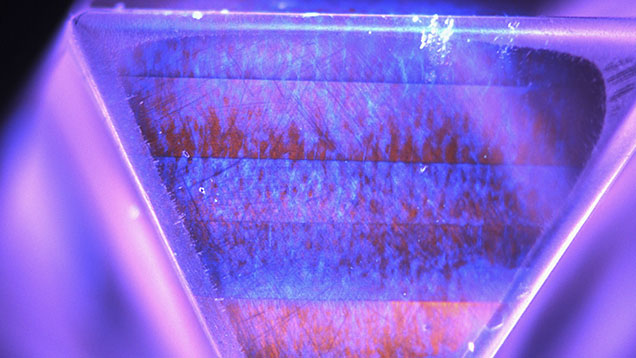
The stone was definitively identified as a CVD synthetic diamond through DiamondView imaging of the flat faces (figure 3). The background luminescence showed bands of orange emission of varying intensity from nitrogen vacancy centers incorporated during the CVD growth process. The bands were consistent with a stop-start growth process in which periods of reasonably consistent growth are interrupted either by a significant change in growth parameters or possibly the stopping of the process to reposition the stone with respect to the plasma in the chamber. Within the coarse growth bands, it is also possible to see growth striations due to step-flow growth with differential uptake of impurities at the terraces and risers of the steps (P.M. Martineau et al., “Identification of synthetic diamond grown using chemical vapor deposition (CVD),” Spring 2004 G&G, pp. 2–25).
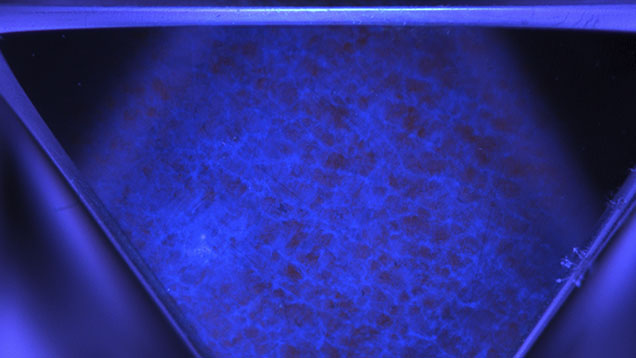
Also evident in figure 3 are “plumes” of blue luminescence that thread through the coarse bands roughly perpendicular to them. These are associated with dislocation bundles due to columnar growth and have been widely reported for CVD synthetic diamonds (M.P. Gaukroger et al., “X-ray topography studies of dislocations in single crystal CVD diamond,” Diamond and Related Materials, Vol. 17, No. 3, 2008, pp. 262–269). The dislocations run approximately parallel to the growth direction and form a network where they intersect the final growth surface. This is evident in figure 4, a view of the face adjacent to and parallel with the final growth surface. This region has very weak orange emission, and the only significant features are the blue dislocation networks.
There is currently no evidence of any widespread switching of synthetic for natural diamonds in the rough diamond pipeline, but overreliance on practices such as assessing the “heft” of a stone would obviously not allow reliable screening for synthetic diamonds. Careful examination of the detailed appearance of this stone allowed it to be identified, and while it could be possible to replicate some of the surface features of a natural diamond (e.g., growth steps and trigons) through etching processes, these features would be extremely difficult to reproduce in detail due to the difference in crystallographic orientations of the polished faces compared with a genuine diamond octahedron. Should synthetic diamonds fashioned in this way become more prevalent, an immediate screening solution for rough diamonds could be implemented through adaptation of existing screening instruments for polished diamonds. Analysis of this stone with a wide range of diamond verification instruments gave the correct referral results, and the main characteristics were consistent with those seen routinely in polished synthetic diamonds.
Nick Davies, Sema Firat, David Fisher, and Thoufieq Shaik are affiliated with De Beers Science & Technology in Maidenhead, United Kingdom.
This report covers the first instance, to the authors’ knowledge, of a synthetic diamond grown by chemical vapor deposition (CVD) being deliberately fashioned into the approximate shape of a rough natural diamond crystal. The authors recently examined a 6.87 ct near-colorless crystal (figure 1). Raman spectroscopy confirmed the stone as diamond, and the near-octahedral shape was similar to the morphology of a natural rough diamond. Further examination revealed that it was not a genuine octahedron, with only one set of opposite faces being parallel. Microscopic observation using differential interference contrast showed extremely flat faces with a series of parallel polishing lines as the only significant feature (figure 2), unlike the growth steps and trigons typical of octahedral faces in natural diamond. The junctions between the facets were extremely rough, possibly due to graphitization during heat treatment to improve the color of the stone, with the main faces having been repolished after the heat treatment.
X-ray Laue diffraction was used to confirm the orientation of the faces. In a natural diamond octahedron, all eight faces are parallel to {111} planes. None of the faces of this stone were parallel to {111} planes. Two of the opposite faces were parallel to {100} planes, consistent with the preparation of a stone from a block of CVD-grown synthetic diamond. The favored direction of growth in CVD synthesis is in a (100) direction on a substrate with a planar face in a {100} plane. An octahedral block maximizing the height of the as-grown material could be prepared from this with two {100} faces aligned with the substrate interface and the final growth surface. Producing a stone such as this one from a block of CVD material grown in a (100) direction requires careful processing, and any resultant polished diamond would have a much lower yield than one produced directly from the as-grown block of material. The only motivation for such an action appears to be a deliberate attempt at deceit.
Infrared absorption measurements indicated that this was a type IIa diamond (i.e., one that contains no detectable nitrogen-related absorption). Around 1 to 2% of natural diamonds are type IIa, but they are usually irregular in shape (I. Sunagawa, “A discussion on the origin of irregular shapes of type II diamonds,” Journal of Gemmology, Vol. 27, No. 7, 2001, pp. 417–425). Natural octahedral diamonds with a well-formed crystal habit are almost always type Ia, making the type and morphology combination observed for this stone inconsistent with natural diamond. All colorless synthetic diamonds are type IIa or very weak type IIb due to the presence of a small concentration of uncompensated boron.
The stone was definitively identified as a CVD synthetic diamond through DiamondView imaging of the flat faces (figure 3). The background luminescence showed bands of orange emission of varying intensity from nitrogen vacancy centers incorporated during the CVD growth process. The bands were consistent with a stop-start growth process in which periods of reasonably consistent growth are interrupted either by a significant change in growth parameters or possibly the stopping of the process to reposition the stone with respect to the plasma in the chamber. Within the coarse growth bands, it is also possible to see growth striations due to step-flow growth with differential uptake of impurities at the terraces and risers of the steps (P.M. Martineau et al., “Identification of synthetic diamond grown using chemical vapor deposition (CVD),” Spring 2004 G&G, pp. 2–25).
Also evident in figure 3 are “plumes” of blue luminescence that thread through the coarse bands roughly perpendicular to them. These are associated with dislocation bundles due to columnar growth and have been widely reported for CVD synthetic diamonds (M.P. Gaukroger et al., “X-ray topography studies of dislocations in single crystal CVD diamond,” Diamond and Related Materials, Vol. 17, No. 3, 2008, pp. 262–269). The dislocations run approximately parallel to the growth direction and form a network where they intersect the final growth surface. This is evident in figure 4, a view of the face adjacent to and parallel with the final growth surface. This region has very weak orange emission, and the only significant features are the blue dislocation networks.
There is currently no evidence of any widespread switching of synthetic for natural diamonds in the rough diamond pipeline, but overreliance on practices such as assessing the “heft” of a stone would obviously not allow reliable screening for synthetic diamonds. Careful examination of the detailed appearance of this stone allowed it to be identified, and while it could be possible to replicate some of the surface features of a natural diamond (e.g., growth steps and trigons) through etching processes, these features would be extremely difficult to reproduce in detail due to the difference in crystallographic orientations of the polished faces compared with a genuine diamond octahedron. Should synthetic diamonds fashioned in this way become more prevalent, an immediate screening solution for rough diamonds could be implemented through adaptation of existing screening instruments for polished diamonds. Analysis of this stone with a wide range of diamond verification instruments gave the correct referral results, and the main characteristics were consistent with those seen routinely in polished synthetic diamonds.
Nick Davies, Sema Firat, David Fisher, and Thoufieq Shaik are affiliated with De Beers Science & Technology in Maidenhead, United Kingdom.