
As mined, Burmese ruby from Mong Hsu can be unattractive due to dense clouds and unusual blue cores, resulting in a low-grade cloudy material. Heat treatment is typically performed to remove the blue color and silk, making the final product a rich, clear red. Because the majority of Mong Hsu rubies are heavily fractured, they are often heated with a flux such as borax to fill voids and allow the fractures to partially heal. The result is a much clearer and more durable product.
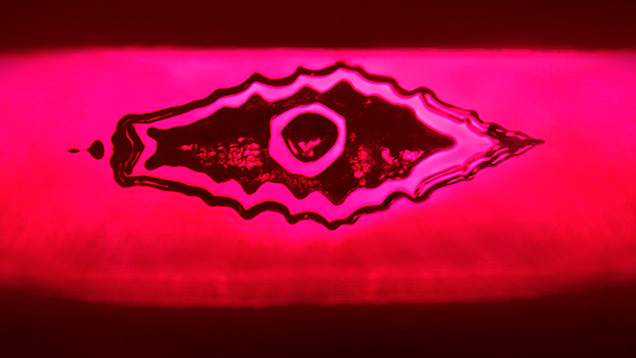
The fissures in a recently examined 1.22 ct heat-treated Mong Hsu ruby were also healed with residual flux. In this case, the mirror reflection of the flux-healed fissure from a step pavilion facet resulted in an inclusion resembling an evil eye (see above). When this stone is viewed under a microscope, an evil eye appears to be staring back at the observer.
As mined, Burmese ruby from Mong Hsu can be unattractive due to dense clouds and unusual blue cores, resulting in a low-grade cloudy material. Heat treatment is typically performed to remove the blue color and silk, making the final product a rich, clear red. Because the majority of Mong Hsu rubies are heavily fractured, they are often heated with a flux such as borax to fill voids and allow the fractures to partially heal. The result is a much clearer and more durable product.
The fissures in a recently examined 1.22 ct heat-treated Mong Hsu ruby were also healed with residual flux. In this case, the mirror reflection of the flux-healed fissure from a step pavilion facet resulted in an inclusion resembling an evil eye (see above). When this stone is viewed under a microscope, an evil eye appears to be staring back at the observer.