
The authors recently examined a 13.99 ct red cushion mixed cut, which revealed interesting inclusions upon microscopic examination. Standard gemological testing of the host material proved consistent with ruby but yielded some unusual results. When subjected to short-wave ultraviolet light, the stone displayed a chalky yellow fluorescence concentrated within surface-reaching fractures.
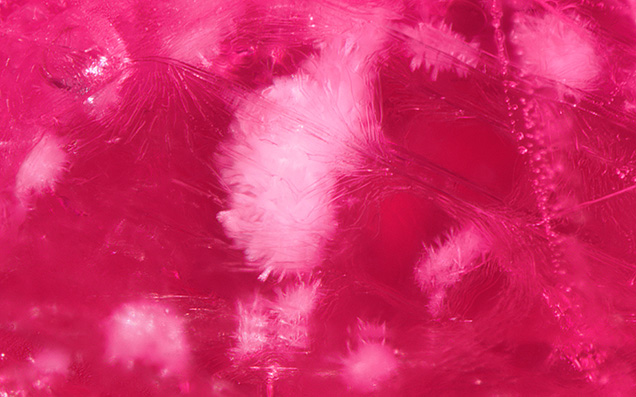
Magnification revealed a collection of fine particles and altered crystals with discoid fractures typical of some natural rubies after heat exposure. Curiously, the stone exhibited partially healed fractures with flux-like textures, with some fractures also containing round and flattened gas bubbles. The authors also observed structures of whitish acicular projections radiating outward that formed spiked spherical crystals resembling pom-poms or sea urchins (see above). These formations occurred within filled cavities that displayed visible luster differences from the host corundum. Laser ablation–inductively coupled plasma–mass spectrometry, Raman spectroscopy, and X-ray imaging confirmed the presence of a foreign material, and X-ray fluorescence identified bismuth within the filled cavities. The authors concluded that bismuth glass was present in the ruby as a clarity enhancement treatment. The acicular pom-pom formations were a result of devitrification of the bismuth glass filler at some stage in the annealing process, a likely unintended and unwelcome byproduct for a treater with the goal of clarity enhancement, but a visually appealing feature for a gemologist nonetheless.
The authors recently examined a 13.99 ct red cushion mixed cut, which revealed interesting inclusions upon microscopic examination. Standard gemological testing of the host material proved consistent with ruby but yielded some unusual results. When subjected to short-wave ultraviolet light, the stone displayed a chalky yellow fluorescence concentrated within surface-reaching fractures.
Magnification revealed a collection of fine particles and altered crystals with discoid fractures typical of some natural rubies after heat exposure. Curiously, the stone exhibited partially healed fractures with flux-like textures, with some fractures also containing round and flattened gas bubbles. The authors also observed structures of whitish acicular projections radiating outward that formed spiked spherical crystals resembling pom-poms or sea urchins (see above). These formations occurred within filled cavities that displayed visible luster differences from the host corundum. Laser ablation–inductively coupled plasma–mass spectrometry, Raman spectroscopy, and X-ray imaging confirmed the presence of a foreign material, and X-ray fluorescence identified bismuth within the filled cavities. The authors concluded that bismuth glass was present in the ruby as a clarity enhancement treatment. The acicular pom-pom formations were a result of devitrification of the bismuth glass filler at some stage in the annealing process, a likely unintended and unwelcome byproduct for a treater with the goal of clarity enhancement, but a visually appealing feature for a gemologist nonetheless.