
Known for its sharp hourglass color zoning and double termination, Moroccan amethyst has been well documented and characterized in the past (Spring 2017 GNI, pp. 126–127). However, it was the precise placement and aqueous nature of the inclusions in the deeply saturated, large faceted amethysts that caught the author’s attention at the Pueblo show this year.
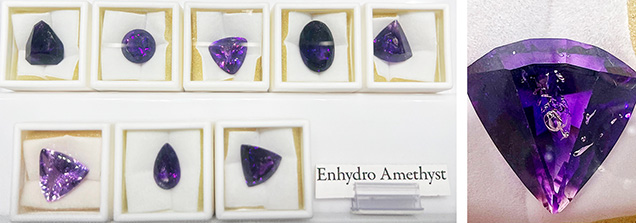
The gemstones were exhibited by Gem & Gold Creations (Scottsdale, Arizona) as “enhydro” amethyst (see above, left). “Enhydro” comes from the Greek word enhydros, which means “water within.” In gemology, enhydro terminology is typically reserved for a hollow nodule or geode of chalcedony containing water. However, “enhydro quartz” is often used in the trade to describe colorless, transparent crystalline quartz with fluid inclusions or liquid-filled cavities. The most interesting examples have a gas bubble within the fluid inclusion that moves freely when the stone is turned.
The Moroccan amethysts displayed were of similar nature to the more commonly seen colorless enhydro quartz, each containing a large primary fluid inclusion with a free-moving gas bubble prominently oriented in the center of the table facet (see above, right). Many of the playful inclusions were so large that magnification was not needed to observe them.
Inclusions such as these aren’t only a treat for the eyes—they also serve as a fascinating reminder of a gemstone’s natural origin. Fluid inclusions are rare samples of natural fluids that were trapped inside rocks and minerals long ago during their formation. A gas bubble within a fluid inclusion is a result of temperature changes endured during a mineral’s journey to the earth’s surface. As the mineral and the fluid cool down over time, the fluid shrinks at a faster rate than the mineral, causing a gas bubble to exsolve within the fluid.
These specimens with eye-visible fluid inclusions were a rare find with such a rich and even reddish purple hue—the most prized hue for amethyst. Ai Van Pham, owner of Gem & Gold Creations, noted that out of the 70 kg of rough amethyst he purchased from Morocco, only 10 amethysts were considered enhydro once faceted.
Loading video player...
Free-Moving Gas Bubble in “Enhydro” Amethyst
Known for its sharp hourglass color zoning and double termination, Moroccan amethyst has been well documented and characterized in the past (Spring 2017 GNI, pp. 126–127). However, it was the precise placement and aqueous nature of the inclusions in the deeply saturated, large faceted amethysts that caught the author’s attention at the Pueblo show this year.
The gemstones were exhibited by Gem & Gold Creations (Scottsdale, Arizona) as “enhydro” amethyst (see above, left). “Enhydro” comes from the Greek word enhydros, which means “water within.” In gemology, enhydro terminology is typically reserved for a hollow nodule or geode of chalcedony containing water. However, “enhydro quartz” is often used in the trade to describe colorless, transparent crystalline quartz with fluid inclusions or liquid-filled cavities. The most interesting examples have a gas bubble within the fluid inclusion that moves freely when the stone is turned.
The Moroccan amethysts displayed were of similar nature to the more commonly seen colorless enhydro quartz, each containing a large primary fluid inclusion with a free-moving gas bubble prominently oriented in the center of the table facet (see above, right). Many of the playful inclusions were so large that magnification was not needed to observe them.
Inclusions such as these aren’t only a treat for the eyes—they also serve as a fascinating reminder of a gemstone’s natural origin. Fluid inclusions are rare samples of natural fluids that were trapped inside rocks and minerals long ago during their formation. A gas bubble within a fluid inclusion is a result of temperature changes endured during a mineral’s journey to the earth’s surface. As the mineral and the fluid cool down over time, the fluid shrinks at a faster rate than the mineral, causing a gas bubble to exsolve within the fluid.
These specimens with eye-visible fluid inclusions were a rare find with such a rich and even reddish purple hue—the most prized hue for amethyst. Ai Van Pham, owner of Gem & Gold Creations, noted that out of the 70 kg of rough amethyst he purchased from Morocco, only 10 amethysts were considered enhydro once faceted.
Loading video player...
Free-Moving Gas Bubble in “Enhydro” Amethyst