
Two yellow sapphires recently examined by the authors each contained a green crystal inclusion. Upon analysis, however, the two inclusions turned out to be very different minerals.
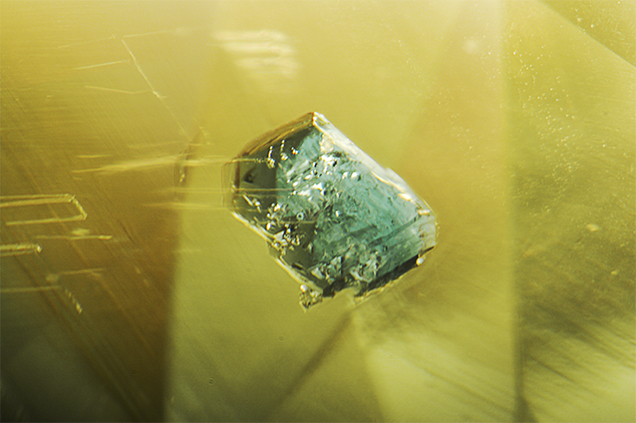
A yellow sapphire of Sri Lankan origin hosted a saturated bluish green crystal inclusion. Optically it was singly refractive, and Raman spectroscopy proved it to be a spinel crystal (figure 1). Spinel inclusions of this color have been documented in yellow sapphires before (E.J. Gübelin and J.I. Koivula, Photoatlas of Inclusions in Gemstones, Vol. 1, ABC Edition, Zurich, 1986, pp. 353–354), but this crystal was remarkably large and completely enclosed in the stone.
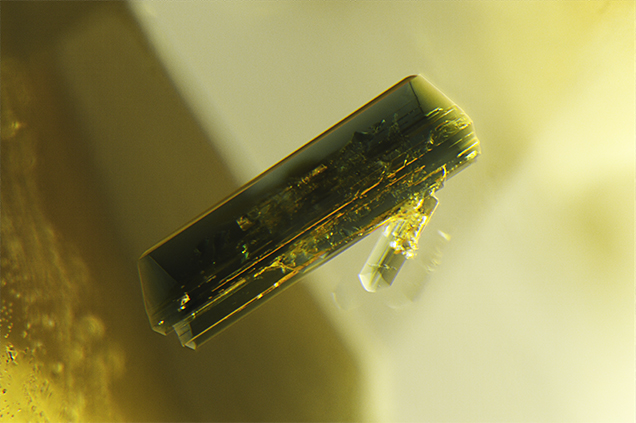
The second yellow sapphire contained a green semitransparent crystal that, unlike the previous inclusion, was doubly refractive and more rectangular in shape (figure 2), with sublinear striations and a smaller secondary crystal on the opposite side. With the aid of Raman spectroscopy, the brownish green crystal was identified as pargasite, a metamorphic calcium-dominated amphibole mineral associated with spinel and corundum deposits (J.W. Anthony et al., Handbook of Mineralogy, Vol. 2, Mineral Data Publishing, Tucson, Arizona, 1995). As an inclusion, pargasite has been previously documented in corundum—more frequently in rubies from Myanmar, Pakistan, and Tanzania, and in blue sapphires from Kashmir (E.J. Gübelin and J.I. Koivula, Photoatlas of Inclusions in Gemstones, Vol. 3, Opinio Verlag, Basel, Switzerland, 2008). The fact that the host sapphire was yellow makes this inclusion a fascinating discovery for the authors.
Two yellow sapphires recently examined by the authors each contained a green crystal inclusion. Upon analysis, however, the two inclusions turned out to be very different minerals.
A yellow sapphire of Sri Lankan origin hosted a saturated bluish green crystal inclusion. Optically it was singly refractive, and Raman spectroscopy proved it to be a spinel crystal (figure 1). Spinel inclusions of this color have been documented in yellow sapphires before (E.J. Gübelin and J.I. Koivula, Photoatlas of Inclusions in Gemstones, Vol. 1, ABC Edition, Zurich, 1986, pp. 353–354), but this crystal was remarkably large and completely enclosed in the stone.
The second yellow sapphire contained a green semitransparent crystal that, unlike the previous inclusion, was doubly refractive and more rectangular in shape (figure 2), with sublinear striations and a smaller secondary crystal on the opposite side. With the aid of Raman spectroscopy, the brownish green crystal was identified as pargasite, a metamorphic calcium-dominated amphibole mineral associated with spinel and corundum deposits (J.W. Anthony et al., Handbook of Mineralogy, Vol. 2, Mineral Data Publishing, Tucson, Arizona, 1995). As an inclusion, pargasite has been previously documented in corundum—more frequently in rubies from Myanmar, Pakistan, and Tanzania, and in blue sapphires from Kashmir (E.J. Gübelin and J.I. Koivula, Photoatlas of Inclusions in Gemstones, Vol. 3, Opinio Verlag, Basel, Switzerland, 2008). The fact that the host sapphire was yellow makes this inclusion a fascinating discovery for the authors.