Conch pearls are among the rarest non-nacreous pearls and are most valued for their distinctive pink coloration, porcelain-like luster, and pronounced flame structure. While pink is the most sought-after hue, conch pearls also occur in a range of colors, including white, yellow, orange, and brown. These pearls originate from the marine gastropod Aliger gigas (formerly known as Strombus gigas and Lobatus gigas), commonly called the Queen conch and found primarily in the Caribbean. Although attempts to culture conch pearls have been reported (A. Minnick, “Marine biologists develop method for creating cultured conch pearls,” Southern Jewelry News, March 2, 2010; Summer 2015 Gem News International, pp. 201–202), commercial production remains experimental and limited.
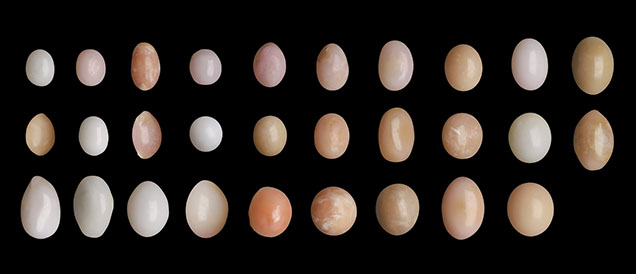
Recently, GIA’s Mumbai laboratory examined a parcel of 29 conch pearls submitted for identification (figure 1). The samples measured 2.92 × 2.53 mm to 5.42 × 4.98 × 4.31 mm and weighed between 0.26 and 0.97 ct. They were oval and near-oval in shape and exhibited light coloration from white to various shades of yellow, orange, and pink. Overall, most pearls exhibited low surface quality. Microscopic examination revealed that the majority displayed the characteristic slender and short flame structures with spiky ends typically observed in natural conch pearls (E. Fritsch and E.B. Misiorowski, “The history and gemology of Queen conch ‘pearls,’” Winter 1987 G&G, pp. 208–221). However, some pearls from the parcel showed granular and uneven surface textures, accompanied by patchy and irregular coloration. Raman spectroscopy analysis of the pearls revealed a doublet at 702 and 705 cm–1 and a peak at 1085 cm–1, indicative of aragonite, with polyenic peaks at 1130 and 1530 cm–1 associated with organic pigments characteristic of pink to orange coloration (S. Karampelas et al., “Raman spectroscopy of natural and cultured pearls and pearl producing mollusc shells,” Journal of Raman Spectroscopy, Vol. 51, No. 9, 2020, pp. 1813–1821).
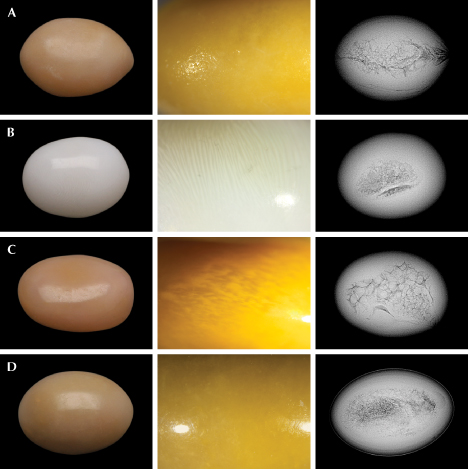
Real-time X-ray microradiography (RTX) imaging of most of the pearls revealed tight to minimal growth features, with a few displaying small faint voids—structures typically observed in natural conch pearls. In contrast, four pearls showed a distinctive large granulated area characterized by irregular outlines and variable radiopacities (figure 2).
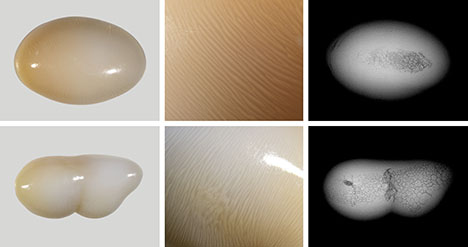
Similar internal characteristics were documented in two reportedly non-bead cultured conch pearls submitted to GIA’s Bangkok laboratory from a trusted source (figure 3). The close resemblance between these features suggests that the four pearls tested in the Mumbai laboratory were also likely cultured. This observation further indicates that some non-bead cultured conch pearls may be intermixed with lower quality natural conch pearls in the marketplace.
This group of conch pearls highlighted the challenges involved in distinguishing natural conch pearls from their cultured counterparts. Borderline linear and void features can be difficult to interpret, and prolonged X-ray exposure poses a risk of potential color alteration in these pearls. While conch pearl culturing remains noncommercial and experimental, internal structures featuring large granular textured areas must be interpreted with caution, as they closely resemble those observed in reportedly non-bead cultured conch pearls.
Roxane Bhot Jain is manager of pearl, melee, and AGSI technical and market development, and Rajesh Patel is a senior gemologist, at GIA in Mumbai. Abeer Al-Alawi is a consultant to GIA. Kwanreun Lawanwong is a senior analytics technician at GIA in Bangkok. Chunhui Zhou is senior manager of research at GIA in New York.
Conch pearls are among the rarest non-nacreous pearls and are most valued for their distinctive pink coloration, porcelain-like luster, and pronounced flame structure. While pink is the most sought-after hue, conch pearls also occur in a range of colors, including white, yellow, orange, and brown. These pearls originate from the marine gastropod Aliger gigas (formerly known as Strombus gigas and Lobatus gigas), commonly called the Queen conch and found primarily in the Caribbean. Although attempts to culture conch pearls have been reported (A. Minnick, “Marine biologists develop method for creating cultured conch pearls,” Southern Jewelry News, March 2, 2010; Summer 2015 Gem News International, pp. 201–202), commercial production remains experimental and limited.
Recently, GIA’s Mumbai laboratory examined a parcel of 29 conch pearls submitted for identification (figure 1). The samples measured 2.92 × 2.53 mm to 5.42 × 4.98 × 4.31 mm and weighed between 0.26 and 0.97 ct. They were oval and near-oval in shape and exhibited light coloration from white to various shades of yellow, orange, and pink. Overall, most pearls exhibited low surface quality. Microscopic examination revealed that the majority displayed the characteristic slender and short flame structures with spiky ends typically observed in natural conch pearls (E. Fritsch and E.B. Misiorowski, “The history and gemology of Queen conch ‘pearls,’” Winter 1987 G&G, pp. 208–221). However, some pearls from the parcel showed granular and uneven surface textures, accompanied by patchy and irregular coloration. Raman spectroscopy analysis of the pearls revealed a doublet at 702 and 705 cm–1 and a peak at 1085 cm–1, indicative of aragonite, with polyenic peaks at 1130 and 1530 cm–1 associated with organic pigments characteristic of pink to orange coloration (S. Karampelas et al., “Raman spectroscopy of natural and cultured pearls and pearl producing mollusc shells,” Journal of Raman Spectroscopy, Vol. 51, No. 9, 2020, pp. 1813–1821).
Real-time X-ray microradiography (RTX) imaging of most of the pearls revealed tight to minimal growth features, with a few displaying small faint voids—structures typically observed in natural conch pearls. In contrast, four pearls showed a distinctive large granulated area characterized by irregular outlines and variable radiopacities (figure 2).
Similar internal characteristics were documented in two reportedly non-bead cultured conch pearls submitted to GIA’s Bangkok laboratory from a trusted source (figure 3). The close resemblance between these features suggests that the four pearls tested in the Mumbai laboratory were also likely cultured. This observation further indicates that some non-bead cultured conch pearls may be intermixed with lower quality natural conch pearls in the marketplace.
This group of conch pearls highlighted the challenges involved in distinguishing natural conch pearls from their cultured counterparts. Borderline linear and void features can be difficult to interpret, and prolonged X-ray exposure poses a risk of potential color alteration in these pearls. While conch pearl culturing remains noncommercial and experimental, internal structures featuring large granular textured areas must be interpreted with caution, as they closely resemble those observed in reportedly non-bead cultured conch pearls.
Roxane Bhot Jain is manager of pearl, melee, and AGSI technical and market development, and Rajesh Patel is a senior gemologist, at GIA in Mumbai. Abeer Al-Alawi is a consultant to GIA. Kwanreun Lawanwong is a senior analytics technician at GIA in Bangkok. Chunhui Zhou is senior manager of research at GIA in New York.