
Recently, the Dubai laboratory encountered a strongly phosphorescent natural type IIa/IaB diamond, which showed a transient response, shifting to type IIb after deep-ultraviolet (<230 nm) excitation. The 2.50 ct oval-shaped diamond was graded as D color with VS1 clarity and received Excellent grades on both polish and symmetry. Although instances of strong phosphorescence (Winter 2017 Gem News International, pp. 476–478; Summer 2021 Gem News International, pp. 177–178) and similar transient responses in natural diamonds (J. Li et al., “A diamond with a transient 2804 cm–1 absorption peak,” Journal of Gemmology, Vol. 35, No. 3, 2016, pp. 248–252; Winter 2018 Gem News International, pp. 453–455) have been reported previously, this diamond’s size and quality make it notable.
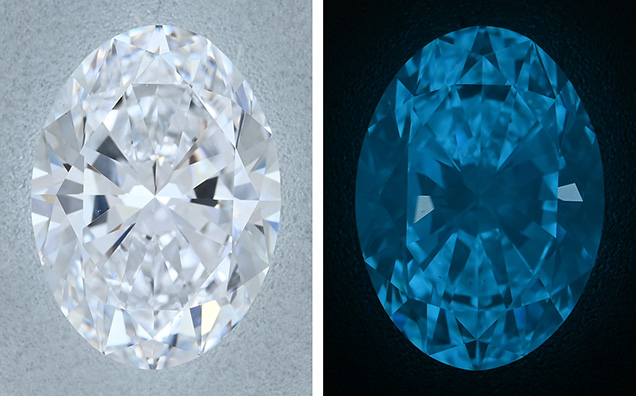
Strong and long-lived phosphorescence such as the blue phosphorescence observed in this diamond is typical of high-pressure, high-temperature (HPHT) laboratory-grown diamonds. As the necessary ingredients for observed phosphorescence, neutral boron and neutral isolated nitrogen can be present in HPHT-grown diamonds in abundance. However, when observed in natural diamonds, particularly those with a D color grade, phosphorescence is usually weak and fleeting. The fact that this diamond exhibited a strong and long-lasting phosphorescence (figure 1) with a duration of more than one minute prompted further investigation.
Photoluminescence (PL) spectra obtained using 830 nm laser excitation at liquid nitrogen temperature showed a very weak 883.1/884.6 nm doublet, a feature that is related to nickel impurities. In addition, 514 nm laser excitation produced a spectrum with a weak nickel-related broad band centered at ~640 nm (W. Wang et al., “Natural type Ia diamond with green-yellow color due to Ni-related defects,” Fall 2007 G&G, pp. 240–243) and a sharp 694 nm peak ascribed to Ni-N complexes (C.M. Breeding et al., “Natural-color green diamonds: A beautiful conundrum,” Spring 2018 G&G, pp. 2–27). These characteristics all indicated the presence of nickel, but compared to those commonly seen in HPHT-grown diamonds, the PL intensities of these nickel-related features were much lower. DiamondView imaging further ruled out the possibility of an HPHT-grown diamond due to the absence of typical growth sectors.

While possible to observe nickel impurities in natural diamonds, it is rarely coupled with strong phosphorescence, warranting a more thorough investigation. A Fourier-transform infrared (FTIR) spectrum (figure 2) was re-collected immediately after deep-UV exposure. An absorption at 2800 cm–1 was induced which correlated to an ~3 ppb concentration of uncompensated boron, and then it slowly decayed and became undetectable within a few minutes, a timeframe longer than the duration in which observable phosphorescence dissipated. The weak nitrogen B-center at 1175 cm–1, on the other hand, remained unaffected by deep-UV exposure. This transient response suggested that boron had been made uncompensated upon deep-UV exposure and then became detectable under FTIR spectroscopy. A mechanism has been suggested by Dean (P.J. Dean, “Bound excitons and donor-acceptor pairs in natural and synthetic diamond,” Physical Review, Vol. 139, 1965, pp. A588–A602), and a decay model has also been proposed and studied (J. Zhao et al., “Phosphorescence and donor-acceptor pair recombination in laboratory-grown diamonds,” Physical Review B, Vol. 108, 2023, article no. 165203).
For PL analysis, the sample was transferred immediately after deep-UV exposure to the PL system. Each PL spectrum was re-collected shortly after deep-UV exposure, but no noticeable changes were seen before and after deep-UV irradiation. Unlike typical type IIb natural diamonds, there were no detectable 648.2 cm–1, 3H, or other characteristic type IIb emissions.
This example demonstrates the intertwined relationships and complexity of features observed in both natural and laboratory-grown diamonds. Reliance on a single observable screening feature such as strong phosphorescence might lead to misidentification. Advanced gemological testing and thorough identification processes are fundamentally important to ensure an accurate gem identification result.
Nick “Ka Chun” Chan is a senior staff gemologist, and Satyaprasad Pradhan is an analytics technician, at GIA in Dubai.
Recently, the Dubai laboratory encountered a strongly phosphorescent natural type IIa/IaB diamond, which showed a transient response, shifting to type IIb after deep-ultraviolet (<230 nm) excitation. The 2.50 ct oval-shaped diamond was graded as D color with VS1 clarity and received Excellent grades on both polish and symmetry. Although instances of strong phosphorescence (Winter 2017 Gem News International, pp. 476–478; Summer 2021 Gem News International, pp. 177–178) and similar transient responses in natural diamonds (J. Li et al., “A diamond with a transient 2804 cm–1 absorption peak,” Journal of Gemmology, Vol. 35, No. 3, 2016, pp. 248–252; Winter 2018 Gem News International, pp. 453–455) have been reported previously, this diamond’s size and quality make it notable.
Strong and long-lived phosphorescence such as the blue phosphorescence observed in this diamond is typical of high-pressure, high-temperature (HPHT) laboratory-grown diamonds. As the necessary ingredients for observed phosphorescence, neutral boron and neutral isolated nitrogen can be present in HPHT-grown diamonds in abundance. However, when observed in natural diamonds, particularly those with a D color grade, phosphorescence is usually weak and fleeting. The fact that this diamond exhibited a strong and long-lasting phosphorescence (figure 1) with a duration of more than one minute prompted further investigation.
Photoluminescence (PL) spectra obtained using 830 nm laser excitation at liquid nitrogen temperature showed a very weak 883.1/884.6 nm doublet, a feature that is related to nickel impurities. In addition, 514 nm laser excitation produced a spectrum with a weak nickel-related broad band centered at ~640 nm (W. Wang et al., “Natural type Ia diamond with green-yellow color due to Ni-related defects,” Fall 2007 G&G, pp. 240–243) and a sharp 694 nm peak ascribed to Ni-N complexes (C.M. Breeding et al., “Natural-color green diamonds: A beautiful conundrum,” Spring 2018 G&G, pp. 2–27). These characteristics all indicated the presence of nickel, but compared to those commonly seen in HPHT-grown diamonds, the PL intensities of these nickel-related features were much lower. DiamondView imaging further ruled out the possibility of an HPHT-grown diamond due to the absence of typical growth sectors.
While possible to observe nickel impurities in natural diamonds, it is rarely coupled with strong phosphorescence, warranting a more thorough investigation. A Fourier-transform infrared (FTIR) spectrum (figure 2) was re-collected immediately after deep-UV exposure. An absorption at 2800 cm–1 was induced which correlated to an ~3 ppb concentration of uncompensated boron, and then it slowly decayed and became undetectable within a few minutes, a timeframe longer than the duration in which observable phosphorescence dissipated. The weak nitrogen B-center at 1175 cm–1, on the other hand, remained unaffected by deep-UV exposure. This transient response suggested that boron had been made uncompensated upon deep-UV exposure and then became detectable under FTIR spectroscopy. A mechanism has been suggested by Dean (P.J. Dean, “Bound excitons and donor-acceptor pairs in natural and synthetic diamond,” Physical Review, Vol. 139, 1965, pp. A588–A602), and a decay model has also been proposed and studied (J. Zhao et al., “Phosphorescence and donor-acceptor pair recombination in laboratory-grown diamonds,” Physical Review B, Vol. 108, 2023, article no. 165203).
For PL analysis, the sample was transferred immediately after deep-UV exposure to the PL system. Each PL spectrum was re-collected shortly after deep-UV exposure, but no noticeable changes were seen before and after deep-UV irradiation. Unlike typical type IIb natural diamonds, there were no detectable 648.2 cm–1, 3H, or other characteristic type IIb emissions.
This example demonstrates the intertwined relationships and complexity of features observed in both natural and laboratory-grown diamonds. Reliance on a single observable screening feature such as strong phosphorescence might lead to misidentification. Advanced gemological testing and thorough identification processes are fundamentally important to ensure an accurate gem identification result.
Nick “Ka Chun” Chan is a senior staff gemologist, and Satyaprasad Pradhan is an analytics technician, at GIA in Dubai.