
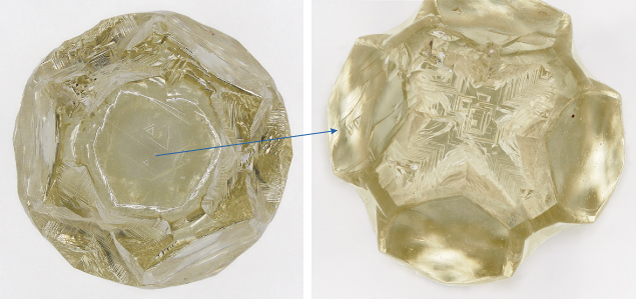
A rare yellow 3.49 ct diamond from a private collector exhibiting an unusual form due to a combination of growth and dissolution features was recently studied by the authors (figure 1). Microscopic examination highlighted the absence of solid inclusions and the presence of brown stains near the surface (figure 2, left). The stains were due to natural irradiation causing the formation of GR1 defects, implying that the stains were initially green and turned brown after the annealing process (S. Eaton-Magaña et al., “Low-temperature annealing and kinetics of radiation stains in natural diamond,” Diamond and Related Materials, Vol. 132, 2023, article no. 109649).

Ultraviolet/visible/near-infrared spectroscopy indicated absorption features at 415, 373, 383, 392, and 404 nm related to N3 and N2 defects. A small percentage of yellow diamonds with these defects also contain hydrogen-related defects (C.M. Breeding et al., “Natural-color green diamonds: A beautiful conundrum,” Spring 2018 G&G, pp. 2–27). In fact, the infrared spectrum of this stone showed the absorption peaks at 3107 and 1405 cm–1 characteristic of N3VH0 defects. With the sharp 3107 cm–1 peak, the hydrogen concentration was enough to classify the diamond as “hydrogen-rich” (T. Hainschwang et al., “A defect study and classification of brown diamonds with non-deformation-related color,” Minerals, Vol. 10, No. 10, 2020, article no. 914). The peak at 1377 cm–1 indicated that the diamond also contained platelets (i.e., extended planar defects considered byproducts of nitrogen aggregation) (J.P. Goss et al., “Extended defects in diamond: The interstitial platelet,” Physical Review B, Vol. 67, No. 16, 2003, article no. 165208).
While its color and size were impressive, the unique shape of the diamond, a result of growth and dissolution events, attests to the specimen’s complex history. The yellow diamond’s well-developed octahedral faces were marked by the presence of shallow trigons (figure 2, right) and separated by slightly curved resorbed faces. Tetragonal etch pits were clearly recognizable in this diamond (figure 1, right). This type of pit has been observed in diamonds from Botswana (C.M. Welbourn et al., “A study of diamonds of cube and cube-related shape from the Jwaneng mine,” Journal of Crystal Growth, Vol. 94, No. 1, 1989, pp. 229–252) and are referred to as “re-entrant cubes,” indicating dissolution processes that modified the initial cuboctahedral mixed habit. Unfortunately, the geological and geographical provenances of the yellow diamond are unknown, making the reconstruction of the formation conditions more difficult. However, trigon features (such as size and shape) can provide information about fluid composition and temperature during dissolution event(s) (Y. Fedortchouk et al., “Diamond destruction and growth during mantle metasomatism: An experimental study of diamond resorption features,” Earth and Planetary Science Letters, Vol. 506, 2019, pp. 493–506), helping to determine if this occurred during kimberlite transport or mantle storage (K.V. Smit and S.B. Shirey, “Diamonds are not forever! Diamond dissolution,” Spring 2020 G&G, pp. 148–155). A possible formation history of this exceptional diamond has been recently proposed by authors IP and CF (I. Pignatelli and C. Ferraris, “A rare yellow diamond: Reconstruction of the possible geological history,” Crystals, Vol. 15, No. 5, 2025, article no. 461) on the basis of non-destructive analyses.
Isabella Pignatelli is with the Centre de Recherches Pétrographiques et Géochimiques (CRPG), and Dominik Schaniel is with the CNRS Laboratoire de Cristallographie, Résonance Magnétique et Modélisation, at the Université de Lorraine in Nancy, France. Cristiano Ferraris is with the Institut de Minéralogie, de Physique des Matériaux et de Cosmochimie at the Museum National d’Histoire Naturelle in Paris.
A rare yellow 3.49 ct diamond from a private collector exhibiting an unusual form due to a combination of growth and dissolution features was recently studied by the authors (figure 1). Microscopic examination highlighted the absence of solid inclusions and the presence of brown stains near the surface (figure 2, left). The stains were due to natural irradiation causing the formation of GR1 defects, implying that the stains were initially green and turned brown after the annealing process (S. Eaton-Magaña et al., “Low-temperature annealing and kinetics of radiation stains in natural diamond,” Diamond and Related Materials, Vol. 132, 2023, article no. 109649).
Ultraviolet/visible/near-infrared spectroscopy indicated absorption features at 415, 373, 383, 392, and 404 nm related to N3 and N2 defects. A small percentage of yellow diamonds with these defects also contain hydrogen-related defects (C.M. Breeding et al., “Natural-color green diamonds: A beautiful conundrum,” Spring 2018 G&G, pp. 2–27). In fact, the infrared spectrum of this stone showed the absorption peaks at 3107 and 1405 cm–1 characteristic of N3VH0 defects. With the sharp 3107 cm–1 peak, the hydrogen concentration was enough to classify the diamond as “hydrogen-rich” (T. Hainschwang et al., “A defect study and classification of brown diamonds with non-deformation-related color,” Minerals, Vol. 10, No. 10, 2020, article no. 914). The peak at 1377 cm–1 indicated that the diamond also contained platelets (i.e., extended planar defects considered byproducts of nitrogen aggregation) (J.P. Goss et al., “Extended defects in diamond: The interstitial platelet,” Physical Review B, Vol. 67, No. 16, 2003, article no. 165208).
While its color and size were impressive, the unique shape of the diamond, a result of growth and dissolution events, attests to the specimen’s complex history. The yellow diamond’s well-developed octahedral faces were marked by the presence of shallow trigons (figure 2, right) and separated by slightly curved resorbed faces. Tetragonal etch pits were clearly recognizable in this diamond (figure 1, right). This type of pit has been observed in diamonds from Botswana (C.M. Welbourn et al., “A study of diamonds of cube and cube-related shape from the Jwaneng mine,” Journal of Crystal Growth, Vol. 94, No. 1, 1989, pp. 229–252) and are referred to as “re-entrant cubes,” indicating dissolution processes that modified the initial cuboctahedral mixed habit. Unfortunately, the geological and geographical provenances of the yellow diamond are unknown, making the reconstruction of the formation conditions more difficult. However, trigon features (such as size and shape) can provide information about fluid composition and temperature during dissolution event(s) (Y. Fedortchouk et al., “Diamond destruction and growth during mantle metasomatism: An experimental study of diamond resorption features,” Earth and Planetary Science Letters, Vol. 506, 2019, pp. 493–506), helping to determine if this occurred during kimberlite transport or mantle storage (K.V. Smit and S.B. Shirey, “Diamonds are not forever! Diamond dissolution,” Spring 2020 G&G, pp. 148–155). A possible formation history of this exceptional diamond has been recently proposed by authors IP and CF (I. Pignatelli and C. Ferraris, “A rare yellow diamond: Reconstruction of the possible geological history,” Crystals, Vol. 15, No. 5, 2025, article no. 461) on the basis of non-destructive analyses.
Isabella Pignatelli is with the Centre de Recherches Pétrographiques et Géochimiques (CRPG), and Dominik Schaniel is with the CNRS Laboratoire de Cristallographie, Résonance Magnétique et Modélisation, at the Université de Lorraine in Nancy, France. Cristiano Ferraris is with the Institut de Minéralogie, de Physique des Matériaux et de Cosmochimie at the Museum National d’Histoire Naturelle in Paris.