
Blue color in quartz is usually caused by micro-inclusions of dumortierite (Spring 2015 GNI, pp. 100–102). Although other blue minerals, such as chrysocolla, apatite, and chlorapatite, have been reported as inclusions in quartz, they have not been known to impart a blue bodycolor to quartz (Spring 2015 GNI, pp. 89–90; Summer 2017 G&G Micro-World, pp. 241–242; Spring 2022 G&G Micro-World, p. 62).
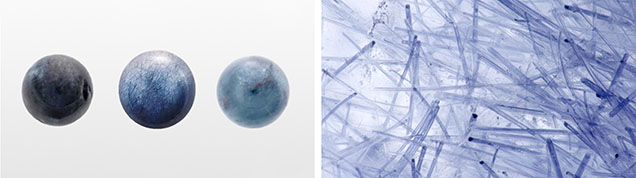
Recently, three semitransparent to opaque quartz spheres weighing 4.85, 5.40, and 5.50 ct, and measuring 9.04, 9.26, and 9.28 mm in diameter, respectively (figure 1, left), were submitted for identification to the National Gemstone Testing Center (NGTC) in Shenzhen, China. Under fiber-optic transmitted illumination, the specimens each exhibited a blue color associated with numerous needle-like blue inclusions.
The spot refractive index of the specimens was approximately 1.55, while hydrostatically calculated specific gravity (SG) values spanned from 2.50 to 2.65. Standard gemological testing, along with Fourier-transform infrared (FTIR) spectroscopy, identified the host material as quartz. Microscopic examination revealed abundant needle-like mineral inclusions and healed fractures. These inclusions were either clustered or randomly distributed, with some displaying a triangular cross-sectional morphology (figure 1, right). The samples’ surfaces showed resin-impregnated fractures contrasting with the inherent vitreous luster of the quartz matrix. Semitransparent zones of the samples maintained full brightness in cross-polarized illumination while being rotated 360° in all directions, whereas the inclusion-dense areas remained opaque. Due to the optical behavior being obscured by numerous inclusions, thin sections were prepared from inclusion-rich areas of all three samples. Both the residual bulk material and the thin sections were subsequently examined by a combination of analyses, including polarizing microscopy, Raman spectroscopy, FTIR, laser-induced breakdown spectroscopy (LIBS), energy-dispersive X-ray fluorescence (EDXRF), and X-ray diffraction (XRD).
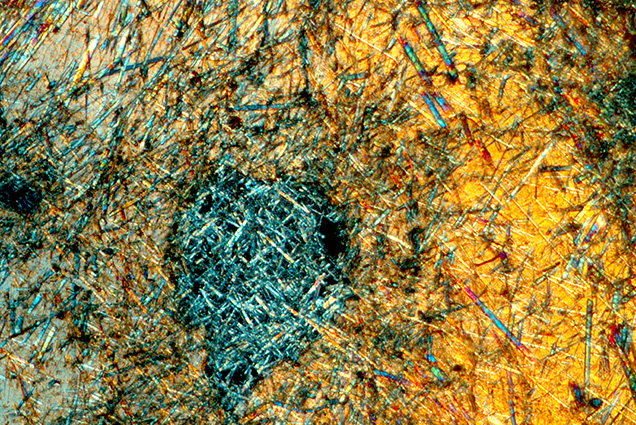
In cross-polarized light, the entire quartz host went extinct at the same time, confirming the quartz was a single crystal. In the thin section from the left sphere in figure 1, seven voids (0.3 to 0.6 mm in diameter) and three fractures (0.01 to 0.04 mm in width) were observed within the quartz matrix. Some of these voids were filled with acicular minerals (figure 2). This sample’s lower SG of 2.50 compared to quartz’s theoretical value is likely attributed to these voids and fractures. Under plane-polarized light, the blue acicular inclusions displayed strong pleochroism, transitioning from deep blue to pale blue.
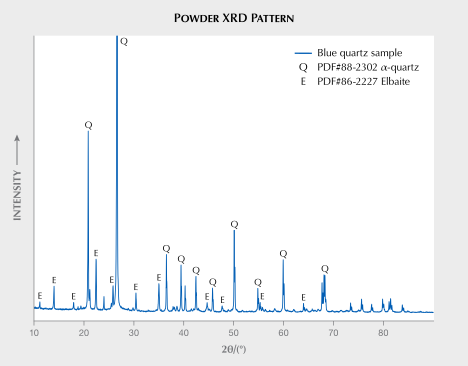
Raman spectroscopy of the inclusions detected peaks at 225, 267, 370, 640, and 707 cm–1, consistent with elbaite (R100137) in the RRUFF database (B. Lafuente et al., 2015, https://rruff.info/about/downloads/HMC1-30.pdf). XRD also identified their mineralogical phase as elbaite, revealing that one specimen (figure 1, left, left stone) exhibited an elbaite content of approximately 20 wt.% (figure 3). Since black tourmaline is a common type of inclusion in quartz, this case of blue elbaite inclusions responsible for the blue bodycolor in these quartz samples is rare.
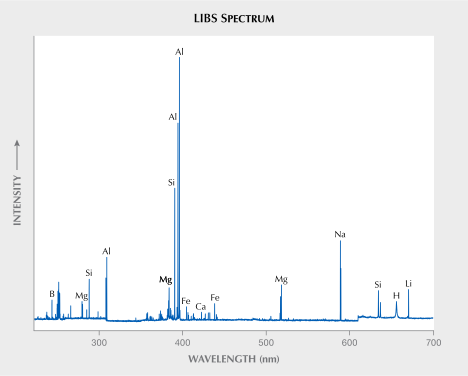
LIBS identified lithium, sodium, magnesium, calcium, aluminum, silicon, iron, and boron in these inclusions (figure 4). The LIBS and EDXRF analyses detected iron but not copper or manganese, suggesting that the blue color was primarily attributable to iron, potentially by an Fe3+-Fe2+ intervalence charge transfer.
FTIR revealed organic absorption peaks at 3036, 3057, 2958, 2928, and 2870 cm–1. Raman peaks at 639, 1110, 1184, and 1605 cm–1 confirmed the presence of epoxy resin in the fractures and voids, indicating resin infiltration for structural stabilization and to improve transparency.
The systematic differentiation of single-crystal versus polycrystalline aggregates is critical to gemological classification. This is one case study in which sample morphology or inclusion density complicates identification, but thin section polarized microscopy observation and related analyses provided simple yet effective methods for determining the mineral phases.
Blue color in quartz is usually caused by micro-inclusions of dumortierite (Spring 2015 GNI, pp. 100–102). Although other blue minerals, such as chrysocolla, apatite, and chlorapatite, have been reported as inclusions in quartz, they have not been known to impart a blue bodycolor to quartz (Spring 2015 GNI, pp. 89–90; Summer 2017 G&G Micro-World, pp. 241–242; Spring 2022 G&G Micro-World, p. 62).
Recently, three semitransparent to opaque quartz spheres weighing 4.85, 5.40, and 5.50 ct, and measuring 9.04, 9.26, and 9.28 mm in diameter, respectively (figure 1, left), were submitted for identification to the National Gemstone Testing Center (NGTC) in Shenzhen, China. Under fiber-optic transmitted illumination, the specimens each exhibited a blue color associated with numerous needle-like blue inclusions.
The spot refractive index of the specimens was approximately 1.55, while hydrostatically calculated specific gravity (SG) values spanned from 2.50 to 2.65. Standard gemological testing, along with Fourier-transform infrared (FTIR) spectroscopy, identified the host material as quartz. Microscopic examination revealed abundant needle-like mineral inclusions and healed fractures. These inclusions were either clustered or randomly distributed, with some displaying a triangular cross-sectional morphology (figure 1, right). The samples’ surfaces showed resin-impregnated fractures contrasting with the inherent vitreous luster of the quartz matrix. Semitransparent zones of the samples maintained full brightness in cross-polarized illumination while being rotated 360° in all directions, whereas the inclusion-dense areas remained opaque. Due to the optical behavior being obscured by numerous inclusions, thin sections were prepared from inclusion-rich areas of all three samples. Both the residual bulk material and the thin sections were subsequently examined by a combination of analyses, including polarizing microscopy, Raman spectroscopy, FTIR, laser-induced breakdown spectroscopy (LIBS), energy-dispersive X-ray fluorescence (EDXRF), and X-ray diffraction (XRD).
In cross-polarized light, the entire quartz host went extinct at the same time, confirming the quartz was a single crystal. In the thin section from the left sphere in figure 1, seven voids (0.3 to 0.6 mm in diameter) and three fractures (0.01 to 0.04 mm in width) were observed within the quartz matrix. Some of these voids were filled with acicular minerals (figure 2). This sample’s lower SG of 2.50 compared to quartz’s theoretical value is likely attributed to these voids and fractures. Under plane-polarized light, the blue acicular inclusions displayed strong pleochroism, transitioning from deep blue to pale blue.
Raman spectroscopy of the inclusions detected peaks at 225, 267, 370, 640, and 707 cm–1, consistent with elbaite (R100137) in the RRUFF database (B. Lafuente et al., 2015, https://rruff.info/about/downloads/HMC1-30.pdf). XRD also identified their mineralogical phase as elbaite, revealing that one specimen (figure 1, left, left stone) exhibited an elbaite content of approximately 20 wt.% (figure 3). Since black tourmaline is a common type of inclusion in quartz, this case of blue elbaite inclusions responsible for the blue bodycolor in these quartz samples is rare.
LIBS identified lithium, sodium, magnesium, calcium, aluminum, silicon, iron, and boron in these inclusions (figure 4). The LIBS and EDXRF analyses detected iron but not copper or manganese, suggesting that the blue color was primarily attributable to iron, potentially by an Fe3+-Fe2+ intervalence charge transfer.
FTIR revealed organic absorption peaks at 3036, 3057, 2958, 2928, and 2870 cm–1. Raman peaks at 639, 1110, 1184, and 1605 cm–1 confirmed the presence of epoxy resin in the fractures and voids, indicating resin infiltration for structural stabilization and to improve transparency.
The systematic differentiation of single-crystal versus polycrystalline aggregates is critical to gemological classification. This is one case study in which sample morphology or inclusion density complicates identification, but thin section polarized microscopy observation and related analyses provided simple yet effective methods for determining the mineral phases.