
Quartz crystals with three-phase fluid inclusions from the Jinkouhe mine in the Sichuan Province of China have been sold for many years at gem and mineral shows such as those held annually in Tucson, Arizona. Unfortunately, many of those crystals are damaged due to the mining methods used and the packing together of numerous crystals for transport. Good terminations on those crystals are few and far between, and the edges are generally chipped, while the broad flat crystal faces are often scratched and abraded.
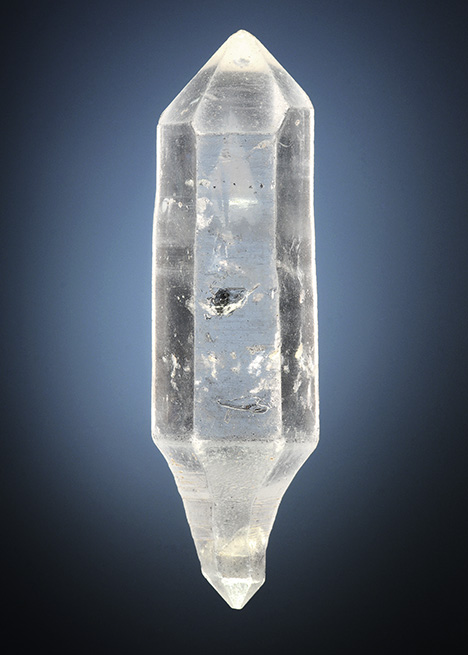
So it was with high interest that we examined the relatively large doubly terminated scepter rock crystal quartz shown in figure 1. At 200.28 ct and measuring 75.03 × 21.76 × 17.98, this crystal was much larger than most others from the Jinkouhe mine. It was preserved in its own cotton-lined box, and as shown in figure 1, essentially undamaged.


Microscopic examination of the crystal revealed light etching on the prism faces (figure 2), which was highlighted using Nomarski differential interference contrast. Internally there were several primary fluid inclusions, with typical black organic compounds as the solid phase. One fluid inclusion in particular contained a gas bubble (figure 3) that moved freely across the entire length of the void (figure 4). The bubble was coated with a metallic-looking substance that gave it the appearance of a small stainless steel ball bearing. We could not identify the coating but suspect that it was an organic compound.
John I. Koivula is analytical microscopist, and Nathan Renfro is manager of colored stones identification, at GIA in Carlsbad, California.
Quartz crystals with three-phase fluid inclusions from the Jinkouhe mine in the Sichuan Province of China have been sold for many years at gem and mineral shows such as those held annually in Tucson, Arizona. Unfortunately, many of those crystals are damaged due to the mining methods used and the packing together of numerous crystals for transport. Good terminations on those crystals are few and far between, and the edges are generally chipped, while the broad flat crystal faces are often scratched and abraded.
So it was with high interest that we examined the relatively large doubly terminated scepter rock crystal quartz shown in figure 1. At 200.28 ct and measuring 75.03 × 21.76 × 17.98, this crystal was much larger than most others from the Jinkouhe mine. It was preserved in its own cotton-lined box, and as shown in figure 1, essentially undamaged.
Microscopic examination of the crystal revealed light etching on the prism faces (figure 2), which was highlighted using Nomarski differential interference contrast. Internally there were several primary fluid inclusions, with typical black organic compounds as the solid phase. One fluid inclusion in particular contained a gas bubble (figure 3) that moved freely across the entire length of the void (figure 4). The bubble was coated with a metallic-looking substance that gave it the appearance of a small stainless steel ball bearing. We could not identify the coating but suspect that it was an organic compound.
John I. Koivula is analytical microscopist, and Nathan Renfro is manager of colored stones identification, at GIA in Carlsbad, California.