
Historical Reading List: The Ancient Silver Mines at Laurium, Greece
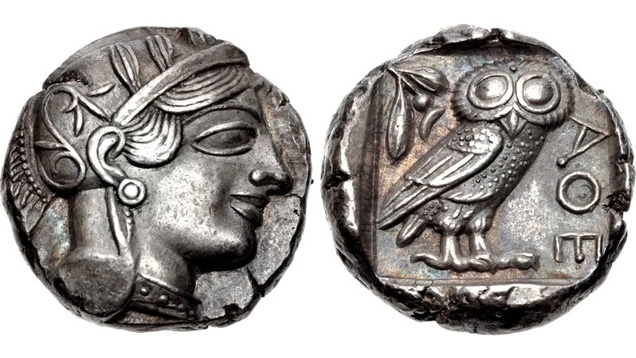
One of the most famous silver mining areas of antiquity was the region of Laurium near Athens on the Attica peninsula of Greece. Silver was the main coinage metal used in ancient Greece, and as such, it was a particularly important commodity. There is archaeological evidence of primitive mining in the Laurium area in the Bronze Age circa 3200 BCE. Systematic exploitation of the ore minerals began in the 6th century BCE. The ancient workings consisted of underground shafts and galleries for excavating the ore, and nearby washing areas for concentrating the ore minerals. The Laurium mines were public property. Mining was under the control of the Athenian city-state, with portions of the area being licensed for exploitation to private citizens in exchange for a fixed percentage of ore production, with most of the work being performed by slaves. Silver occurred there in lead minerals such as galena, and the recovery of silver provided prosperity to Athens, and financial resources used in part to build a large naval fleet that helped to defeat the Persians at the Battle of Salamis (480 BCE). Production from the Laurium mines had a major financial effect on the creation of the Athenian Empire (454-404 BCE), and the ‘golden age’ of Athenian democracy. The ancient historian Xenophon described the mines in his essay Ways and Means written in 355 BCE. The most important period of production took place from about 480 to 380 BCE, after which the ore that was accessible by shallow underground workings became exhausted, and the mines gradually became dormant and were then were abandoned for more than two millennia. Mining did not resume until the 1860s, and it continued on a limited scale until 1982.
In ancient times, Greek coins were handmade. The design of one side of the coin was carved into block or bronze or iron, with the design of the reverse side being carved into a metal punch. A blank disk of gold, silver, or electrum (a natural gold-silver alloy) was cast in a mold, and then placed between the block and the punch. The latter was struck with a hammer to create the designs on the front and back of the coin. A number of Greek city-states produced their own coins with unique symbols and designs.
How to Use this Reading List
This reading list was compiled to give you an opportunity to learn more about the history of the famous Laurium silver mines. The list is presented in chronological order to emphasize the development of ideas over time. The list is not comprehensive, but a compilation of some interesting information that has often been forgotten or overlooked.
Many of the articles in the reading list exist in the public domain and can be found online at digital libraries such as Hathitrust, Internet Archive, or other digital repositories. More recent publications can often be found in libraries. Abstracts of these articles can usually be found on the website of the original journal or magazine, and the article itself is often available for purchase from the publisher.
“A Journey into Greece”, G. Wheler, London, (1682). The author, an English clergyman, traveled in Greece in 1675 and 1676, and visited the Laurium region in Attica.
Beyträge zu den Untersuchungen über das Electrum und den Lyncur der Alten [Contribution to the Understanding of Electrum and Lyncur of the Ancients], J.P.E. von Scheffler, Neue Sammlung von Versuche und Abhandlungen der Naturforschenden Gesellschaft in Danzig, Vol. 1, pp. 234-246, (1778). The author discusses the use of silver and electrum among the ancient Greeks.
“Geschichte des Bergbaues und Hüttenwesens bey den alten Völkern [History of Mining and Smelting by Ancient Peoples]”, J.F. Reitemeier, J.C. Dieterich Publishers, Göttingen, 166 pp., (1785). This early book on mining in various parts of the ancient world includes a discussion of the Laurium mines.
Über die Laurischen Silberbergwerke in Attika [About the Laurian Silver Mines in Attica], A. Böckh, Abhandlungen der Königlichen Akademie der Wissenschaften zu Berlin (Historisch-Philologische Klasse), pp. 85-140, (1818). The author, a scholar of classical Greece, provided one of the first descriptions of the Laurium mines based on the translation of works by ancient scholars.
“Der Staatshaushaultung der Athener [The Public Economy of Athens, to which is added a Dissertation on the Silver Mines of Laurion]”, A. Böckh, 688 pp., translation by G.C. Lewis of the original 1817 book, J.W. Parker Publishers, London, (1842). The author discusses various aspects of the Athenian economy, including silver mining at Laurium.
Über die in Griechenland sich findenden Bergwerke aus den Zeiten der alten Hellanen [About Mines found in Greece from the Time of the Ancient Hellens], X. Landerer, Neues Jahrbuch für Mineralogie, Geognosie, Geologie und Petrefakten-Kunde, Vol. 17, pp. 417-436, (1849). A review of mines in Greece and Aegean islands that existed in ancient times.
Sur les Mines d'Argent de Laurion, et sur le Procédé d’Extraction de l’Argent suivi dans l’Antiquité [On the Silver Mines of Laurium, and the Process of Silver Extraction used since Antiquity], X. Landerer, Revue Scientifique et Industrielle, Vol. 36, pp. 274-275, (1849). A brief note on the silver mines, and comments of the process of extracting silver from the ore. A similar article by this author appeared as Über die Silbergruben von Laurion und die muthmassliche Silberscheidung bei den Alten [On the Silver Mines of Laurium and the presumed Separation of Silver in Ancient Times], Archiv der Pharmazie und Berichte der Deutsche Pharmazeutischen Gesellschaft, Vol. 108, No. 1, pp. 25-28, (1849).
Sketches of a Traveller from Greece, Constantinople, Asia Minor, Syria, and Palestine, A.L. Koeppen, Reformed Church Review, Vol. 6, (April), pp. 258-275, (1854). The author describes Laurium and the importance of the silver produced by the mine to the economy of Athens. A similar article by this author appeared in the Mercersburg Quarterly Review, Vol. 8, No. 1, pp. 40-79 and No. 3, pp. 350-383, (1856).
Sur l'Électrum d'Homère [On the Electrum of Homer], P. Giguet, Revue Archéologique, Vol. 16, No. 1, pp. 235-241, (1859). The author discusses the nature of the electrum mentioned in the written works of Homer.
Mitteilungen über die Bergwerke der Alten [Communication on the Mines of the Ancients], X. Landerer, Neues Jahrbuch für Mineralogie, Geologie und Paläontologie, pp. 45-48, (1864). A discussion of the Laurium and other mines in ancient Greece.
"Le Laurium", A. Cordella, Typographie Cayer, Marseilles, 120 pp., (1869). Book not seen.
Les Mines du Laurium [The Mines of Laurium], C.H. Gorceix, Bulletin de l'École Français d'Athenes, No. 8, pp. 171-181, (1870). The author, a geologist and mining engineer, describes the ore deposit at Laurium.
Le Laurium et les Mines d'Argent en Grèce [Laurium and the Silver Mines of Greece], C.E. Ledoux, Revue des Deux Mondes, Vol. 97, (February), pp. 552-571, (1872). The author, a mining engineer, made a visit to Greece in 1869-1870, and in this article he described the silver mines.
Ancient Mining - The Grecian Mines Reopened, Unknown author, Van Nostrand's Engineering Magazine, Vol. 7, No. 48, pp. 573-576, (1872). The silver mines were reopened in the 1860s after remaining dormant for more than 1800 years.
Mittheilungen über die Geologie von Laurion und den dortigen Bergbau [Contribution to the Geology of Laurion and the Mining There], R. Nasse, Zeitschrift für das Berg-, Hütten- und Salinen-Wesen in dem Preussischen Staate, Vol. 21, pp. 12-22, (1873). A geological description of the Laurium silver mines.
The Laurium Mines of Greece, Unknown author, Journal of the Society of Arts, Vol. 22, No. 1102, p. 120, (1874). A note on the mine with a discussion of the potential for further exploitation of lead-silver ores.
Du Laurium [About Laurium], A.R. Rangavis (Rangabé), Mémoires Présentés par divers Savants a l'Academie des Inscriptions et Belles-Lettres, Vol. 8, Pt. 2, pp. 297-346 (1874). This article provides a detailed discussion of historical references to the silver mines.
Greece as it is, J.M. Francis, Journal of the American Geographical Society, Vol. 6, pp. 138-168, (1874). Report of a public lecture in New York by the author, the former U.S. Minister to Greece, with a discussion of the reopening of the Laurium mines (pp. 145-148).
“Notice Historique sur Laurion et ses Environs [Historical Notice on Laurium and its Surroundings]”, A. Le Nepvou de Carfort, Paris, (1875). Book not seen.
Description des Produits des Mines du Laurium et d’Oropos [Description of the Products of the Mines of Laurium and Oropos], A. Cordella, Perris Frères, Athens, 47 pp., (1875). Book not seen.
Note sur les Mines du Laurium et sur les Nouveaux Gites de Minerai de Zinc (Smithsonite) [Note on the Laurium Mines and a New Deposit of the Zinc Mineral (Smithsonite)], A. Cordella, Bulletin de la Sociéte Géologique de France, Vol. 6, pp. 577-581, (1878). Note on some of the minerals found in the mines.
Memoire sur le Laurium [Memoir on Laurium], A. Huet, Mémoires et Compte-Rendu des Travaux de la Société des Ingénieurs Civils de France, pp. 261-263 and 731-772, (1879). A geologic description of the Laurium ore deposits.
La Geologie, la Metallurgie, et les Mines du Laurium [The Geology, Metallurgy and the Mines of Laurium], G. Mayer, La Revue Scientifique, Vol. 22, No. 32, pp. 758-760, (1879). A short description of the silver mines.
Der Geologische Bau von Attica, Boeotien, Lokris und Parnassis [The Geological Structure of Attica, Boetia, Locris and Parnassis], A. Bittner, Denkschriften der Kaiserlischen Akademie der Wissenschaften in Wien, Mathematisch-Naturwissenschaftliche Classe, Vol. 40, pp. 1-74, (1880). A geological description of Greece including the historical mining areas.
Laveries Anciennes du Laurium [Ancient Ore Washeries of Laurium], P. Negris, Annales des Mines, Vol. 20, pp. 160-164, (1881). A description of the ancient lead ore washing facilities at the mine.
[Commercial and Industrial Situation of Laurium], J. Galand, Recueil Consulaire Contenant les Rapports Commerciaux des Agents Belges a l'Etranger, Vol. 36, No. 97, pp. 393-400 and 401-413, (1881). A report by the Belgian vice-consul on the mining situation at Laurium.
Mineralogisch-Geologische Reisekizzen aus Griechenland [Mineralogical-Geological Travel Sketches of Greece], A. Cordella, Berg- und Hüttenmännische Zeitung, Vol. 42, No. 3, pp. 21-23, No. 4, pp. 33-36, No. 5, pp. 41-44 and No. 6, 57-59, (1883). The author describes ore deposits in Greece including the Laurium mines.
Le Laurium - Étude sur les Dépots Métalliques [Laurium - Study of the Metal Deposits], B. Simonnet, Bulletin de la Société de l’Industrie Minérale, Vol. 12, pp. 641-660, (1883). A geological study of the Laurium deposits.