
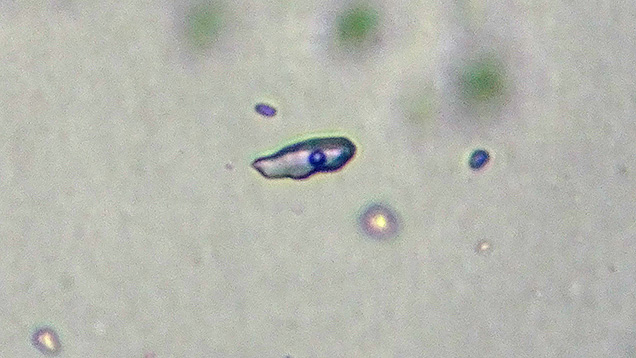
Recently, the authors encountered a transparent faint yellow pendant with a striking white cross inclusion (figure 1). Raman and Fourier-transform infrared spectroscopy identified the pendant as rock crystal. Microscopic observation revealed that the white cross was composed of numerous two-phase inclusions measuring less than 20 μm. One of the two-phase inclusions contained a gas bubble with a diameter of approximately 2 μm (figure 2) that was found to exhibit Brownian motion due to the influence of water molecules (see video below). Brownian motion refers to the unstable random movement of microscopic particles in a fluid, caused by continuous bombardment from molecules of the surrounding medium. This motion becomes more pronounced as the particle size decreases, fluid viscosity lowers, and temperature increases. Brightfield illumination, polarized light, and optical zoom techniques were used to obtain the photomicrographs.
Two-Phase Inclusion Exhibits Brownian Motion
Loading video player...