
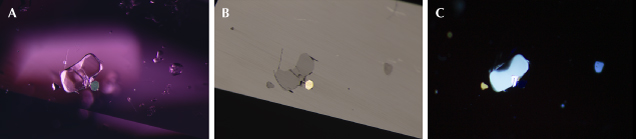
The authors examined a 7.01 ct spinel reportedly from Tanzania. Under short-wave (254 nm) ultraviolet light, a small fluorescent spot was observed on the stone’s surface, caused by cut-through crystal inclusions. Micro-Raman analysis identified the inclusions as diopside, phlogopite, and edenite, forming a cluster of transparent crystals associated with a dark, opaque pyrite grain (see above, A). In reflected light, the inclusions showed luster distinct from the spinel host, with the pyrite exhibiting a golden metallic luster (see above, B). Under short-wave ultraviolet light, the crystals fluoresced in different colors: white for diopside, yellow for phlogopite, and blue for edenite (see above, C). Fluorescence from inclusions is often overlooked but can provide important identification clues.
Natcha Rattana-anan is a gemologist, and E. Billie Hughes is a gemologist and cofounder, at Lotus Gemology in Bangkok.
The authors examined a 7.01 ct spinel reportedly from Tanzania. Under short-wave (254 nm) ultraviolet light, a small fluorescent spot was observed on the stone’s surface, caused by cut-through crystal inclusions. Micro-Raman analysis identified the inclusions as diopside, phlogopite, and edenite, forming a cluster of transparent crystals associated with a dark, opaque pyrite grain (see above, A). In reflected light, the inclusions showed luster distinct from the spinel host, with the pyrite exhibiting a golden metallic luster (see above, B). Under short-wave ultraviolet light, the crystals fluoresced in different colors: white for diopside, yellow for phlogopite, and blue for edenite (see above, C). Fluorescence from inclusions is often overlooked but can provide important identification clues.
Natcha Rattana-anan is a gemologist, and E. Billie Hughes is a gemologist and cofounder, at Lotus Gemology in Bangkok.