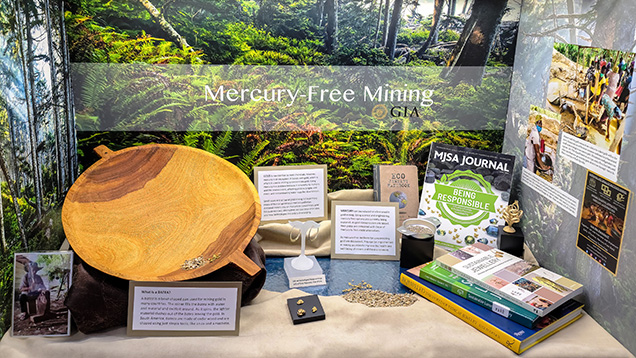
GIA’s Richard T. Liddicoat Gemological Library and Information Center was awarded the Betty Clayton Gibson Memorial Trophy for Best Museum Exhibit for 2023 at the Tucson Gem and Mineral Show. The winning exhibit illustrated the importance of mercury-free gold mining (see above). Historically, mercury has been used in artisanal and small-scale gold mining because of its ability to bond with gold to form an amalgam, but its high toxicity and negative effects on humans and wildlife have led to increased emphasis on mercury-free options for mining gold.
The exhibit featured a traditional wooden bowl used for gold panning, along with many of the library’s books on ecological jewelry and responsible and sustainable mining and jewelry practices.
“This exhibit illustrates how mercury-free gold mining can have positive long-term implications for both gold miners and the environment,” said library director Robert Weldon. He noted that among all the deserving exhibits displayed at TGMS, the GIA Library’s stood out due to the importance of responsible mining and sustainability in the industry.
In 2021, GIA provided a grant to Mercury Free Mining (MFM) and the Alliance for Responsible Mining (ARM). New methods for concentrating gold continue to be explored and tested with the goal of significantly reducing, or even eliminating, the use of mercury in gold mining.