
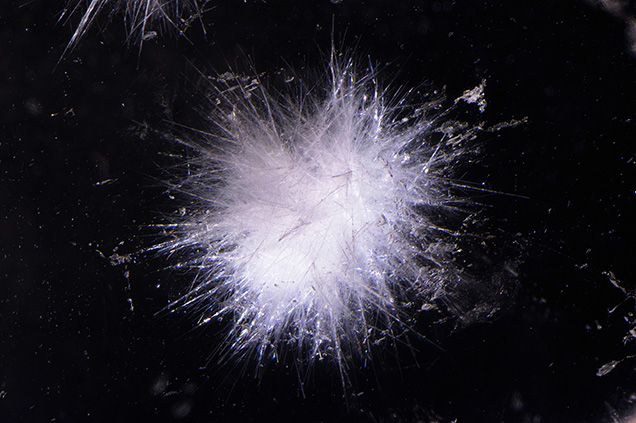
The author recently had the opportunity to examine a 233.60 ct faceted quartz containing numerous white radial inclusions, courtesy of Mike Bowers (see above). The unusual inclusions were identified as the mineral bavenite by Raman and laser ablation–inductively coupled plasma–mass spectrometry (LA-ICP-MS) analysis.
South America claims a long history of gemstone production and arguably produces some of the finest gem specimens in the world. Of the South American gem-producing areas, Brazil is by far the most prolific source of important gemstones. Due to the array of different geologic environments, a number of uncommon minerals can be found. The mineral bavenite, Ca4Be2Al2Si9O26(OH)2, is an uncommon orthorhombic mineral that occurs as drusy in miarolitic cavities in granite and associated pegmatite, formed by a low-temperature alteration of beryl and other beryllium-bearing minerals, and also in hydrothermal veins and skarns. It generally forms in more alkali environments and is often associated with bertrandite, titanite, danalite, and zeolites (J.W. Anthony et al., Eds., Handbook of Mineralogy, Mineralogical Society of America. This is believed to the first time GIA has encountered bavenite inclusions in quartz.
The author recently had the opportunity to examine a 233.60 ct faceted quartz containing numerous white radial inclusions, courtesy of Mike Bowers (see above). The unusual inclusions were identified as the mineral bavenite by Raman and laser ablation–inductively coupled plasma–mass spectrometry (LA-ICP-MS) analysis.
South America claims a long history of gemstone production and arguably produces some of the finest gem specimens in the world. Of the South American gem-producing areas, Brazil is by far the most prolific source of important gemstones. Due to the array of different geologic environments, a number of uncommon minerals can be found. The mineral bavenite, Ca4Be2Al2Si9O26(OH)2, is an uncommon orthorhombic mineral that occurs as drusy in miarolitic cavities in granite and associated pegmatite, formed by a low-temperature alteration of beryl and other beryllium-bearing minerals, and also in hydrothermal veins and skarns. It generally forms in more alkali environments and is often associated with bertrandite, titanite, danalite, and zeolites (J.W. Anthony et al., Eds., Handbook of Mineralogy, Mineralogical Society of America. This is believed to the first time GIA has encountered bavenite inclusions in quartz.