
Pectolite is a mineral of the wollastonite group with the chemical formula NaCa 2 Si 3 O 8 (OH). It has a refractive index of 1.599–1.628, with a typical spot RI reading of about 1.60, and a specific gravity of 2.81. The light blue variety of this mineral, known by the trade name Larimar, has only been found in the Dominican Republic (R.E. Woodruff and E. Fritsch, “Blue pectolite from the Dominican Republic,” Winter 1989 G&G , pp. 216–225; see figure 1).
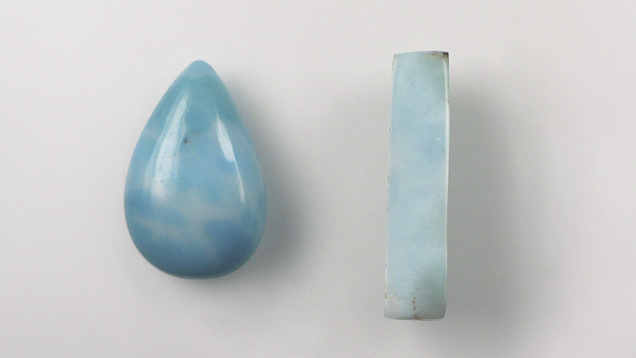
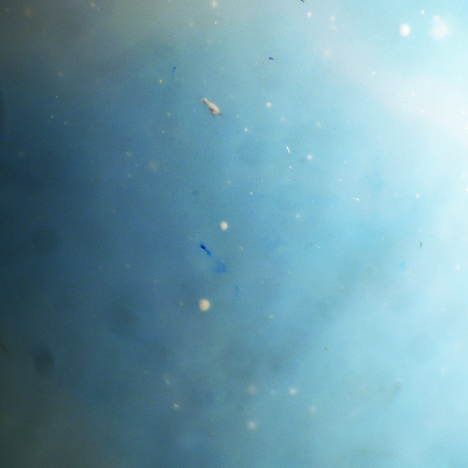
One of these contributors (PG) recently acquired a 3.91 ct drop-shaped cabochon, purchased in India as a Larimar imitation, that consisted of a ceramic material (figure 1, left). According to the vendor, the material was manufactured in China. Close microscopic examination showed white gas bubbles and blue color concentration (figure 2).
The cabochon’s spot RI reading of 1.53 and SG of 1.87 were distinctly lower than the values for Larimar. Semi-quantitative EDXRF chemical analysis gave a composition of 95% Al 2 O 3 and 4% SiO 2 , with traces of SO 3 , K 2 O, CaO, Sc 2 O 3 , Cr 2 O 3 , Fe 2 O 3 , and Ga 2 O 3 . In contrast, the average composition of pectolite consists of 54.23% SiO 2 , 33.74% CaO, 9.32% Na 2 O, and 2.71% H 2 O.
Although the imitation material does indeed resemble Larimar, standard gemological tests such as microscopy, refractive index, and specific gravity should be sufficient to distinguish it.
Lore Kiefert
Gubelin Gem Lab Ltd.
Lucerne, Switzerland
Peter Groenenboom
AEL Arnhem
A rnhem, Netherlands
Pectolite is a mineral of the wollastonite group with the chemical formula NaCa 2 Si 3 O 8 (OH). It has a refractive index of 1.599–1.628, with a typical spot RI reading of about 1.60, and a specific gravity of 2.81. The light blue variety of this mineral, known by the trade name Larimar, has only been found in the Dominican Republic (R.E. Woodruff and E. Fritsch, “Blue pectolite from the Dominican Republic,” Winter 1989 G&G , pp. 216–225; see figure 1).
One of these contributors (PG) recently acquired a 3.91 ct drop-shaped cabochon, purchased in India as a Larimar imitation, that consisted of a ceramic material (figure 1, left). According to the vendor, the material was manufactured in China. Close microscopic examination showed white gas bubbles and blue color concentration (figure 2).
The cabochon’s spot RI reading of 1.53 and SG of 1.87 were distinctly lower than the values for Larimar. Semi-quantitative EDXRF chemical analysis gave a composition of 95% Al 2 O 3 and 4% SiO 2 , with traces of SO 3 , K 2 O, CaO, Sc 2 O 3 , Cr 2 O 3 , Fe 2 O 3 , and Ga 2 O 3 . In contrast, the average composition of pectolite consists of 54.23% SiO 2 , 33.74% CaO, 9.32% Na 2 O, and 2.71% H 2 O.
Although the imitation material does indeed resemble Larimar, standard gemological tests such as microscopy, refractive index, and specific gravity should be sufficient to distinguish it.
Lore Kiefert
Gubelin Gem Lab Ltd.
Lucerne, Switzerland
Peter Groenenboom
AEL Arnhem
A rnhem, Netherlands