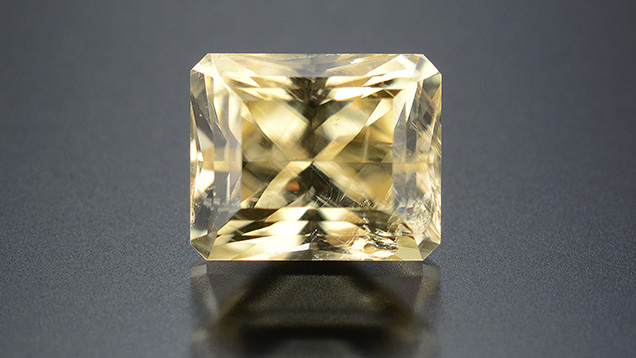
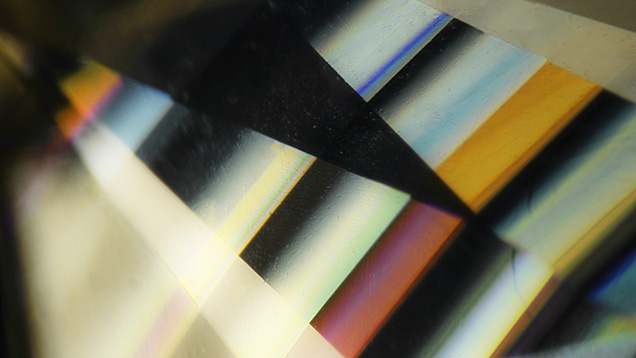
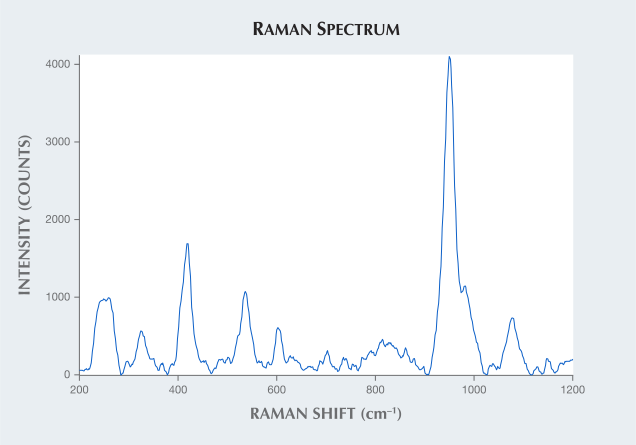
The Carlsbad laboratory recently received for identification service a stone with properties that were not consistent with stones previously identified at GIA. This yellow octagonal modified brilliant (figure 1), measuring 6.41 × 5.26 × 4.68 mm, weighed 1.20 ct and had a specific gravity of 3.01. Microscopic features observed included distinct parallel twinning planes (figure 2), iridescent fractures, stringers, and fingerprints. Standard gemological testing revealed that it was doubly refractive, with a biaxial optic figure and a refractive index of 1.608–1.628. It fluoresced a very weak yellow under short-wave UV and had no reaction under long-wave UV. The Raman spectrum of the stone (figure 3) was matched to one in the RRUFF database, which confirmed the gem’s identity as vlasovite, an inosilicate mineral with the chemical formula Na2ZrSiO4O11 (rruff.info/vlasovite/R060913).
Vlasovite is known to be found in pegmatites in northern Russia, Canada, and Portugal. It was named after Kuzma Alekseevich Vlasov, who studied the region where vlasovite originated (handbookofmineralogy.com). Vlasovite is a rare mineral, and faceted stones are especially rare. This is the first faceted example examined at GIA’s Carlsbad laboratory.
The Carlsbad laboratory recently received for identification service a stone with properties that were not consistent with stones previously identified at GIA. This yellow octagonal modified brilliant (figure 1), measuring 6.41 × 5.26 × 4.68 mm, weighed 1.20 ct and had a specific gravity of 3.01. Microscopic features observed included distinct parallel twinning planes (figure 2), iridescent fractures, stringers, and fingerprints. Standard gemological testing revealed that it was doubly refractive, with a biaxial optic figure and a refractive index of 1.608–1.628. It fluoresced a very weak yellow under short-wave UV and had no reaction under long-wave UV. The Raman spectrum of the stone (figure 3) was matched to one in the RRUFF database, which confirmed the gem’s identity as vlasovite, an inosilicate mineral with the chemical formula Na2ZrSiO4O11 (rruff.info/vlasovite/R060913).
Vlasovite is known to be found in pegmatites in northern Russia, Canada, and Portugal. It was named after Kuzma Alekseevich Vlasov, who studied the region where vlasovite originated (handbookofmineralogy.com). Vlasovite is a rare mineral, and faceted stones are especially rare. This is the first faceted example examined at GIA’s Carlsbad laboratory.