
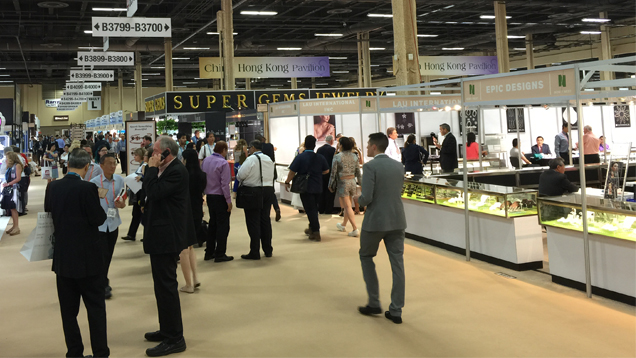
Business at the JCK Show in Las Vegas fell at the low end of expectations as retailers continue to remain cautious about the direction of the U.S. economy and struggle to retool their sales efforts to appeal to consumers beset by stagnant incomes and appeals from competing products.
Buying Segments
Designers at the upscale Luxury and Couture shows reported decent demand, but the trend continued away from obvious bling toward pieces with distinctive looks using small diamonds and gemstones.
Demand for commercial jewelry and loose diamonds was very spotty. Buyers tended to order the minimum they believed they would need before the fall season. Jewelry and diamond demand was better in the upper segment of more than $20,000 and in the lower-priced market under $2,500.
Demand for loose colored stones at the accompanying American Gem Trade Association show was very slow, but better in finished jewelry pieces as designers wanted to create larger looks with stones such as aquamarine, amethyst, chalcedony, opals and various types of garnets.
Design Trends
A number of designers offered convertible pieces – pendants that could be detached as a ring or multi-pieced rings that could be worn as separate items. There were also ear pendants of opaque stones and very fine gold or sterling silver strands. Items made with larger stones like opal, accented by diamond pavé or unusual gemstones, invite retailers to talk about them with their customers.
Loose Diamonds
Dealers said profitability has improved since last fall, but sales remain sluggish. As one high-end diamond dealer put it: “We’ve done OK, but every year the definition of OK seems to be getting a little lower. “
At the high end, demand for better qualities larger than 5 carats was there, but seller competition was keen.
“Consumers in that price range still have good disposable incomes and many are veteran jewelry buyers,” said one major dealer. “And there is still demand at the lower price level, but competition there is extremely intense and retailers are squeezing harder than ever for terms and memo, so that makes it difficult to recover.”
The middle, he said, is the biggest challenge. “The squeeze middle class consumers face today is well-publicized. We, as an industry, have to figure out how to sell to them again.”
Marketing Initiatives
Indeed, marketing to the millennial generation was on everybody’s mind, even though the difficulties of the middle class extend well beyond that age range.
There were a number of sales initiatives and seminars announced at the show to try and help retailers, jewelry manufacturers and gem dealers connect with that generation. The most significant was an estimated $12 million program developed by the Diamond Producers Association (DPA), a group formed a year ago from the world’s seven largest diamond mining companies.
The campaign, which will be presented in various social media and TV outlets, has the slogan “Real is rare. Real is a diamond.” The campaign, showing young couples in clubs and in resorts, continues to be relationship-oriented similar to the De Beers “Forever” advertising of past years, but is not aimed specifically at engagement or anniversary jewelry as those were.
“Marketing diamonds is much more complex today, so you cannot employ the same practices we used 20 years ago,” said Stephen Lussier, DPA chairman and CEO of De Beers’ Forevermark.
David Lamb, a marketing consultant for DPA, said this generation wants real connections, but are much less about formality and traditional rules than previous generations. The purpose of this campaign “is to get them think that a diamond is the perfect symbol of a real connection,” he noted.
The diamond trade generally reacted positively to the campaign and slogan, particularly because it addressed growing competition from synthetic diamond producers. These man-made diamonds appeared in a number of designer lines offered at the Vegas shows and a number of wholesalers were offering both colorless and fancy colored synthetics.
The well-publicized start-up Diamond Foundry was test-marketing diamonds through four companies exhibiting at the show and a spokesman for the company noted that it has begun commercial production.
Russell Shor is senior industry analyst at GIA in Carlsbad.
Business at the JCK Show in Las Vegas fell at the low end of expectations as retailers continue to remain cautious about the direction of the U.S. economy and struggle to retool their sales efforts to appeal to consumers beset by stagnant incomes and appeals from competing products.
Buying Segments
Designers at the upscale Luxury and Couture shows reported decent demand, but the trend continued away from obvious bling toward pieces with distinctive looks using small diamonds and gemstones.
Demand for commercial jewelry and loose diamonds was very spotty. Buyers tended to order the minimum they believed they would need before the fall season. Jewelry and diamond demand was better in the upper segment of more than $20,000 and in the lower-priced market under $2,500.
Demand for loose colored stones at the accompanying American Gem Trade Association show was very slow, but better in finished jewelry pieces as designers wanted to create larger looks with stones such as aquamarine, amethyst, chalcedony, opals and various types of garnets.
Design Trends
A number of designers offered convertible pieces – pendants that could be detached as a ring or multi-pieced rings that could be worn as separate items. There were also ear pendants of opaque stones and very fine gold or sterling silver strands. Items made with larger stones like opal, accented by diamond pavé or unusual gemstones, invite retailers to talk about them with their customers.
Loose Diamonds
Dealers said profitability has improved since last fall, but sales remain sluggish. As one high-end diamond dealer put it: “We’ve done OK, but every year the definition of OK seems to be getting a little lower. “
At the high end, demand for better qualities larger than 5 carats was there, but seller competition was keen.
“Consumers in that price range still have good disposable incomes and many are veteran jewelry buyers,” said one major dealer. “And there is still demand at the lower price level, but competition there is extremely intense and retailers are squeezing harder than ever for terms and memo, so that makes it difficult to recover.”
The middle, he said, is the biggest challenge. “The squeeze middle class consumers face today is well-publicized. We, as an industry, have to figure out how to sell to them again.”
Marketing Initiatives
Indeed, marketing to the millennial generation was on everybody’s mind, even though the difficulties of the middle class extend well beyond that age range.
There were a number of sales initiatives and seminars announced at the show to try and help retailers, jewelry manufacturers and gem dealers connect with that generation. The most significant was an estimated $12 million program developed by the Diamond Producers Association (DPA), a group formed a year ago from the world’s seven largest diamond mining companies.
The campaign, which will be presented in various social media and TV outlets, has the slogan “Real is rare. Real is a diamond.” The campaign, showing young couples in clubs and in resorts, continues to be relationship-oriented similar to the De Beers “Forever” advertising of past years, but is not aimed specifically at engagement or anniversary jewelry as those were.
“Marketing diamonds is much more complex today, so you cannot employ the same practices we used 20 years ago,” said Stephen Lussier, DPA chairman and CEO of De Beers’ Forevermark.
David Lamb, a marketing consultant for DPA, said this generation wants real connections, but are much less about formality and traditional rules than previous generations. The purpose of this campaign “is to get them think that a diamond is the perfect symbol of a real connection,” he noted.
The diamond trade generally reacted positively to the campaign and slogan, particularly because it addressed growing competition from synthetic diamond producers. These man-made diamonds appeared in a number of designer lines offered at the Vegas shows and a number of wholesalers were offering both colorless and fancy colored synthetics.
The well-publicized start-up Diamond Foundry was test-marketing diamonds through four companies exhibiting at the show and a spokesman for the company noted that it has begun commercial production.
Russell Shor is senior industry analyst at GIA in Carlsbad.